Employee productivity software for UK teams.
Output first. Monitoring by choice.
Planning a UK rollout? The sections below set out what the ICO expects on DPIAs, lawful basis and telling staff, and how to configure TrackForce to match.
No credit card required · Plans from $4.99 a month · Choose what each device captures before anyone is enrolled
Built by AKIJ iBOS, part of AKIJ Resource · Offices in Dhaka and San Francisco
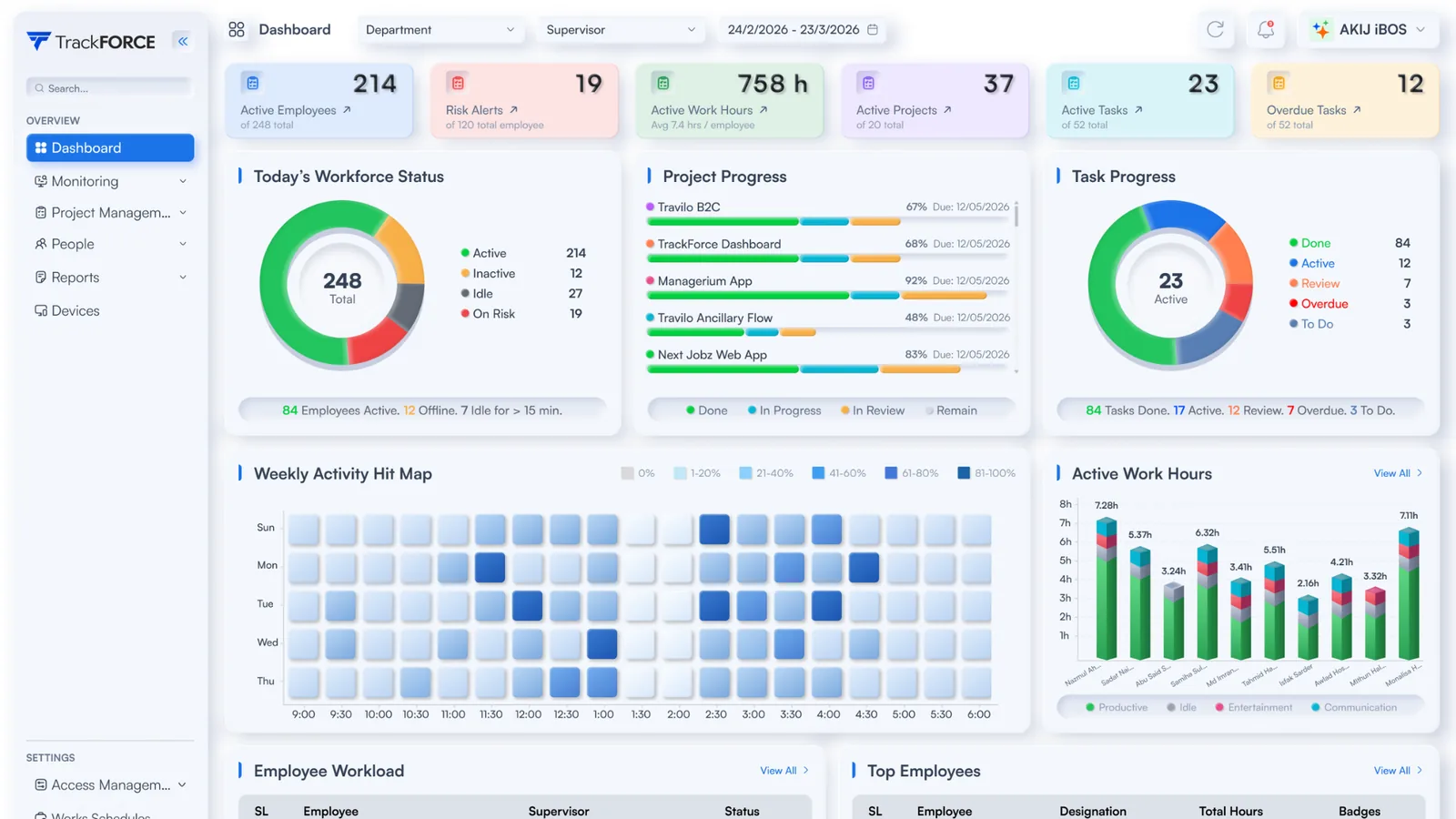
What managers get from TrackForce
See delivery in context
Completed tasks, project progress and hours sit in one view, so a low number is read against the workload behind it.
Spot overload early
Each person carries an overloaded, balanced or underloaded status, and insights suggest where tasks could move before deadlines slip.
Choose what is captured
Screenshot intervals, keystroke logging and app tracking are set per device during setup, so capture can follow a written purpose.
From install to a workload view managers can act on
Three steps. Settings come first, so the data collected is the data you decided to collect.
Install and choose capture
Install the desktop app on Windows or Mac devices, then set screenshot intervals, keystroke logging and app tracking per device. Leave off anything the purpose does not need.
Organise teams and access
Import staff from Excel or CSV, tag them by department and assign supervisors. Managers and admins get separate roles and permissions.
Read output, then talk
Workload sits beside output for the whole period. The conversation starts from evidence rather than from the last fortnight.
 1234
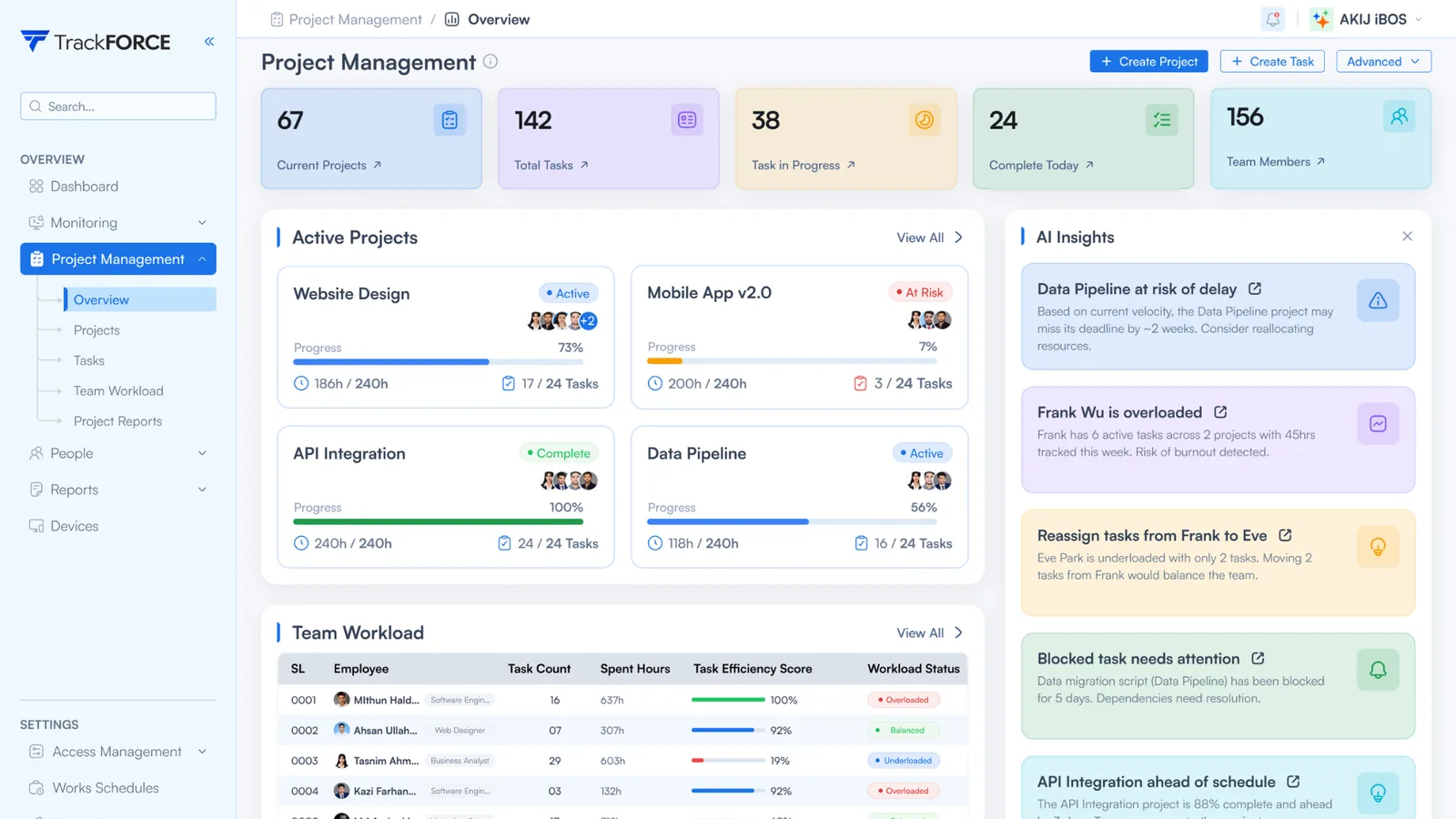
1234- Projects and tasks at a glance. Current projects, total tasks, work in progress and tasks completed today.
- Progress against hours. Each project shows completion beside hours used against hours planned.
- Team workload. Task count, hours spent, efficiency score and an overloaded, balanced or underloaded status per person.
- Insights. Flags delivery risk and overload, and suggests where tasks could move.
A UK rollout starts with the DPIA question
The ICO’s guidance on monitoring workers lists keystroke monitoring of workers in its own set of high-risk processing examples. Where processing is likely to result in a high risk, the ICO’s position is that a Data Protection Impact Assessment has to be completed before the processing starts. This can turn a software evaluation into a documentation and governance exercise. Our guide to employee activity monitoring software covers what each category of tool collects.
A purpose written down first
A DPIA records the purpose, the data, the necessity argument and the risks before anything is switched on. Working backwards from a live dashboard is harder to defend.
Collection nobody can justify
Data gathered because the tool offers it has no stated purpose behind it. That is the gap a reviewer is most likely to question.
Capture you choose, per device
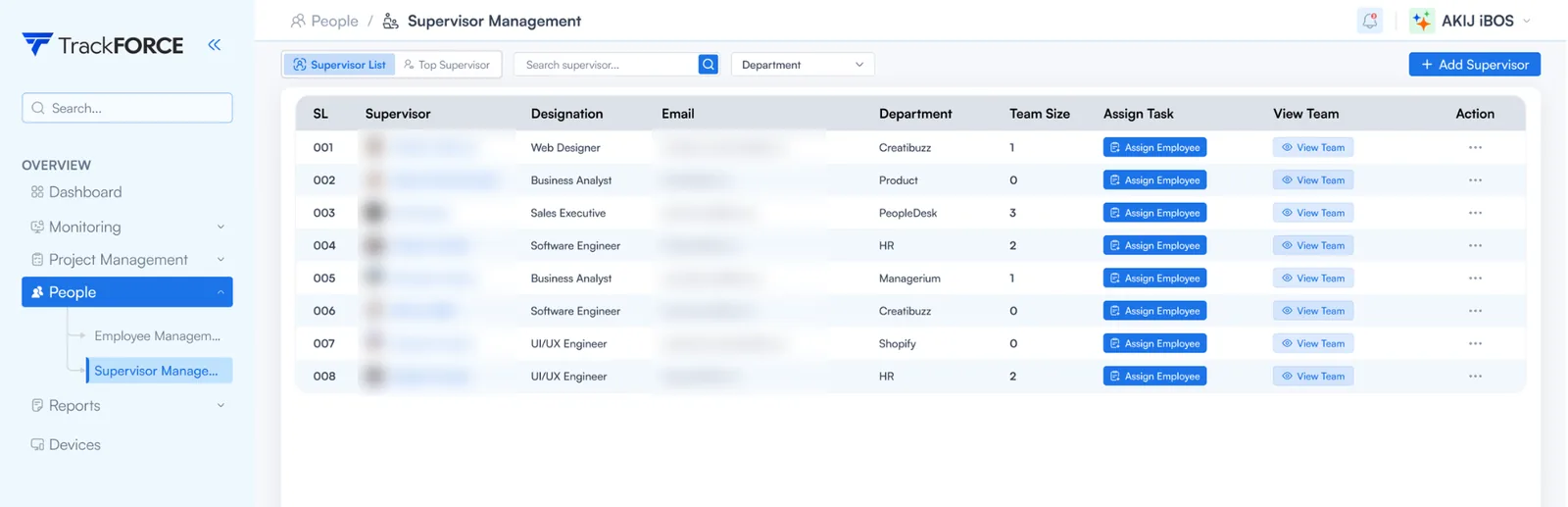
Screenshot, keystroke and app settings are chosen per device, and devices are tagged by department, so what is collected can match the written purpose.
Record of processing
Productivity measurement, United Kingdom
- Purpose
- Measure team output and workload to balance allocation across a hybrid workforce.
- Lawful basis
- Legitimate interests, with a documented Legitimate Interests Assessment. Not consent.
- Collected
- Task completion, workload volume, time allocation by project, working hours.
- Not collected
- Keystrokes, screenshots and screen recordings, unless a written purpose needs them.
- Staff informed
- Before go live, in writing, with the purpose and the data named.
- Retention
- Working time records held 2 years, under regulation 9.
Before any device is enrolled
- Write down the purpose before anything is switched on.
- Run a DPIA where keystrokes, screenshots or recordings are in scope.
- Complete a Legitimate Interests Assessment rather than a consent form.
- Tell staff in writing what is measured, and why, before go-live.
- Set a retention period, with working time records kept for two years.
The card shows the record a reviewer expects for a typical rollout. The free template below walks through each field. ICO guidance on monitoring workers is under review following the Data (Use and Access) Act. Last reviewed: October 2026.
Consent does not work for monitoring in a UK workplace
“Consent is not usually appropriate in the employment context, due to the imbalance of power.”
Information Commissioner's Office, guidance on monitoring workers
The ICO's reasoning is that workers are likely to feel they have no choice but to agree, so consent gathered from staff is not freely given and will not hold. UK employers deploying this category almost always rely on legitimate interests instead, and legitimate interests carries its own homework. The difference between workforce analytics and employee monitoring is where that argument is won or lost.
Purpose test
Name the business interest the monitoring serves, in specific terms. Better allocation across a hybrid team is a purpose. Visibility is not.
Necessity test
Show the purpose cannot reasonably be met with less data. This is where output measures hold up and keystroke counts usually do not.
Balancing test
Weigh that interest against what staff would reasonably expect. Telling people in advance is what moves this test in the employer's favour.
UK DPIA and LIA template for workplace monitoring
A blank DPIA form is not the hard part. Knowing what a reviewer expects in the necessity and balancing sections is. This template is written for productivity measurement specifically, with the ICO's own wording quoted where it matters.
- A DPIA screening question set that tells you whether you need one
- The DPIA itself: processing, consultation, risks and sign-off
- The three-part Legitimate Interests Assessment, with worked wording
- A measurement scope table to fill in before anything is switched on
- The staff notice wording Acas guidance points towards
- A quarterly review sheet for retiring measures nobody uses
Editable Word file, 12 pages, A4.
Working time records, kept for two years
The 48-hour duty is familiar. The record-keeping duty attached to it is the part that catches employers out, and it sits in the same instrument.
| Regulation | The duty | What it means in practice |
|---|---|---|
| Regulation 4 | Average working week capped at 48 hours over a 17-week reference period. | A single busy week is not a breach. The 17-week average is what has to be defensible, which means hours tracked continuously rather than sampled. |
| Regulation 5 | Workers may opt out in writing. The opt-out is terminable on 7 days' notice, and any contractual notice period is capped at 3 months. | Opt-out status changes, sometimes at short notice. The hours record has to stay accurate on both sides of that change. |
| Regulation 9 | Employers must keep records adequate to show the 48-hour limit is complied with, and retain them for 2 years. | Two years of hours data, retrievable per worker. Quarterly spreadsheet reconstruction can make continuous, employee-level records harder to maintain and retrieve reliably. |
TrackForce logs working hours per employee and shows them over the full period, so the 17-week average can be read from one record. Confirm the retention period for your plan against the two-year requirement.
Acas is direct about what excessive monitoring costs
Monitoring that is excessive “can damage trust, cause stress, reduce productivity.”
Acas, monitoring performance of staff who work from home, updated 22 May 2025
That is published guidance from the body UK employers turn to on workplace practice, and it argues against the way most of this category is sold. Acas also says monitoring must follow human rights and data protection law, and that employers should carry out an impact assessment. Taking the warning seriously makes a deployment far easier to defend in a staff survey, a union conversation or an employment tribunal. We have written separately on how to measure employee productivity without micromanaging.
What proportionate looks like
- Measure delivered output, not activity signals.
- Default to team-level views. Individual views need a stated reason.
- Tell staff what is collected and why, before collection starts.
- Review the measures quarterly and retire the unused ones.
What it protects
- The necessity argument in the DPIA holds, because the data set is small.
- Managers get a conversation starter rather than a verdict.
- Staff can see the basis of a judgement about their work.
- The deployment survives a change of HR director.
Hybrid work split the evidence, and nobody rebuilt it
28% of working adults in Great Britain hybrid worked between January and March 2025, on ONS figures published 11 June 2025. Work is spread across home, office and client site, while the record of what got delivered stayed in whichever tools each team happened to pick.
The honest framing matters here. UK output per hour rose 0.7% year on year in the second quarter of 2026 on the ONS preferred measure, so this is not a story about falling productivity. It is a measurement problem. Managers judging a hybrid team often have less direct evidence of work than an office gave them, yet they make the same decisions. See our guide to productivity tracking software for hybrid teams.
What TrackForce measures
The six views below carry the UK case. The same desktop agent can also capture screenshots, screen recordings, keystrokes, application and website use, and file transfers. The ICO lists keystroke monitoring of workers as an example of high-risk processing, so switch these on only for a team whose DPIA justifies them.
Full-period trend
Output per employee across the whole review period, not the fortnight before a conversation.
Workload context
Volume carried alongside output, so a low number reads correctly when the work was heavy.
Delivery consistency
Whether output holds steady or arrives in bursts, which is often the more useful signal.
Time allocation
Where hours went by project, which is what makes a reallocation argument concrete.
Team comparison
Like for like across a team, with workload differences visible rather than averaged away.
Capture settings per device
Screenshot intervals, keystroke logging and app tracking are set per device, so teams can run different settings.
What to check in any productivity tool, and where TrackForce stands
Seven questions worth asking every vendor on your shortlist, with TrackForce’s own answers. A wider market view sits in our guide to the best workforce analytics software.
| What to check | TrackForce | Why it matters in the UK |
|---|---|---|
| Output and workload reporting | Task efficiency, workload status and project progress per employee | Output evidence is what the necessity test favours |
| Working hours | Logged per employee by the desktop app and shown over the full period | Regulation 9 needs records adequate to show the 48-hour limit |
| Activity capture | Screenshots, keystroke logging, app and website use, file transfers, configured per device | The ICO lists keystroke monitoring of workers as high-risk processing |
| Visibility to staff | A login-based app staff sign in to. Centrally managed background deployment is also supported for IT-managed devices | The ICO says covert monitoring needs senior sign-off and a DPIA |
| Access control | Separate roles and permissions for managers and admins | Limits who can see individual data |
| Team structure | Staff tagged by department and assigned to supervisors | Lets scope follow teams rather than the whole company |
| Retention | Confirm the retention period for your plan with TrackForce | The ICO says monitoring data must not be kept longer than necessary |
Answers reflect TrackForce’s published documentation. Ask any supplier the same seven questions, including TrackForce, and get the answers in writing.
Start with a free 30-day trial. Paid plans from $4.99 a month.
UK questions, answered before you ask
Do UK employers need a DPIA before deploying employee productivity software?
Where the processing is likely to result in a high risk, yes. The ICO includes keystroke monitoring of workers in its own examples of high-risk processing, and its guidance is that a DPIA must be carried out before that processing begins.
Whether a specific configuration crosses that line depends on what it collects. A deployment limited to task output and project hours is a different assessment from one capturing keystrokes or screen content. Setting the scope first, then writing the DPIA against it, is the order that works.
Can we rely on employee consent as the lawful basis?
The ICO advises against it. Its guidance states that consent is not usually appropriate in the employment context because of the imbalance of power, and that workers are likely to feel they have no choice but to agree.
UK employers in this category generally rely on legitimate interests, supported by a documented Legitimate Interests Assessment. A signed consent form from staff is not a substitute for that assessment and can weaken the position rather than strengthen it.
What does a Legitimate Interests Assessment need to cover?
Three tests. The purpose test names the specific business interest. The necessity test shows the purpose cannot reasonably be achieved with less data. The balancing test weighs that interest against what staff would reasonably expect.
The balancing test is where advance notice does the heavy lifting. Monitoring that staff already know about is far easier to defend than monitoring they discover.
How long do working time records have to be kept?
Two years. Regulation 9 of the Working Time Regulations 1998 requires employers to keep records adequate to show the 48-hour weekly limit is being complied with, and to retain those records for two years from the date they were made.
Because regulation 4 sets the limit as an average over 17 weeks, the record has to be continuous rather than sampled.
Does Acas guidance allow employee monitoring?
Yes, with conditions. Acas guidance, updated 22 May 2025, says monitoring must follow human rights and data protection laws and that employers should carry out an impact assessment.
It also warns plainly that monitoring which is excessive can damage trust, cause stress and reduce productivity. That warning is worth reading as a design brief rather than a disclaimer.
Is TrackForce priced in pounds sterling?
List prices are published in US dollars: Essential is $4.99 a month and Professional is $14.99 a month, with Custom priced on request. GBP invoices are available on request for UK-registered companies, and VAT may apply.
The 30-day trial needs no card and no currency decision.
Does TrackForce need software on employees’ computers?
Yes. A desktop app runs on each Windows or Mac device, and admins manage everything from a web portal. Staff can be imported from Excel or CSV and grouped by department.
Capture settings such as screenshot intervals, keystroke logging and app tracking are chosen per device during setup.
Can staff see when TrackForce is running?
TrackForce offers a login-based app that staff sign in to and start themselves. For IT-managed devices, TrackForce also supports centrally managed deployment that runs in the background.
Before using background operation, confirm the legal basis, staff notice and internal approval it needs. The ICO says covert monitoring should only be authorised by senior management, needs a DPIA, and should not continue after the investigation it was for.
Can managers and admins have different access?
Yes. Managers and admins are given separate roles and permissions in the web portal, which limits who can see individual-level data.
Write the purpose down, then switch it on
Thirty days is long enough to set the scope, run one reporting cycle and see whether the measures hold up. No card, no procurement step, no commitment.
Free 30-day trial · No credit card required · Cancel anytime