Employee Activity Monitoring Software: How Businesses
Improve Productivity with Better Workforce Visibility
2026-09-17
•
Author: TrackForce Team
•
~1 min read
•
Updated September 20, 2026
- What Is Employee Activity Monitoring Software?
- Activity Tracking vs. Time Tracking: What's the Difference?
- What Employee Activity Monitoring Software Actually Shows — and the Decision Behind Each Signal
- Connecting Activity Data to Tasks, Projects and Workload
- Employee Activity Monitoring Software for Remote and Hybrid Teams
- Hybrid Team Management: Reviewing Schedules and Attendance
- From Raw Activity to Employee Productivity Reports and Dashboards
- Introducing Activity Monitoring Responsibly: Policy, Roles and US Considerations
- Frequently Asked Questions
- —Does this software track remote employees differently?
- —What reports does a manager actually get?
- —How is this different from a timesheet?
- —Is this appropriate for a small team?
- —Do I need screen activity enabled to get value?
- Get Started with TrackForce
Employee activity monitoring software records how working time is actually spent and connects it to the work that time was supposed to produce. For a US business running a hybrid, remote or back-office team, that connection matters more than any single metric. The point is not to watch people. The point is to answer questions you currently cannot: which projects are moving, who is overloaded, and where a deadline quietly slipped.
Here is the gap most teams run into. A timesheet proves someone was available for eight hours. It says nothing about whether the work assigned to those hours advanced. Activity data alone has the opposite problem — it shows plenty of motion with no direction. Employee activity monitoring software becomes useful only when the two sit next to task progress, project movement and workload distribution.
What Is Employee Activity Monitoring Software?
Employee activity monitoring software is a workforce intelligence platform that records work-related activity signals — active and idle time, application and website usage, attendance, schedules, and screen activity where configured — and presents them alongside tasks, projects and workload so managers can review productivity and project movement rather than raw surveillance output.
That definition matters because the category is widely misunderstood. Activity monitoring is not a camera over someone's shoulder. It is a measurement layer. It answers "what happened during the working day" so a manager can follow up on "why didn't this task move."
What it does not do is equally important. It does not replace project management, and it does not tell you whether a piece of work was good. It gives you structured, reviewable evidence about time and activity so that your judgment — and your team's — has something solid to work from.
Activity Tracking vs. Time Tracking: What's the Difference?
These two terms get used interchangeably, and that confusion is why so many small teams buy a timesheet tool and still cannot answer basic questions about output. The distinction is simple once you see it side by side.
| Time tracking | Activity tracking | |
| Measures | Hours logged, clock-in and clock-out, attendance | Active vs. idle time, application and website usage, configured screen activity signals |
| Answers | Was the person available? | Was work actually moving during that time? |
| Best for | Payroll, attendance, billable hours, schedule coverage | Productivity review, workload balance, delivery risk, follow-up |
| Blind spot | Says nothing about output | Says nothing on its own about whether the work was valuable |
| Typical failure | Eight hours logged, task untouched | Constant activity on the wrong project |
Neither one is enough by itself. For a small business — where one person often carries several roles — that matters more than it does at enterprise scale. A five-person team cannot afford to guess which of its people is stretched and which is quietly idle. Employee activity monitoring software for small business is less about control and more about not flying blind — pick a tool built for a five-person team, not an enterprise rollout.
What Employee Activity Monitoring Software Actually Shows — and the Decision Behind Each Signal
Every signal a platform records should earn its place by supporting a specific managerial decision. If you cannot name the decision, you do not need the metric. Here is how that mapping works in practice for teams learning how to track employee productivity without turning the process into a scoreboard.
| Signal | The decision it supports |
| Active vs. idle time | Who is blocked, who is stretched, and whether a stall is a workload problem or a process problem |
| Application usage | Where the working day actually goes — and whether tool sprawl is eating delivery time |
| Website activity | Whether research time is proportionate or whether distraction is a recurring pattern worth a conversation |
| Attendance and schedules | Whether shift coverage held and whether staffing matches the work coming in |
| Screen activity, where configured | Role-based review of specific signals when a project issue needs clarifying, not continuous scrutiny |
| Device and system activity | Whether the tools people depend on are available and working |
Read that table as a follow-up guide, not a verdict list. Idle time is a question, not an accusation — a developer idle for ninety minutes may be blocked waiting on a decision, and that is a management problem. Heavy application usage in a chat tool may mean collaboration is healthy, or it may mean the team is coordinating around unclear priorities. The data tells you where to look. It never tells you what to conclude.
Connecting Activity Data to Tasks, Projects and Workload
This is where most tools stop and where workforce intelligence begins. Activity hours in isolation are a number. Activity hours next to task progress, project movement and workload distribution are a decision.
Consider a software team of eight with a release due Friday. Two engineers have logged long, active weeks. Two others show lighter activity. On a monitoring dashboard alone, that looks like a motivation problem.
Now put the same data next to task and project status:
Engineer A — high activity, five tasks in progress, two blocked on review. Overloaded, and the bottleneck is review, not effort.
Engineer B — moderate activity, three tasks completed this week, one large task in progress. Healthy.
Engineer C — low activity, no active tasks assigned since Monday. Underloaded, and probably invisible in stand-up.
Engineer D — high activity concentrated in one application, project falling behind. Possibly working at the wrong altitude.
Same numbers, entirely different management response. You do not ask A to work harder; you clear the review queue. You do not reprimand C; you reassign work. This is workload management for teams done with evidence instead of impression, and it is the difference between a monitoring tool and a workforce intelligence platform.
Employee Activity Monitoring Software for Remote and Hybrid Teams
Remote team productivity monitoring gets a bad reputation because it is usually described as a way to compensate for not seeing people. The better framing is the opposite: when you cannot rely on walking past a desk, you replace ambient awareness with structured review, and structured review is more consistent than impression.
Scattered updates are the real cost of remote work. Progress arrives in chat threads, stand-ups, emails and a project board that someone forgot to update. A manager spends the morning reconstructing what happened yesterday. A single dashboard that combines time, activity, task progress and project movement removes that reconstruction work and gives the team one shared version of the status.
The tone matters here. Structured review means looking at patterns over days, not watching minute by minute. It means a weekly conversation about workload rather than a daily interrogation about idle time. Remote and hybrid teams respond to visibility they can see too — when the same dashboard informs both the manager's follow-up and the team's priorities, it reads as coordination rather than oversight.
Hybrid Team Management: Reviewing Schedules and Attendance
Hybrid team management adds a scheduling layer that fully remote teams do not have. On any given day, some people are in, some are out, and coverage depends on the schedule holding. Attendance data answers three concrete questions: who was scheduled, who actually worked, and whether coverage held for the tasks that needed it.
That is a shift-planning question, not a trust question. If Tuesday's coverage consistently runs short while Thursday's is overstaffed, you have a scheduling problem you can fix with data instead of a performance problem you would have guessed at.
From Raw Activity to Employee Productivity Reports and Dashboards
Features are an inventory; a workflow is what actually changes how a team operates. Here is the chain that turns activity signals into management action — and it is the chain most competing tools never show.
1. Activity and time are recorded throughout the working day, alongside attendance and, where configured, role-appropriate activity signals.
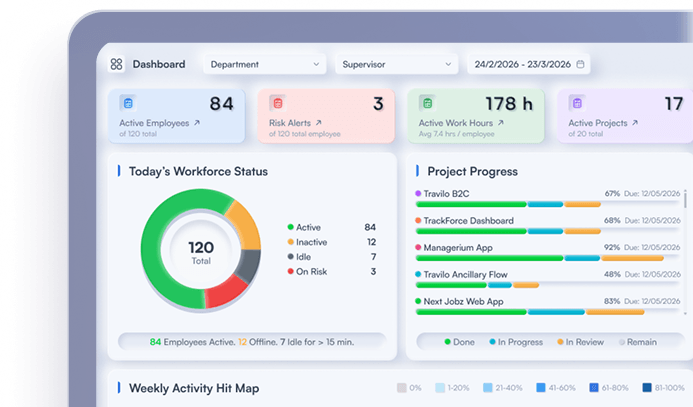
2. Data rolls into workforce dashboards where activity, time, tasks and project movement sit side by side.
3. Daily and monthly reports compress that into something reviewable — a daily view for the team lead, a monthly view for operations or ownership.
4. AI Summary and Insights surface patterns a busy manager would miss: a project trending late, a person trending overloaded, a recurring idle block on one team.
5. The manager follows up on task and project movement — clearing a blocker, reassigning work, adjusting a deadline.
One worked example makes the value obvious. An agency team has a client deliverable due the following Monday. Nothing looks wrong on Tuesday and Wednesday passes without incident. Wednesday's daily report flags that two of the five assigned tasks have not moved since Monday and that one team member's activity is heavily concentrated in review work rather than production. The team lead has Thursday and Friday to reassign the stalled tasks. Without that report, the same problem surfaces Monday morning as a missed deadline — and the post-mortem focuses on the wrong cause.
That is what an employee productivity report is for. Not to prove anyone worked, but to give you enough lead time to do something about it.
Introducing Activity Monitoring Responsibly: Policy, Roles and US Considerations
Employee activity monitoring is adopted responsibly when three things are in place: a written policy, role-based access, and a review cadence that focuses on patterns rather than individuals under a microscope. Get those right and the technology question becomes straightforward.
Policy. The policy should state plainly what is recorded, what is not, who can see it, and what it is used for. If screen activity is configured for a role, the policy says so. A policy employees have read is worth more than any technical control.
Roles. Access should be scoped, not universal. Team leads typically need task and project movement for their own team. Supervisors need workload and follow-up views. HR and admin need attendance and structured reporting. IT and compliance need role-based review of devices and configured system signals. Executives need aggregate trends. Nobody needs everything.
Review cadence. Daily follow-up belongs on tasks and blockers. Workload and pattern conversations belong weekly or monthly. A dashboard is a planning instrument, not a live feed to hover over.
United States legal considerations. Employment privacy requirements in the United States vary by state, and notice and consent obligations differ depending on where your employees work and how they are classified. This article is not legal advice and does not summarize any specific state's requirements.
That is also how you genuinely improve employee productivity: clearer priorities, faster blocker removal, fairer workload distribution. Measurement supports all three. It does not replace any of them.
Frequently Asked Questions
Does this software track remote employees differently?
No. The recording layer is the same whether someone works from an office, home or a coworking space. What changes is the management context — a remote or hybrid team depends more on dashboard review and scheduled check-ins because there is no ambient visibility to fall back on. Location changes the workflow around the data, not the data itself.
What reports does a manager actually get?
Typically two layers. A daily view covering task movement, activity patterns and blockers for quick follow-up, and a monthly view covering attendance, workload distribution and project delivery trends for planning. Most platforms also support AI-assisted summary and insights that highlight patterns worth a closer look, plus export for review meetings.
How is this different from a timesheet?
A timesheet records hours present; activity data records whether work moved during those hours. Timesheets are built for payroll and billable hours. Activity monitoring connected to tasks and projects is built for productivity review and delivery risk. Most teams need both, and they answer different questions.
Is this appropriate for a small team?
Yes, often more so than for large organizations. A five- to twenty-person team has less slack to absorb an unnoticed bottleneck, and the owner is usually the one doing the review. The main requirement is the same at any size: a clear policy and a review cadence focused on workload and delivery, not on individuals.
Do I need screen activity enabled to get value?
No. Active and idle time, application and website usage, attendance, task progress, and project movement deliver the majority of the operational value. Screen activity is an optional, configuration-dependent layer for specific roles where a project issue genuinely needs clarifying — not a prerequisite for workforce visibility.
Get Started with TrackForce
TrackForce is a Workforce Intelligence and Productivity Management platform, and it is built around exactly the chain described above: activity and time data connected to tasks, projects, workload and delivery progress, with role-based access, workforce dashboards, daily and monthly reporting, and AI Summary and Insights for the patterns that are easy to miss.
The practical next step is to see it against your own workflow rather than a generic demo. TrackForce offers a Get Free Trial so you can connect your projects and review how activity data lands next to task progress for your team. Start there, then build the policy and review cadence around it.
Similar blog you can explore
Employee Performance Metrics: The 9 That Predict Results
How to Improve Work Performance: 12 Changes That Hold
Workforce Analytics vs Employee Monitoring: Where the Line Sits
Start Your 30-Day
Free TrackForce Trial