Workforce Analytics vs Employee Monitoring:
Where the Line Sits
2026-09-23
•
Author: TrackForce Team
•
~1 min read
•
Updated September 23, 2026
- The Short Answer
- Workforce Analytics vs Employee Monitoring at a Glance
- What Employee Monitoring Actually Does
- What Workforce Analytics Adds
- Where the Line Actually Sits
- —1. Purpose: watch the person or improve the work?
- —2. Granularity: individual events or useful patterns?
- —3. Context: raw activity or the work around it?
- —4. Judgment: automatic score or reviewable evidence?
- —5. Action: punish the signal or fix the cause?
- The Same Feature Can Sit on Either Side
- —Active and idle time
- —Application and website tracking
- —Screenshots
- —Time tracking
- —Productivity reports
- When Individual Monitoring May Be Appropriate
- When Workforce Analytics Is the Better Default
- A Responsible Configuration Checklist
- Where TrackForce Fits
- The Line Is a Management Choice
- Frequently Asked Questions
- —Is workforce analytics the same as employee monitoring?
- —Is employee monitoring always surveillance?
- —Can active time measure employee productivity?
- —What makes workforce analytics privacy-conscious?
- —Can one software platform provide both monitoring and analytics?
Two companies can install the same workforce software and create completely different workplaces.
One manager checks every screenshot, ranks employees by active time and questions each idle period. Another reviews team-level trends, finds that a process requires six application switches and removes the bottleneck. Both used activity data. Only one used it as workforce analytics.
That is why workforce analytics vs monitoring cannot be settled by a feature checklist. The difference is the purpose of collection, level of interpretation, context and management action.
Employee monitoring is not automatically wrong, and workforce analytics is not automatically privacy-friendly. Either depends on configuration and use.
The Short Answer
Employee monitoring records or reviews what an individual employee does. It answers questions such as: Did this person work the scheduled hours? Which applications did they use? What happened on this device? Was a policy or security rule breached?
Workforce analytics identifies patterns across work. It asks: Where is time going across the team? Which workflows create delay? Is workload uneven? Which tools create friction? Are work patterns changing over time?
Monitoring produces evidence. Analytics gives that evidence organizational context.
The boundary is not the data alone. It is the question being asked.
Workforce Analytics vs Employee Monitoring at a Glance
| Dimension | Employee monitoring | Workforce analytics |
| Primary focus | Individual actions and compliance | Team, workflow and organizational patterns |
| Core question | “What did this person do?” | “How does work happen, and what should improve?” |
| Typical data | Time, activity, websites, apps, screenshots, files or device events | Aggregated time, workload, tool usage, trends, exceptions and outcome context |
| Review level | Individual record or event | Team, project, department or period |
| Common use | Attendance, investigation, policy enforcement, security | Capacity planning, workflow improvement, technology decisions, performance context |
| Main risk | Surveillance, overcollection and false conclusions | Bad inference, misleading averages and opaque scoring |
| Better practice | Targeted, necessary and authorized review | Aggregated, contextual and connected to business outcomes |
These are differences in emphasis, not completely separate product categories. A platform can contain both; the employer decides which mode becomes normal.
What Employee Monitoring Actually Does
Employee monitoring collects or displays records associated with a worker, account or device. Depending on the software and configuration, that may include:
- clock-in and clock-out times;
- active and idle periods;
- application and website usage;
- screenshots or screen recordings;
- search, email, file or meeting activity;
- device information;
- policy, access or risk events.
Some of these records serve ordinary operational purposes. Timekeeping can support payroll and attendance. Application logs can help investigate a technical issue. Detailed records may be relevant to a defined security or compliance incident.
Monitoring becomes problematic when collection expands beyond the stated need, when employees do not understand what is captured, or when managers treat activity as proof of performance. A screenshot shows a screen at one moment. It does not establish the quality, difficulty or value of the work.
The UK Information Commissioner's Office lists timekeeping, screenshots, keystroke monitoring, productivity tools and internet tracking among forms of worker monitoring. Its official worker-monitoring guidance emphasizes lawful purpose, transparency, necessity, proportionality, accuracy and security. Other jurisdictions have their own requirements, so organizations must verify the laws that apply to their workers.
What Workforce Analytics Adds
Workforce analytics starts with some of the same operational data but changes the level of analysis.
Instead of asking why one employee used a browser for three hours, analytics may show that an entire department spends 35% of tracked time moving between a browser, spreadsheet and legacy system. That pattern supports a workflow or technology decision.
Instead of treating one long day as evidence of commitment, analytics may show that a team has worked beyond its normal schedule for four consecutive weeks. That supports a capacity or workload review.
Instead of ranking individuals by active time, analytics may compare project allocation, task movement and completion trends to identify where work stalls.
Useful workforce analytics normally adds four things to raw monitoring data:
- Aggregation: patterns across teams, roles, projects or periods.
- Context: tasks, workloads, schedules and business processes.
- Comparison: change over time or against a relevant baseline—not a universal score.
- Action: a decision about staffing, tools, workflow, training or support.
TrackForce's guide to workforce performance measuring software explains the measurement ladder in more detail: presence and activity are inputs, workflow is interpretation, and outcomes require quality, quantity, timeliness or business context.
Where the Line Actually Sits
The line between monitoring and analytics sits across five decisions.
1. Purpose: watch the person or improve the work?
A clear purpose is the first test.
“Collect everything in case we need it” is a monitoring posture with no boundary. “Measure time spent across three applications to determine whether a workflow should be automated” is a defined analytics purpose.
Monitoring may still have a legitimate purpose, such as investigating an authorized security incident. The difference is that the collection is tied to a specific need rather than becoming permanent observation.
2. Granularity: individual events or useful patterns?
Managers sometimes need individual records—for example, correcting a time entry or examining a confirmed policy concern. But routine management rarely requires constant review of every screenshot, URL or idle period.
Team and trend views often answer the business question with less intrusion. If the goal is to balance workload, start with department-level allocation. Move to individual data only when the decision genuinely requires it and access is authorized.
3. Context: raw activity or the work around it?
An idle-time figure without context is ambiguous. The employee may have been in a meeting, reviewing a document, dealing with a system failure or working away from the monitored device.
Analytics connects activity to schedules, roles, tasks, projects and outcomes. Monitoring without context encourages the simplest—and often wrong—interpretation.
4. Judgment: automatic score or reviewable evidence?
Opaque productivity scores can make weak assumptions look objective. A manager should understand which inputs created a score, whether the rules fit the role and how employees can challenge inaccurate data.
The ICO specifically warns that analytics can make incorrect inferences about workers and stresses accuracy when monitoring information may affect performance reviews or other adverse decisions. Data should inform judgment, not hide it.
5. Action: punish the signal or fix the cause?
The final action reveals the system's real purpose.
If a manager sees high idle time and immediately penalizes an employee, the data is being used as surveillance. If the manager checks workload, assignments, system performance and employee context, the same signal becomes an analytical starting point.
Workforce analytics asks what the organization should change—not only what the employee should explain.
The Same Feature Can Sit on Either Side
Active and idle time
Monitoring use: question every idle interval.
Analytics use: identify recurring team-level patterns, process delays or workload differences, then investigate with context.
Application and website tracking
Monitoring use: label sites globally as productive or unproductive and judge individuals by the label.
Analytics use: understand tool adoption, workflow switching, license use and where teams lose time.
Screenshots
Monitoring use: capture continuously and review routinely without a defined reason.
Targeted use: configure screenshots for a documented requirement, restrict access and use them only when less intrusive evidence cannot answer the question.
Time tracking
Monitoring use: treat longer hours as better performance.
Analytics use: support accurate records, compare planned and actual allocation, and identify sustained overload. The U.S. Department of Labor's recordkeeping guidance notes that covered employers must maintain certain complete and accurate records for non-exempt employees; requirements vary by jurisdiction and worker type.
Productivity reports
Monitoring use: publish a league table based on activity alone.
Analytics use: combine time and activity with role-appropriate output, quality and timeliness measures. The U.S. Office of Personnel Management describes quality, quantity, timeliness and cost-effectiveness as general performance measures—none of which is fully represented by mouse or keyboard activity.
When Individual Monitoring May Be Appropriate
An honest distinction should not pretend that all individual monitoring is unnecessary. Specific use cases may include:
- maintaining accurate work-time records;
- investigating a credible security or data-loss concern;
- verifying compliance with a defined policy;
- troubleshooting an employee's technical problem;
- documenting work on regulated or contractually controlled systems;
- responding to a specific customer or operational incident.
The controls should match the risk. Define authorization, scope, duration, access, retention and employee notice. Use the least intrusive method that can answer the question. High-risk monitoring may require a formal impact assessment or legal review.
TrackForce's article on employee monitoring for in-office teams provides a practical rollout model based on purpose, proportionality and transparent policy.
When Workforce Analytics Is the Better Default
Use analytics when the management question concerns the system of work:
- Are workloads balanced across the team?
- Which project is consuming more capacity than planned?
- Where does work wait for approval?
- Which tools are overused, underused or duplicative?
- Are long hours becoming a sustained pattern?
- Did a process change improve cycle time?
- Which teams need additional training or resources?
These questions are better answered through trends and context than continuous inspection of individuals. They also produce decisions management can act on: reassign work, simplify a process, replace a tool, clarify ownership or adjust staffing.
For remote teams, TrackForce's monitoring-without-micromanaging guide shows how visibility can focus on patterns and results rather than isolated actions.
A Responsible Configuration Checklist
Before deploying workforce software, document the following:
- Purpose: What exact business question will the data answer?
- Data: Which fields are genuinely necessary?
- Scope: Which workers, devices and working hours are included?
- Visibility: What will employees be told before collection begins?
- Access: Which roles can see team reports and detailed records?
- Retention: How long will each data type be kept?
- Interpretation: What context must be reviewed before drawing a conclusion?
- Challenge: How can employees view, explain or correct their data?
- Action: Which decisions may use the data, and which may not?
- Review: When will the organization reassess necessity and effectiveness?
The strongest configuration is not the one that captures the most. It is the one that answers a legitimate question with the least data and turns the result into a fair, useful decision.
Where TrackForce Fits
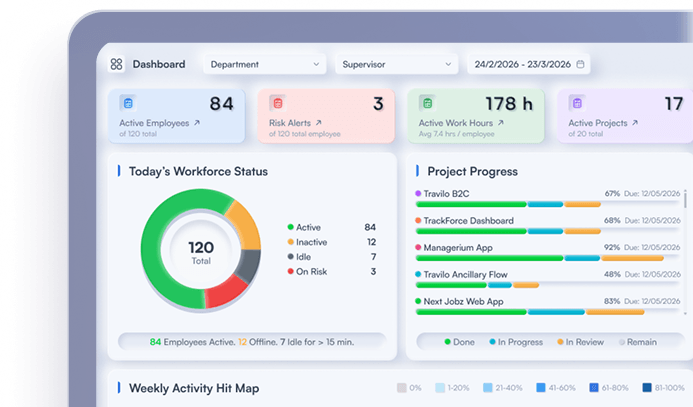
TrackForce combines automatic time and activity tracking, application and website insights, employee management, workload and productivity reports, configurable monitoring controls and role-based access. That means the platform can support both detailed monitoring and broader workforce analytics.
The responsible positioning is not “monitoring versus analytics” as if one set of capabilities disappears. It is a progression:
Collect necessary work signals → organize them into patterns → add task and workload context → make a better management decision.
Managers may still use detailed records for a defined attendance, security or operational case. But routine performance management should start with team patterns and outcomes, not individual surveillance.
TrackForce's employee activity monitoring guide covers the collection layer. This article defines the boundary: data becomes workforce intelligence only when it helps improve how work is designed, distributed and supported.
The Line Is a Management Choice
Employee monitoring and workforce analytics can use similar data. Their difference is purpose, scale, context and action.
Monitoring asks what a person did. Analytics asks what the pattern means for the team and the work. Monitoring may be justified for a specific, documented need. Analytics should be the default when the goal is productivity, capacity or process improvement.
The line is crossed when observation becomes broader than the business need, activity becomes a substitute for outcomes, or an automated score replaces context and human review.
The better approach is straightforward: collect less, explain more, analyze patterns, connect data to real work and use the result to improve the system—not merely to watch the people inside it.
Want visibility without losing the bigger picture? Explore TrackForce or review its plans and 30-day trial to see how configurable monitoring and workforce reporting can support your team.
Frequently Asked Questions
Is workforce analytics the same as employee monitoring?
No. Employee monitoring records individual activity or events. Workforce analytics uses work data to identify patterns across teams, workflows, tools and time. The categories overlap because analytics may use data produced by monitoring features.
Is employee monitoring always surveillance?
Not always. Timekeeping, security investigation and regulated workflows may require individual records. It becomes surveillance-like when collection is excessive, hidden, continuous without need or used to make unsupported judgments.
Can active time measure employee productivity?
Active time measures device interaction, not the quality or value of work. It can support investigation of work patterns but should be combined with tasks, outcomes, quality, timeliness and employee context.
What makes workforce analytics privacy-conscious?
A defined purpose, data minimization, transparent notice, team-level reporting, limited access, appropriate retention, accurate interpretation and a way for employees to challenge data all reduce privacy risk. Legal requirements vary by jurisdiction.
Can one software platform provide both monitoring and analytics?
Yes. The same platform may collect time and activity records and also produce team-level trends, workload reports and workflow insights. Configuration and management practice determine how the data is used.
Similar blog you can explore
Employee Performance Metrics: The 9 That Predict Results
How to Improve Work Performance: 12 Changes That Hold
Workforce Performance Measuring Software: What It Is and What It Actually Measures
Start Your 30-Day
Free TrackForce Trial