Best Workforce Analytics Software:
7 Platforms Compared
2026-10-07
•
Author: Team TrackForce
•
~1 min read
•
Updated October 7, 2026
- What Is Workforce Analytics Software?
- Best Workforce Analytics Software at a Glance
- How We Compared the Best Workforce Analytics Software
- 1. TrackForce: Best for Evidence-Based Performance Visibility
- 2. ActivTrak: Best for Workforce and Technology Optimisation
- 3. Insightful: Best for Work-Pattern and Workflow Analysis
- 4. Time Doctor: Best for Distributed Team Time Analytics
- 5. Hubstaff: Best for Time, Projects and Workforce Operations
- 6. Teramind: Best for Analytics With Security Controls
- 7. Microsoft Viva Insights: Best for Microsoft 365 Organisations
- How to Choose the Best Workforce Analytics Software
- —Does it connect activity to meaningful context?
- —Can employees understand the system?
- —Can you test a real management question?
- —Does it fit your existing stack?
- Which Platform Should You Choose?
- Frequently Asked Questions
- —What is the best workforce analytics software?
- —
- —What should workforce analytics software measure?
- —
- —Is workforce analytics the same as employee monitoring?
- —
- —Can workforce analytics software improve productivity?
- —
- —How should we evaluate workforce analytics tools?
Choosing the best workforce analytics software is not about finding the dashboard with the most charts. It is about finding a platform that answers the decisions your managers actually need to make: Where is work slowing down? Which teams are overloaded? Are people using the right tools? Is performance improving, and what evidence supports that conclusion?
This guide compares seven leading platforms for 2026. We reviewed their current, publicly documented capabilities and focused on practical fit rather than declaring one tool perfect for every company. Product features and plan availability can change, so confirm critical requirements with each vendor before buying.
What Is Workforce Analytics Software?
Workforce analytics software collects and organises work-related data so leaders can identify patterns in time, activity, workload, tool use and performance. The best systems turn those signals into decisions about staffing, coaching, workflow design and technology investment.
It is important to separate analytics from surveillance. Active time, application use and attendance provide operational context; they do not prove quality or business value by themselves. Read our guide to workforce analytics vs employee monitoring for the distinction.
Best Workforce Analytics Software at a Glance
| Platform | Best for | Notable strengths | Consider carefully |
| TrackForce | Evidence-based performance visibility | Time, activity, workload and reporting in one system | Define how activity data will support, not replace, outcome metrics |
| ActivTrak | Workforce and technology optimisation | Capacity, productivity, workflow and application-use insights | Broad analytics may require a clear rollout owner |
| Insightful | Work-pattern and workflow analysis | Productivity trends, activity timelines and location comparisons | Confirm which reporting and enterprise controls your plan includes |
| Time Doctor | Distributed teams that need time context | Time, productivity, workforce and software-use insights | Set fair rules for individual-level monitoring |
| Hubstaff | Time, project cost and operational management | Timesheets, analytics, budgets, payments and integrations | Strong time focus may not replace HR people analytics |
| Teramind | Security- and compliance-sensitive operations | Workforce analytics plus behaviour and risk controls | Deeper monitoring requires strong governance |
| Microsoft Viva Insights | Microsoft 365-centred organisations | Collaboration, wellbeing and organisational work-pattern insights | Advanced capabilities can depend on Microsoft licensing |
How We Compared the Best Workforce Analytics Software
We assessed each platform against six buyer questions:
- What data does it collect?
- Does it show trends and context, not just raw activity?
- Can managers connect signals to workload, projects or outcomes?
- Are privacy, access and transparency controls available?
- Does it fit the organisation’s existing workflow and technology stack?
- Can a buyer test the reporting with a realistic use case before rollout?
That framework prevents a long feature list from disguising a poor operational fit.
1. TrackForce: Best for Evidence-Based Performance Visibility
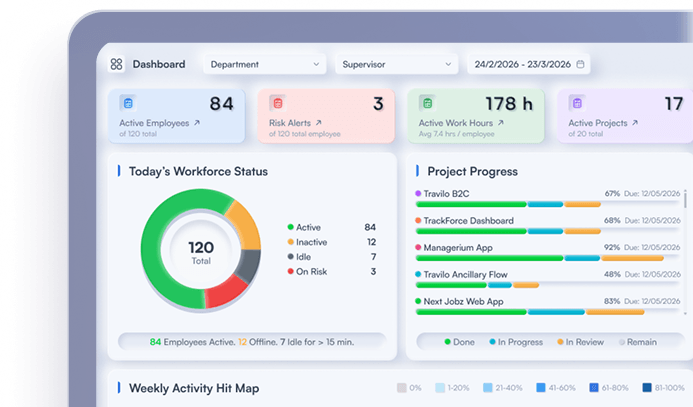
TrackForce workforce analytics software is designed to give managers one view of working hours, active and idle time, application and website usage, workload information, productivity trends and reports. This combination is useful when a company wants to understand how work happens without treating one activity score as a final performance verdict.
TrackForce is a strong fit for remote, hybrid and office-based teams that need consistent visibility across departments. Managers can use the data to investigate missed deadlines, uneven workloads or changing work patterns, then bring project results and quality measures into the conversation. That evidence-first approach also supports more balanced reviews; the nine employee performance metrics guide explains how to connect operational signals to actual results.
Best fit: Teams that want workforce visibility, productivity analytics and reporting in one platform.
Watch for: Agree on the purpose, access rules and outcome metrics before implementation.
2. ActivTrak: Best for Workforce and Technology Optimisation
ActivTrak analyses digital work activity across remote and office environments. Its current platform covers productivity trends, workload balance, capacity and headcount planning, application usage, technology investment analysis and AI adoption insights.
The platform stands out when operations, IT and executive teams all need different views of the same workforce data. It can help a business identify process friction, underused software and capacity constraints, not merely record time.
Best fit: Mid-sized and larger organisations seeking workforce planning and technology-use intelligence.
Watch for: Decide which decisions matter first; a broad platform can produce more data than a team is ready to act on.
3. Insightful: Best for Work-Pattern and Workflow Analysis
Insightful combines employee activity data with workforce analytics for productivity trends, work-pattern analysis, activity timelines and comparisons across working locations. Its positioning makes it relevant to businesses trying to understand how distributed teams use time and tools.
Insightful may appeal to organisations that want granular work data alongside team-level analysis. During evaluation, use real workflows and ask whether its reports explain the cause of a delay or simply confirm that a pattern exists.
Best fit: Distributed operations that need detailed visibility into digital work patterns.
Watch for: Confirm the plan, deployment method and controls required for your organisation.
4. Time Doctor: Best for Distributed Team Time Analytics
Time Doctor combines time tracking with productivity and workforce analytics. Its documented capabilities include benchmarks, unusual-activity reporting, meeting insights, dashboards and software-cost insights.
It is particularly relevant when leaders need to understand how a remote or outsourced team allocates time. However, time allocation remains an input. A thoughtful implementation should compare it with delivery, quality and customer outcomes instead of ranking employees by activity alone.
Best fit: Remote, outsourced and service teams where tracked time is operationally important.
Watch for: Configure monitoring proportionately and explain the purpose to employees.
5. Hubstaff: Best for Time, Projects and Workforce Operations
Hubstaff brings together time tracking, workforce analytics, productivity benchmarks, project-cost information, payments and integrations. This makes it useful for agencies, field teams and distributed businesses that move directly from tracked hours to budgets, invoices or payroll workflows.
Hubstaff is less about traditional HR analytics such as retention or hiring forecasts and more about the operational side of work. Buyers should decide whether that is exactly the problem they need to solve.
Best fit: Agencies and operational teams connecting time data with project economics.
Watch for: Check whether separate HR or performance-management tools are still needed.
6. Teramind: Best for Analytics With Security Controls
Teramind combines workforce analytics with employee activity, behaviour analysis and security-focused controls. Its documented privacy options include scheduled monitoring, masking sensitive data, excluding non-business domains and role-based permissions.
This depth can suit regulated or high-risk environments where productivity visibility and insider-risk controls must coexist. It also raises the governance bar. Companies should collect only data that serves a defined purpose and restrict access to people who genuinely need it.
Best fit: Organisations with demanding security, compliance or investigation requirements.
Watch for: A comprehensive monitoring policy and legal review may be necessary across jurisdictions.
7. Microsoft Viva Insights: Best for Microsoft 365 Organisations
Microsoft Viva Insights uses Microsoft 365 work-pattern data to support productivity and wellbeing insights. For organisations already centred on Microsoft tools, it can reduce integration friction and provide organisational views of collaboration habits, focus time and meeting patterns.
Viva Insights is not a like-for-like replacement for every activity or time-tracking platform. Its value is strongest when collaboration patterns and Microsoft 365 adoption are the primary questions. Buyers should verify licensing because advanced organisational and Copilot-related capabilities may have additional requirements.
Best fit: Enterprises that want workplace insights inside the Microsoft ecosystem.
Watch for: Validate licensing and whether the available data answers your operational use case.
How to Choose the Best Workforce Analytics Software
Start with one decision, not a catalogue of features. For example: “We need to detect workload imbalance before delivery dates slip.” Then test each shortlisted platform against the following questions.
Does it connect activity to meaningful context?
A useful workforce analytics platform should show teams, roles, projects, schedules or workload beside activity. Otherwise, a manager sees motion without knowing whether important work progressed. Our guide to workforce performance measuring software explains why activity and performance require different evidence.
Can employees understand the system?
Document what is collected, why it is needed, who can see it and how long it is kept. Give employees a way to correct missing context. Transparent rules improve data quality and reduce the risk that analytics becomes micromanagement.
Can you test a real management question?
Run a limited pilot with one team and a defined baseline. Test whether the software helps managers identify a bottleneck, rebalance workload or improve a process. Do not judge a pilot by the number of dashboards opened.
Does it fit your existing stack?
Check operating systems, identity management, project tools, HR systems, exports, APIs and reporting workflows. Also verify support, data location, retention settings and role-based access before signing a contract.
Which Platform Should You Choose?
The best workforce analytics software is the platform that provides enough evidence for your decisions without collecting unnecessary data.
Choose TrackForce for unified time, activity, workload and performance visibility. Consider ActivTrak for broad work and technology optimisation, Insightful for detailed work-pattern analytics, Time Doctor for distributed team time intelligence, Hubstaff for project economics, Teramind for security-led use cases and Viva Insights for Microsoft 365 collaboration analysis.
Before committing, shortlist two or three platforms and test the same use case in each. If you want to explore how TrackForce turns workforce activity into practical management context, review its workforce analytics software capabilities.
Frequently Asked Questions
What is the best workforce analytics software?
There is no universal winner. TrackForce is a strong option for evidence-based workforce visibility; ActivTrak suits broad workforce optimisation; Hubstaff connects time with project costs; Teramind serves security-heavy environments; and Viva Insights fits Microsoft 365-centred organisations. The right choice depends on the decision you need the data to support.
What should workforce analytics software measure?
It may measure time, attendance, active and idle periods, application use, workload, collaboration patterns, project allocation and trends. Performance decisions should also include role-specific outcomes such as quality, quantity, timeliness and customer or business impact.
Is workforce analytics the same as employee monitoring?
No. Monitoring records individual activity signals. Workforce analytics aggregates and interprets data to reveal patterns in capacity, workflow, technology use and performance. The categories can overlap, but their purpose and level of analysis differ.
Can workforce analytics software improve productivity?
Software does not improve productivity automatically. It can reveal bottlenecks, imbalanced workloads and inefficient tool use. Managers still need to investigate the cause, make a change and measure whether the outcome improves.
How should we evaluate workforce analytics tools?
Define one use case, confirm the required data and controls, run a limited pilot, compare the insight with real business outcomes and collect employee feedback. Choose the tool that helps people make a better decision, not the one that generates the most activity data.
Similar blog you can explore
Team Productivity Dashboards: 9 Metrics Managers Should Actually Track
Performance Appraisal Software: How to Choose in 2026
TrackForce vs Time Doctor for Performance Reviews
Start Your 30-Day
Free TrackForce Trial