How to Measure Employee
Productivity Without Micromanaging
2026-09-30
•
Author: TrackForce Team
•
~1 min read
•
Updated September 30, 2026
- Quick Answer: How Do You Measure Productivity Without Micromanaging?
- Measurement and Micromanagement Are Not the Same
- 1. Begin With the Result, Not the Tracking Tool
- 2. Use a Balanced Productivity Scorecard
- 3. Define Productivity for Each Role
- 4. Treat Activity Data as Diagnostic Context
- 5. Establish a Baseline Before Setting Targets
- 6. Separate Employee Control From System Conditions
- 7. Make the Measurement Rules Visible
- 8. Replace Constant Check-Ins With a Review Rhythm
- 9. Give Employees Access to Their Own Evidence
- A Practical Example
- How TrackForce Supports Productivity Measurement
- Frequently Asked Questions
- —What is the best way to measure employee productivity?
- —
- —Is time worked a productivity metric?
- —
- —Can employee monitoring improve productivity?
- —
- —How often should productivity be reviewed?
- Measure to Improve the Work
Employee productivity should be measured by the value of completed work: not by how often a manager checks whether someone is online.
That sounds straightforward, but many teams begin with the data that is easiest to collect: hours, keyboard activity, app usage, or messages sent. Those signals can explain how work happens. Used alone, however, they can reward visible busyness while missing quality, progress and customer impact.
The answer is not to stop measuring. It is to build a system that gives managers useful evidence without turning every working minute into a performance test. This guide explains how to measure employee productivity through clear outcomes, balanced metrics, trends and transparent conversations.
Quick Answer: How Do You Measure Productivity Without Micromanaging?
To measure employee productivity without micromanaging:
- Define the outcome each role exists to produce.
- Select three to five role-specific metrics.
- Balance output with quality and timeliness.
- Use time and activity data as context, not a verdict.
- Compare trends against a fair baseline.
- Account for workload, dependencies and interruptions.
- Explain what data is collected and why.
- Review results in regular conversations instead of constant check-ins.
This approach creates accountability while leaving employees room to decide how to complete the work.
Measurement and Micromanagement Are Not the Same
Productivity measurement answers: Is valuable work moving forward at a sustainable rate?
Micromanagement asks employees to prove activity repeatedly, requires approval for routine decisions or reacts to individual data points without context. It focuses managerial attention on control rather than results.
A healthy measurement system gives employees a clear finish line and gives managers early warning when delivery, quality or workload changes. It does not require a supervisor to watch the dashboard all day.
The distinction also matters for data protection. The UK Information Commissioner’s Office says worker monitoring should have a defined purpose, use the least intrusive means and be transparent. Its worker-monitoring guidance is useful even outside the UK as a practical design reference, although every employer must follow the laws that apply in its own jurisdictions.
1. Begin With the Result, Not the Tracking Tool
Before selecting metrics, write one sentence that explains why the role exists.
Examples:
- A support agent resolves customer problems accurately and within service targets.
- A salesperson creates profitable, suitable customer relationships.
- A developer delivers reliable product improvements.
- An operations employee processes work correctly and on schedule.
Then identify the work products and outcomes that prove progress. Do not begin with “What can our software record?” Beginning with available data encourages teams to mistake device interaction for productivity.
2. Use a Balanced Productivity Scorecard
A useful scorecard normally contains three to five measures across different dimensions.
| Dimension | Question | Example metric |
| Output | How much relevant work was completed? | Cases resolved, orders processed, milestones delivered |
| Quality | Was the work correct and useful? | First-pass quality, error rate, customer satisfaction |
| Timeliness | Did work arrive when needed? | On-time delivery, cycle time, SLA achievement |
| Efficiency | What resources did the result require? | Cost per case, time per completed unit |
| Impact | Did the work create value? | Retention, revenue, resolution rate, stakeholder outcome |
The U.S. Office of Personnel Management similarly frames performance measurement around quality, quantity, timeliness and cost-effectiveness. That is a stronger starting point than a single activity score.
For formulas and limitations, use TrackForce’s guide to employee performance metrics. If you need to narrow a large metric set into priorities, the guide to key performance indicators for employees explains how to build a smaller KPI scorecard.
3. Define Productivity for Each Role
There is no fair universal employee-productivity formula. A basic calculation may be:
Productivity = useful output ÷ resources used
But “useful output” changes by role, and raw quantity needs a quality guardrail.
For example:
- Support: resolved cases, first-contact resolution and customer satisfaction.
- Sales: qualified opportunities, conversion, revenue quality and retention.
- Engineering: milestones delivered, cycle time, defects and rework.
- Finance: transactions completed, accuracy, close time and exceptions.
- Creative work: approved deliverables, timeliness, revision rate and campaign impact.
Do not compare unlike roles on the same output target. Even employees with the same title may handle different complexity, territories or customer segments.
4. Treat Activity Data as Diagnostic Context
Working hours, active time, app use and website activity can help explain a result. They rarely prove the result by themselves.
Suppose on-time delivery falls. Activity data may show heavy application switching, repeated overtime or long periods waiting in a system. Those patterns help a manager investigate interruptions, overload or process delays. They do not automatically prove low effort.
Use activity data to ask questions such as:
- Is the employee assigned enough meaningful work?
- Are interruptions fragmenting focus?
- Is one tool or process creating a bottleneck?
- Is the workload sustainable?
- Does the activity pattern align with the employee’s actual responsibilities?
TrackForce’s guide to workforce analytics versus employee monitoring explains why recording activity and interpreting performance are different jobs.
5. Establish a Baseline Before Setting Targets
A target without a baseline is often an opinion disguised as a standard.
Measure normal performance for several representative work cycles. Account for seasonality, case complexity, training periods, system outages and changes in demand. Then set a range that is realistic and challenging.
Review trends rather than isolated days. One missed deadline or unusual idle period should prompt a question, not an immediate conclusion. A four-week pattern is usually more useful than a single screenshot or hourly score.
The CIPD performance-management factsheet advises that measures should be necessary, relevant and aligned with organisational strategy. It also notes that performance is more difficult to quantify for many knowledge workers, which makes context and reliable judgement important.
6. Separate Employee Control From System Conditions
Before holding someone accountable for a result, identify what they could reasonably control.
Productivity can fall because of:
- conflicting priorities;
- delayed approvals;
- missing information or access;
- uneven workload allocation;
- unreliable software;
- repeated meetings and interruptions;
- dependencies on another team;
- unclear quality standards.
A fair review separates individual execution from process failure. If five employees slow down after the same workflow change, the first investigation should be the workflow—not five disciplinary conversations.
7. Make the Measurement Rules Visible
Employees should know:
- what information is collected;
- when collection occurs;
- why each measure is needed;
- who can access the information;
- how long it is retained;
- how it influences decisions;
- how an employee can explain or challenge inaccurate data.
Write these rules in plain language and discuss them before measurement begins. Transparency reduces uncertainty and helps managers use the system consistently. It does not, by itself, make excessive monitoring appropriate; collect only what serves a legitimate, defined need.
Legal requirements differ by location, industry, and workforce arrangement. Obtain qualified advice before implementing employee monitoring or making automated employment decisions.
8. Replace Constant Check-Ins With a Review Rhythm
Managers do not need to inspect every activity event. Use a predictable cadence:
- Daily: address urgent blockers and service risks.
- Weekly: review priorities, workload, and exceptions.
- Monthly: examine productivity and quality trends.
- Quarterly: revisit goals, development and role expectations.
In weekly conversations, ask what was completed, what changed, what is blocked, and what support is needed. If a metric moves, let the employee add context before deciding what it means.
For remote teams, TrackForce’s guide to remote employee monitoring without micromanaging covers the same principle: visibility should reduce unnecessary status chasing, not create permanent surveillance.
9. Give Employees Access to Their Own Evidence
Measurement is more useful when employees can see their trends, correct errors, and act before a formal review.
A shared dashboard can help an employee notice rising rework, missed service targets, or an unsustainable schedule. The conversation then becomes collaborative: what caused the change, and what adjustment is likely to help?
Do not let an unexplained score determine promotion, discipline, or termination. Verify the source, check for missing work, consider reasonable adjustments, and provide human review.
A Practical Example
Imagine a customer-support manager who wants to improve productivity.
The weak approach is to rank agents by active computer time. That may reward long sessions while ignoring whether customers received correct answers.
A better scorecard uses:
- cases resolved;
- first-contact resolution;
- customer satisfaction;
- average resolution time;
- schedule adherence as an operational measure.
The manager reviews team trends weekly. If one agent’s resolution time rises, workload and activity data provide context. The employee may be handling more complex cases, waiting for approvals or struggling with a new system. The data identifies where to investigate; the conversation identifies why.
How TrackForce Supports Productivity Measurement
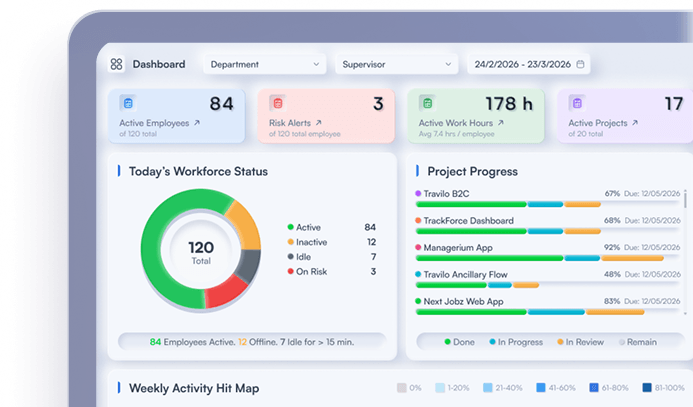
TrackForce brings work hours, active and idle time, application and website use, workload information, productivity trends and reports into one view. Custom monitoring controls and role-based access help organisations decide what to collect and who should see it.
The strongest use is not continuous supervision. It is combining operational signals with role-specific output, quality and delivery metrics so managers can identify overload, underutilisation, workflow friction or changing performance with more context.
Explore TrackForce employee productivity software or review the pricing and 30-day free-trial options to test the approach with a defined team, transparent policy and agreed success measures.
Frequently Asked Questions
What is the best way to measure employee productivity?
Use three to five role-specific measures covering output, quality, timeliness, efficiency or business impact. Review them as trends and add workload and activity context before drawing conclusions.
Is time worked a productivity metric?
Time worked is an input and an operational signal. It can support staffing, attendance and workload decisions, but it does not prove that valuable or high-quality work was completed.
Can employee monitoring improve productivity?
It can improve visibility when the data has a clear purpose and is connected to work outcomes. Excessive or unexplained monitoring can create mistrust and misleading conclusions, so employers should use proportionate controls and transparent policies.
How often should productivity be reviewed?
Review urgent operational exceptions daily, workload and priorities weekly, broader trends monthly, and goals quarterly. Match the cadence to the work instead of continuously checking individuals.
Measure to Improve the Work
Learning how to measure employee productivity is not about finding a perfect surveillance score. It is about defining valuable work, selecting a small set of fair measures and understanding the conditions behind the result.
Measure outcomes first. Use activity as context. Review trends, invite explanation and fix process problems alongside individual performance gaps. That gives managers the evidence they need without taking ownership of every minute away from the employee.
Similar blog you can explore
Productivity Tracking Software for Hybrid Employees
Key Performance Indicators for Employees: The 2026 Guide
TrackForce vs ActivTrak: Activity Data or Performance Evidence?
Start Your 30-Day
Free TrackForce Trial