Productivity Tracking Software
for Hybrid Teams
2026-09-29
•
Author: TrackForce Team
•
~1 min read
•
Updated September 29, 2026
- Why Hybrid Teams Need a Different Measurement Model
- What Is Productivity Tracking Software for Hybrid Employees?
- What Hybrid Productivity Software Should Measure
- —1. Working Time and Availability
- —2. Activity Trends
- —3. Workload and Capacity
- —4. Delivery
- —5. Quality
- —6. Team and Location Patterns
- Features to Look For
- —Flexible Schedule and Time-Zone Support
- —Team-Level Trends With Drill-Down Controls
- —Role-Based Productivity Rules
- —Workload and Time-Allocation Reporting
- —Outcome Context
- —Employee Visibility
- —Configurable Collection and Retention
- —Security for Remote Devices
- Privacy and Trust Are Product Requirements
- How to Implement Productivity Tracking Across a Hybrid Team
- —Step 1: Define the Problem
- —Step 2: Establish a Baseline
- —Step 3: Configure the Minimum Data
- —Step 4: Pilot With One Team
- —Step 5: Train Managers
- —Step 6: Review Outcomes
- A Balanced Hybrid Productivity Scorecard
- Common Mistakes
- How TrackForce Supports Hybrid Productivity Tracking
- Frequently Asked Questions
- —Can productivity software tell whether remote employees are working?
- —Should hybrid employees be tracked differently from office employees?
- —Are screenshots necessary for hybrid productivity tracking?
- —How often should managers review productivity data?
- —What is the most important feature?
- Final Takeaway
Hybrid work creates a visibility problem, but not the one many managers assume. The question is not whether employees are sitting at a desk. It is whether priorities are clear, workloads are balanced, important work is moving and teams have the support needed to deliver.
Productivity tracking software for hybrid employees connects time, activity, workflow and performance trends across locations. Used badly, it rewards keyboard activity. Used well, it supports capacity planning, coaching and process improvement without confusing presence with results.
This guide explains what hybrid productivity tracking should measure, which features matter and how to introduce it fairly across locations.
Why Hybrid Teams Need a Different Measurement Model
Office attendance is easy to see. Productive work is not. A person in the office can spend hours in low-value meetings, while a remote colleague may finish a complex deliverable with fewer visible interactions.
A randomized controlled trial published in Nature followed 1,612 employees and found that working from home two days a week improved satisfaction and reduced quit rates by one-third without damaging measured performance. The result is not universal, but it shows why location alone is a weak productivity score.
Hybrid measurement should instead answer:
- Are goals and milestones being completed?
- Is work arriving on time and at the expected quality?
- Are some employees overloaded while others wait for work?
- Where do approvals, tools or handoffs create delay?
- Are work patterns improving or declining over several weeks?
- Does location reveal a workflow difference worth investigating?
Location can provide context. It should not become the verdict.
What Is Productivity Tracking Software for Hybrid Employees?
It collects selected work signals and turns them into reports across remote and office schedules. Signals may include hours, active and idle time, application use, workload, task progress and performance trends.
The distinction between tracking and judging matters. Active time shows interaction with a device. It cannot prove quality, creativity, customer value or completed work. Application use may reveal workflow friction, but an application labelled “unproductive” can be essential for a specific role.
Good software helps managers combine activity context with outputs and outcomes. TrackForce’s guide to workforce analytics versus employee monitoring explains the boundary: monitoring records individual events; analytics looks for patterns across teams, workflows and time.
What Hybrid Productivity Software Should Measure
1. Working Time and Availability
Time records support attendance, payroll and coverage where hours matter. The system should accommodate schedules, time zones, flexible arrangements and offline work.
2. Activity Trends
Activity and application trends can expose technical problems or heavy context switching. A single idle block may represent a meeting, planning or work away from the device.
3. Workload and Capacity
Managers need to see whether work is distributed fairly. Sustained overtime may signal overload; low activity may indicate a blocker or missing access.
4. Delivery
Goal completion, milestones reached, cycle time and on-time delivery connect daily work to progress. These measures are more useful than hours alone because they show whether assigned work moves forward.
5. Quality
First-pass acceptance, rework, defects, customer satisfaction and audit results prevent speed or volume from becoming the only definition of productivity. TrackForce’s guide to employee performance metrics provides formulas and limitations for nine measures covering delivery, quality, capacity and business impact.
6. Team and Location Patterns
Compare locations only when the result can guide a decision. Slower office days may reflect meetings; slower remote handoffs may reflect documentation or access. Investigate the process first.
Features to Look For
Flexible Schedule and Time-Zone Support
The system should recognize shifts, hybrid schedules and time zones and avoid collecting outside defined working hours.
Team-Level Trends With Drill-Down Controls
Start with team or project patterns. Restrict detailed employee records to authorized roles and defined needs.
Role-Based Productivity Rules
A developer, salesperson, designer and support agent should not share the same productive-application list or performance score. Look for policies that can vary by role, team and project.
Workload and Time-Allocation Reporting
The platform should show project allocation, fragmented work and unsustainable loads.
Outcome Context
Managers should review activity alongside tasks, deadlines, quality and business measures—not as an unexplained verdict.
Employee Visibility
Employees should understand their records and trends and be able to explain or correct missing context.
Configurable Collection and Retention
The organization should control what is collected, when, by whom and for how long. Avoid default capture of everything.
Security for Remote Devices
NIST’s telework and BYOD security guide covers remote access, device and network security. Productivity software should complement endpoint protection, access controls and incident response.
Privacy and Trust Are Product Requirements
Employee monitoring law differs by country and sometimes by state, region or free zone. Obtain advice for every location in which employees work.
The UK Information Commissioner’s Office explicitly includes software used to monitor productivity in its worker-monitoring guidance. Its principles are useful even outside the UK: define a lawful purpose, use proportionate methods, collect only necessary data, be transparent and prevent inaccurate or misleading conclusions.
Before rollout, write down:
- The business question each data field answers
- Which employees, devices and working hours are in scope
- Whether personal devices are excluded or separately governed
- Which managers can access individual records
- How long each type of data is retained
- How employees can see, explain or correct their information
- Which employment decisions may use the data
- When necessity and effectiveness will be reviewed
Tell employees before collection begins, including what is not collected.
How to Implement Productivity Tracking Across a Hybrid Team
Step 1: Define the Problem
Choose a specific use case: unreliable time records, uneven workload, missed deadlines, poor capacity visibility or repeated workflow delays. “We want more visibility” is too broad.
Step 2: Establish a Baseline
Measure current delivery, quality, workload and employee experience before installing the tool. Without a baseline, managers cannot tell whether the software improved anything.
Step 3: Configure the Minimum Data
Enable only the information required for the stated purpose. Start with time, workload and team trends. Add more detailed monitoring only when a documented need justifies it.
Step 4: Pilot With One Team
Pilot across office and remote days. Test time zones, meetings, offline work, leave and failures, then collect employee feedback.
Step 5: Train Managers
Train managers that idle time is not inactivity, application use is not output and a score is not a disciplinary decision.
Step 6: Review Outcomes
Compare delivery, rework, cycle time and workload with the baseline. Remove data that does not support a decision.
A Balanced Hybrid Productivity Scorecard
Use three to five role-specific measures rather than one universal score.
| Dimension | Example measure | Question answered |
| Delivery | On-time milestones | Is important work arriving when expected? |
| Quality | First-pass acceptance or rework | Does the work meet the required standard? |
| Capacity | Workload and overtime trend | Is the workload sustainable? |
| Workflow | Cycle time or application switching | Where does work slow down? |
| Impact | Customer, revenue or service result | Did the work create value? |
Working hours and activity can sit beside this scorecard as context. They should not outweigh the results. For a wider selection framework, use TrackForce’s guide to key performance indicators for employees.
Common Mistakes
Comparing home and office without context. Different days may contain different assignments, meetings or customer responsibilities.
Ranking people by active time. High device activity may reflect unnecessary switching, while valuable planning can look inactive.
Collecting outside working hours. This creates privacy and trust risks and may capture personal activity.
Using one rule for every role. Productivity signals must reflect the work being performed.
Keeping detailed data indefinitely. Retention should match a defined need.
Launching without manager training. Even accurate data becomes harmful when interpreted carelessly.
How TrackForce Supports Hybrid Productivity Tracking
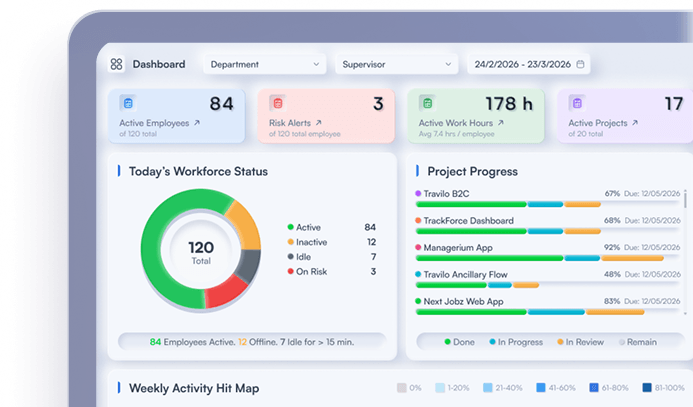
TrackForce brings live status, automatic time and activity records, productivity graphs, application insights, workflow visibility, team comparisons and centralized employee and device management into one system. Its verified productivity and workforce-management features help managers view patterns across hybrid teams while configurable controls determine what is measured.
The value is the connection between signals. If delivery slows, managers can review workload and time allocation. If activity changes, they can check whether project assignment, schedule or tools changed. The data starts a better investigation rather than replacing human judgement.
For formal reviews, TrackForce’s employee performance management software extends the record across longer periods so managers can use trends instead of relying on the most recent office week.
Frequently Asked Questions
Can productivity software tell whether remote employees are working?
It can record time and activity signals, but they do not prove performance. Add delivery, quality and context.
Should hybrid employees be tracked differently from office employees?
The core performance standards should be consistent for equivalent roles. Configuration may differ because schedules, devices, networks and security risks differ. Do not apply more intrusive tracking simply because someone works remotely.
Are screenshots necessary for hybrid productivity tracking?
Usually not for routine productivity management. They may be justified for a specific authorized need, but team trends, workload, time allocation and outcomes are generally more useful and less intrusive.
How often should managers review productivity data?
Use daily views for urgent coverage or operational exceptions, weekly views for workload and blockers, and monthly or quarterly trends for performance discussions. Avoid constant inspection.
What is the most important feature?
Context. The system should connect work signals with role, schedule, workload and outcomes so managers can understand why a pattern changed before acting on it.
Final Takeaway
Productivity tracking software for hybrid employees should make distributed work easier to manage—not make employees feel permanently watched. The most useful platform combines limited activity data with workload, delivery, quality and longer-term trends.
Begin with a defined business problem, collect the minimum information, give employees visibility and train managers to investigate context. When tracking is transparent and tied to real outcomes, it supports fairer coaching, better capacity decisions and stronger hybrid operations.
Similar blog you can explore
Key Performance Indicators for Employees: The 2026 Guide
TrackForce vs ActivTrak: Activity Data or Performance Evidence?
Employee Performance Metrics: The 9 That Predict Results
Start Your 30-Day
Free TrackForce Trial