TrackForce vs Time Doctor
for Performance Reviews
2026-10-04
•
Author: TrackForce Team
•
~1 min read
•
Updated October 4, 2026
- Quick Verdict: TrackForce or Time Doctor?
- TrackForce vs Time Doctor at a Glance
- 1. Which Product Solves the Review Problem?
- 2. Recency Bias and Historical Evidence
- 3. Activity Evidence Versus Performance Evidence
- 4. Employee Visibility and Review Trust
- 5. Screenshots and Detailed Monitoring
- 6. Where Time Doctor Is Stronger
- 7. Where TrackForce Is Stronger
- How to Test Both Products With One Review
- Which Time Doctor Alternative Should You Choose?
- Frequently Asked Questions
- —Is TrackForce a good Time Doctor alternative?
- —
- —Can Time Doctor be used for performance reviews?
- —
- —Does TrackForce replace an HR performance platform?
- —
- —Which tool is better for employee privacy?
- —
- —Which platform offers a longer trial?
- Final Verdict
Searching for Time Doctor alternatives usually begins with time tracking, screenshots and productivity reports. Those features do not answer the main review question:
Can the manager explain a rating with evidence from the full review period, and can the employee see and discuss that evidence?
Time Doctor is a mature time-tracking and workforce-analytics platform covering hours, attendance, projects, tasks, app use, screenshots, payroll and reports. Those records can inform an appraisal.
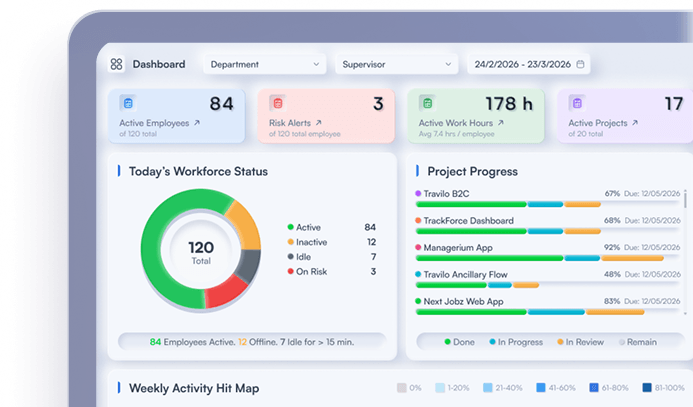
TrackForce starts from the review itself. It turns daily work data into multi-month trends and connects evidence to the rating. The distinction is whether the product supplies reports for another process or brings evidence into the review workflow.
This comparison uses information published by both vendors as of October 4, 2026. Features and packaging can change, so confirm the selected plan during a trial.
Quick Verdict: TrackForce or Time Doctor?
Choose TrackForce when the priority is evidence-based performance reviews: reviewing trends across months, attaching evidence to ratings, sharing the same view with employees and reducing recency bias.
Choose Time Doctor when the primary need is detailed time tracking, attendance, client or project hours, productivity reporting, payroll workflows and a broad integration ecosystem. Its data can support appraisals run in an HR system or existing management process.
Evaluate both when operations needs granular records while HR needs defensible review evidence. Run the same review scenario in each product.
TrackForce vs Time Doctor at a Glance
| Review requirement | TrackForce | Time Doctor |
| Automatic time and activity data | Yes | Yes |
| Website and application context | Yes | Yes |
| Task and project context | Yes | Yes |
| Multi-month performance trends | Central to the review workflow | Available through historical reports, subject to plan and retention |
| Evidence attached to a rating | Presented as a native TrackForce review capability | Public product pages focus on reports used as appraisal input |
| Employee sees their own evidence | Yes | Employees can see their own dashboard and permitted reports |
| Attendance and schedule reporting | Yes | Strong attendance, schedule, leave and time-approval reporting |
| Payroll and client-hour workflows | Not the primary review position | Stronger emphasis on payroll, billing and client access |
| Screenshots or screen records | Configurable | Configurable; screenshots can be blurred, adjusted or disabled |
| Advanced unusual-activity reporting | Risk and activity visibility within TrackForce’s monitoring suite | Premium reporting includes unusual-activity and keyboard/mouse anomaly signals |
| Formal appraisal workflow | Evidence and rating positioned together | Best treated as evidence feeding a separate appraisal process |
| Trial | 30 days, no credit card stated | 14-day Premium-feature trial stated |
The table reflects public vendor information, not a hands-on audit of every plan. Time Doctor’s official pricing and feature comparison shows that reporting depth, historical data and advanced capabilities vary by tier.
1. Which Product Solves the Review Problem?
A performance review needs:
- a defined period and agreed expectations;
- evidence covering output, quality and timeliness;
- an explanation for the rating;
- employee visibility and a chance to respond;
- a coaching action.
Time Doctor’s official guide explains how attendance, project activity and productivity patterns support appraisals. Its product is strongest as the measurement layer managers take into that conversation. See its guide to performance appraisals.
TrackForce’s employee performance management software starts with the review period. It is designed to show multi-month trends, attach evidence to a rating, and let the employee see the same trend. That reduces the gap between collecting information and explaining the final judgment.
2. Recency Bias and Historical Evidence
Managers often remember recent weeks better than earlier months. A strong finish can hide an inconsistent quarter, while one mistake can overshadow reliable work.
Both tools can preserve history, but buyers should test how easily a reviewer can use it.
Time Doctor offers date-filtered reports for hours, activity, projects, tasks, applications and attendance. Historical data periods vary by plan, and managers can assemble those reports for an appraisal.
TrackForce positions the review around the period, movement across months, and evidence supporting the rating. It fits organisations that want the review screen, not a spreadsheet, to explain the rating.
3. Activity Evidence Versus Performance Evidence
Neither hours nor active time proves valuable performance. A person can remain active while priorities stall, and a high performer can complete excellent work with fewer visible interactions.
Use four dimensions:
- Quantity: what relevant work was completed?
- Quality: was it correct and useful?
- Timeliness: did it arrive when needed?
- Efficiency: what time or cost did the result require?
The U.S. Office of Personnel Management uses these dimensions in its guidance on measuring performance.
Time Doctor contributes strong input evidence: hours, task allocation, attendance, idle time, app and website classifications, screenshots and reports. Its official productivity-reporting guide also cautions that visible activity and actual outcomes can differ.
TrackForce combines activity with tasks, projects, workload and longer-term trends. Its guide to employee performance metrics provides formulas and guardrails. Role-specific outcome and quality data are still necessary.
4. Employee Visibility and Review Trust
A defensible review should not reveal a hidden score for the first time at the meeting.
Time Doctor states that employees can see their own data, supporting self-correction and transparent conversations when permissions allow.
TrackForce makes shared evidence part of the review: employee and manager can inspect the same period and discuss what caused a change.
Whichever product you choose, document:
- what data contributes to reviews;
- which measures cannot be used alone;
- who can see individual records;
- how employees correct inaccurate data;
- what context must be checked before an adverse decision.
The UK Information Commissioner’s Office warns that analytics can make incorrect inferences and that monitoring data used in performance reviews must be accurate, fair and open to challenge. Its worker-monitoring guidance is a useful design reference, while local legal advice remains necessary.
5. Screenshots and Detailed Monitoring
Both products offer detailed monitoring capabilities, but screenshots should not become the review.
Time Doctor allows admins to control screenshot frequency, blur images or disable screenshots. Its documentation says screencasts can complement, but should not replace, performance review processes.
TrackForce includes configurable snapshots, screen records and deeper operational or security evidence in applicable setups. That can help investigate a defined event, but routine ratings should begin with trends, workload and role outcomes.
The right configuration is the least intrusive one that answers the business question. If delivery and quality records explain performance, opening a gallery of screenshots adds risk without improving the review.
6. Where Time Doctor Is Stronger
Time Doctor is likely the better fit when review evidence comes from a broader time-management operation:
- client and project hour tracking;
- attendance, schedules, leave and time approval;
- payroll-related workflows;
- offline and mobile time;
- client access to selected projects;
- 60-plus integrations;
- executive, meeting, software-cost or office-versus-remote reporting on applicable plans;
- enterprise API, SSO and provisioning requirements.
Its official reports documentation covers productivity, attendance and project allocation. For businesses billing by tracked hour, these records may matter more than a native appraisal screen.
7. Where TrackForce Is Stronger
TrackForce is likely the better choice among Time Doctor alternatives when review quality drives the purchase:
- multi-month evidence is placed at the start of the review;
- ratings can carry a visible reason;
- employees can see the trend used in the discussion;
- time, activity, tasks, projects and workload can be reviewed together;
- custom measurement controls define what enters the record;
- the same platform can support productivity and detailed operational investigation;
- a 30-day trial allows a longer evaluation cycle.
TrackForce does not replace every HRIS function. If another system handles goals, competencies, compensation and approvals, TrackForce can provide the work record behind those decisions.
For the wider difference between collection and interpretation, read workforce analytics vs employee monitoring. For a second competitor perspective, see TrackForce vs ActivTrak.
How to Test Both Products With One Review
Use the same employee, role and three- to six-month period.
- Define three role outcomes and one quality measure.
- Import or collect task, project and activity data.
- Find a month where performance changed.
- Ask each platform to show what changed and why.
- Create a rating with supporting evidence.
- Show the evidence to the employee.
- Record context, disagreement and the next coaching action.
- Export the completed record for HR.
Score manual steps, evidence clarity and whether the employee can understand the conclusion.
Which Time Doctor Alternative Should You Choose?
Choose Time Doctor when time, attendance, payroll, billing and operational reporting are the main system of record, and performance reviews will remain in another process.
Choose TrackForce when the central problem is review credibility: ratings rely on memory, evidence is scattered, employees cannot see the basis and managers need trends connected to work context.
Review the live TrackForce pricing and 30-day trial, then run one representative review before committing. Configure only the data needed for that review and confirm current Time Doctor plan limits directly with its sales or trial environment.
Frequently Asked Questions
Is TrackForce a good Time Doctor alternative?
Yes, particularly for organisations that want work data converted into evidence for performance reviews. Time Doctor may be stronger when time tracking, payroll, client billing and integrations are the main priorities.
Can Time Doctor be used for performance reviews?
Yes. Its time, attendance, task, project, activity and productivity reports can support appraisal conversations. Based on its public product pages, it is best treated as an evidence source feeding a separate formal review process.
Does TrackForce replace an HR performance platform?
Not necessarily. TrackForce supplies objective work evidence and performance trends. An existing HR platform may still manage goals, competencies, compensation, approvals and wider employee records.
Which tool is better for employee privacy?
Privacy depends on configuration and management practice. Both offer configurable visibility. Collect only necessary data, explain its purpose, restrict access, allow employees to see or challenge records and avoid using screenshots or activity scores as standalone ratings.
Which platform offers a longer trial?
TrackForce currently states a 30-day trial with no credit card required. Time Doctor currently states a 14-day trial with access to Premium features. Verify both offers before purchasing.
Final Verdict
Time Doctor provides a broad, mature set of records that can strengthen performance appraisals, especially where hours, attendance, projects and billing already drive management decisions.
TrackForce is the stronger fit when the review itself is the problem. It is designed to carry evidence across the review period, connect that evidence to a rating and make the basis visible to the employee.
The right choice depends on where you want the workflow to end: at a productivity report, or at a performance review that can explain its conclusion.
Similar blog you can explore
How to Measure Employee Productivity Without Micromanaging
Productivity Tracking Software for Hybrid Employees
Key Performance Indicators for Employees: The 2026 Guide
Start Your 30-Day
Free TrackForce Trial