TrackForce vs ActivTrak: Activity
Data or Performance Evidence?
2026-09-27
•
Author: TrackForce Team
•
~1 min read
•
Updated September 27, 2026
- Quick Verdict: TrackForce or ActivTrak?
- TrackForce vs ActivTrak at a Glance
- What ActivTrak Measures Well
- Where ActivTrak’s Evidence Model Stops
- How TrackForce Approaches Performance Evidence
- Performance Evidence Does Not Mean Constant Surveillance
- ActivTrak’s Privacy-First Defaults
- Activity Data vs Performance Evidence
- —Question: Why did the project miss its deadline?
- —
- Reporting and Management Use Cases
- —ActivTrak is stronger when managers need to:
- —TrackForce is stronger when managers need to:
- Pricing and Contract Considerations
- Which ActivTrak Alternative Is Right for Your Team?
- —Choose TrackForce if:
- —Stay with or choose ActivTrak if:
- —Evaluate both if:
- A Fair Demo Test for Both Platforms
- Frequently Asked Questions
- —Is TrackForce a good ActivTrak alternative?
- —What is the main difference between TrackForce and ActivTrak?
- —Does ActivTrak take screenshots?
- —Does ActivTrak record keystrokes?
- —Which platform is better for privacy?
- —Which product is better for project performance?
- Final Verdict
Searching for ActivTrak alternatives usually starts with a feature checklist: time tracking, application usage, productivity reports, screenshots and workforce analytics.
That checklist does not resolve the real buying decision.
The more useful question is: what evidence does your management team need?
ActivTrak is built primarily around workforce analytics. It converts digital activity into patterns involving productivity, utilization, workload, schedules, technology use and organizational capacity.
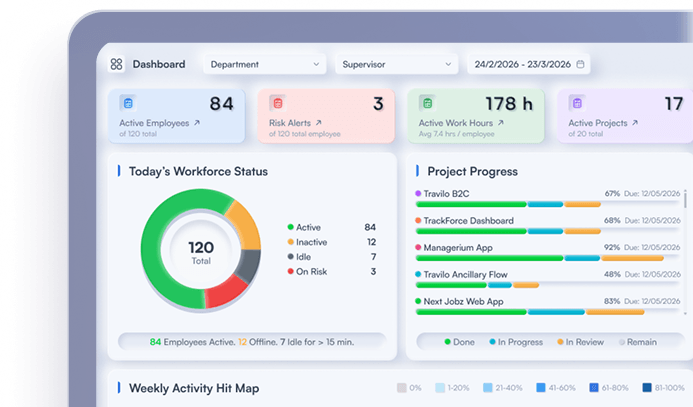
TrackForce combines activity and time data with tasks, projects, workload, delivery progress and, where configured, more detailed monitoring evidence. Its approach is designed for managers who need to move from “How was time spent?” to “What work moved, what stalled and what evidence explains the difference?”
Both platforms collect work-related activity. The distinction is how that activity is organized, how deep managers can investigate and what decision the resulting data is expected to support.
Quick Verdict: TrackForce or ActivTrak?
Choose ActivTrak when your priority is:
- Organization- or department-level workforce analytics
- Capacity and headcount planning
- Productivity benchmarking
- Schedule and location adherence
- Technology utilization
- Aggregated or anonymized reporting
- Privacy-oriented monitoring defaults
- Measuring AI application use and adoption
Choose TrackForce when your priority is:
- Connecting time and activity to tasks and projects
- Reviewing workload alongside delivery progress
- Investigating specific operational events
- Project-based time and cost visibility
- Configurable screenshots or screen records
- File-transfer, search and device evidence
- Role-based operational reporting
- Combining performance and security visibility in one system
Neither product is automatically better for every team. ActivTrak is likely the stronger fit when the desired output is broad workforce intelligence. TrackForce is likely the stronger fit when managers need activity data connected to concrete work and optional evidence behind a specific event.
TrackForce vs ActivTrak at a Glance
| Area | TrackForce | ActivTrak |
| Primary operating lens | Work activity connected to tasks, projects, workload and delivery | Workforce activity analyzed for productivity, utilization and planning |
| Time and activity tracking | Yes | Yes |
| Application and website usage | Yes | Yes |
| Real-time visibility | Yes | Yes |
| Task and project context | Built into TrackForce’s stated workforce intelligence workflow | Available through platform capabilities and external integrations, depending on plan and setup |
| Workload analysis | Employee, team and project-oriented workload reporting | Utilization, capacity and workload-balance analytics |
| Screenshots | Configurable monitoring capability | Off by default; requires applicable Screen Details access and alarm configuration |
| Screen recording | Listed in TrackForce’s monitoring suite | ActivTrak focuses on activity analytics rather than continuous video monitoring |
| Keystroke logging | Available as a configurable TrackForce monitoring parameter | ActivTrak explicitly states that it does not collect keystroke logs |
| File and device evidence | File transfers, device management and related activity records | Focused more on digital work activity, application use and workforce analytics |
| Privacy model | Monitoring controls should be configured by role and business purpose | Privacy-first defaults, anonymization options and restricted sensitive details |
| Workforce planning | Workload, tasks, projects and delivery visibility | Strong capacity, utilization, headcount and productivity optimization |
| Best fit | Operations-heavy teams needing traceable performance evidence | Organizations needing broad workforce analytics and planning |
The table reflects information published by both vendors at the time of writing. Buyers should verify plan availability and feature packaging before purchase.
What ActivTrak Measures Well
ActivTrak describes itself as a workforce analytics and intelligence platform that analyzes digital activity data to explain how work happens.
Its official workforce analytics overview lists capabilities such as:
- Automatic time and activity tracking
- Productivity trends
- Real-time workforce visibility
- Daily work metrics
- Schedule adherence
- Location and return-to-office adherence
- Application and website usage
- Workload balance
- Capacity and headcount planning
- Coaching opportunities
- Technology investment analysis
- AI adoption and productivity-impact measurement
This makes ActivTrak especially relevant for HR, operations, finance and executive teams asking organization-wide questions:
- Which departments appear over capacity?
- Where is underutilized capacity available?
- Are work schedules aligned with actual activity?
- How do work patterns differ between remote and office locations?
- Which applications are widely used?
- Is technology spending aligned with adoption?
- Are employees working unusually long hours?
- How is AI usage affecting work patterns?
ActivTrak also supports integrations with systems such as Microsoft 365, Salesforce, Zendesk, Monday.com and Jira. Its ActivConnect offering can make platform data available to external analytics and business systems.
Therefore, describing ActivTrak as “only an activity tracker” would be inaccurate. It uses activity as the base layer for broader workforce analytics and can combine that information with external business data.
Where ActivTrak’s Evidence Model Stops
ActivTrak’s primary strength is analyzing patterns at scale. That may not be the same as building a detailed evidence chain around one project, employee action or operational incident.
Consider a delivery problem.
An analytics dashboard may show:
- Working hours increased
- Focus time declined
- Communication time increased
- Application switching rose
- The team appears over capacity
Those signals are useful. They tell the manager where to investigate.
But an operations manager may need a second layer:
- Which assigned task stopped moving?
- Which project consumed the additional hours?
- Was the employee waiting for approval?
- Did a file move unexpectedly?
- What happened immediately before the issue?
- Which work item was completed despite lower digital activity?
- Does the employee’s recorded activity support or contradict the project status?
ActivTrak can add business context through integrations and configurable analytics. However, organizations should confirm whether the required connection between activity, tasks, projects and detailed evidence is available in the selected package and workflow.
How TrackForce Approaches Performance Evidence
TrackForce begins with many of the same signals: working hours, active and idle time, application use, website activity and attendance.
The difference is the platform’s stated focus on connecting those signals to:
- Tasks
- Projects
- Workload
- Project costs
- Delivery progress
- Daily and monthly reports
- Employee and team comparisons
- Risk and operational events
TrackForce’s guide to employee activity monitoring software explains the underlying principle: activity data becomes useful when it sits beside the work that the time was expected to produce.
For example, high activity with little task progress may indicate:
- A blocked workflow
- Excessive application switching
- Rework
- Unclear priorities
- An overloaded employee
- Work being performed against the wrong assignment
Lower activity with strong delivery may indicate efficient work—not poor performance.
This is why TrackForce frames its platform around evidence rather than treating active minutes as an automatic productivity score.
Performance Evidence Does Not Mean Constant Surveillance
Detailed monitoring can create useful operational evidence, but collecting more data is not automatically better.
TrackForce documentation describes configurable capabilities including:
- Screenshots
- Screen records
- Application and website tracking
- File-transfer monitoring
- Search activity
- Device records
- Keystroke settings
- Console-command records
- Email and messaging activity
- Role-based permissions
These tools should not all be enabled for every employee.
A reasonable monitoring setup may use:
- Time, tasks and project progress for most knowledge workers
- Application usage for workflow analysis
- Workload reports for managers
- Screenshots only for defined operational or compliance cases
- File-transfer evidence for roles handling sensitive data
- More detailed controls only where a documented risk justifies them
TrackForce’s feature overview emphasizes configurable monitoring, centralized user management and role-based access. The organization remains responsible for selecting controls that are necessary, proportionate and transparent.
ActivTrak’s Privacy-First Defaults
Privacy is one of ActivTrak’s clearest differentiators.
According to ActivTrak’s official explanation of what data it collects:
- It does not collect keystroke logs.
- It does not collect webcam video.
- Screenshots and screen views are disabled by default.
- Title bars and URL subpages are excluded by default.
- Optional hashing is available.
- Reports can use anonymized and aggregated data.
- Access can be restricted by role and group.
ActivTrak does offer screenshots through its Screen Details capability. However, its screenshot documentation explains that screenshots are triggered through configured alarms, remain off by default and should be used selectively.
This approach suits organizations that want productivity analytics while deliberately limiting more intrusive forms of monitoring.
Activity Data vs Performance Evidence
The difference becomes clearer when the same workplace question is examined through both models.
Question: Why did the project miss its deadline?
An activity-data analysis may show:
- The team worked longer hours.
- Meeting time increased.
- Focused activity decreased.
- Several employees appeared overloaded.
- One business application dominated the workday.
A performance-evidence analysis adds:
- Which tasks missed their due dates
- Which assignments were blocked
- Who owned each work item
- How much time was associated with the project
- Whether completed work required rework
- Which operational events need investigation
Both views matter.
Activity data identifies the pattern. Performance evidence connects the pattern to the work and supports a specific management response.
Reporting and Management Use Cases
ActivTrak is stronger when managers need to:
- Benchmark teams or departments
- Find unused workforce capacity
- Analyze remote and office work patterns
- Support headcount planning
- Review technology adoption
- Identify possible burnout signals
- Measure the impact of AI tools
- Share privacy-conscious aggregated analytics
TrackForce is stronger when managers need to:
- Connect hours to tasks or projects
- Review project movement and workload together
- Identify stalled assignments
- Track project-related costs
- Investigate a defined operational event
- Review user and device activity
- Maintain more detailed security evidence
- Combine employee, project and monitoring reports
Before choosing either product, define the decision the report must support. A dashboard is only useful if the manager knows what to do after reading it.
Pricing and Contract Considerations
ActivTrak’s official pricing page currently lists:
- A free plan for up to three workers with limited functionality
- Work Activity Tracking at a published $10 per worker per month
- Workforce Management at $15 per worker per month
- Productivity Optimization at $17 per worker per month
- Annual contracts for paid plans
- Separate options or add-ons for Screen Details, API access and extended data history
Those prices and packages can change, so buyers should confirm the current quote.
TrackForce offers monthly and yearly plan selection and advertises a 30-day free trial. Its pricing page says core monitoring, productivity and security functions are included without hidden feature lock-ins, although buyers should still confirm which monitoring and reporting modules are available in the intended plan.
Review current TrackForce pricing and plan information before comparing total cost.
Cost comparisons should include more than the base seat price:
- Required add-ons
- API access
- Data-retention period
- Support requirements
- Implementation work
- Reporting needs
- Number of monitored users
- Contract duration
- Time required to connect activity with operational outcomes
A cheaper platform can become more expensive if managers must export data and rebuild the required evidence manually.
Which ActivTrak Alternative Is Right for Your Team?
Choose TrackForce if:
- Tasks and projects need to sit beside activity data.
- Managers require individual and team-level operational evidence.
- You need configurable screen, file, device or risk monitoring.
- Project time and workload must be reviewed together.
- One platform should support productivity and security investigations.
- Your organization wants a 30-day evaluation period.
Stay with or choose ActivTrak if:
- Department-level workforce analytics is the priority.
- Privacy-first defaults are essential.
- Capacity and headcount planning matter more than detailed monitoring.
- You need mature productivity benchmarking.
- AI adoption and technology-use analytics are important.
- Your reporting model depends on aggregated or anonymized insights.
- Existing integrations already provide sufficient business-outcome context.
Evaluate both if:
- You manage a large hybrid workforce with operational teams.
- HR wants aggregated insights while operations wants employee-level evidence.
- Privacy requirements differ by role or country.
- You are unsure whether integrations will provide enough task context.
- The final decision depends on real reporting workflows rather than a feature checklist.
A Fair Demo Test for Both Platforms
Give both vendors the same scenario:
A ten-person service team has worked longer hours for two weeks, but a client delivery is late. Two employees appear highly active, one shows limited activity and three tasks have not moved.
Ask each vendor to show:
- How it identifies the workload problem
- How it connects activity to the delayed work
- How it distinguishes overload from low effort
- Which employee and team views are available
- How managers see task or project context
- What detailed evidence can be reviewed
- How private or sensitive information is protected
- Which capabilities require an add-on
- How data access is restricted by role
- What report a manager receives at the end
The better product is the one that answers your management question with the least manual reconstruction and an acceptable level of employee-data collection.
Frequently Asked Questions
Is TrackForce a good ActivTrak alternative?
TrackForce is a strong ActivTrak alternative for organizations that need time and activity data connected to tasks, projects, workload and more detailed operational evidence. ActivTrak may remain stronger for broad workforce analytics, capacity planning and privacy-first aggregated reporting.
What is the main difference between TrackForce and ActivTrak?
ActivTrak primarily turns digital work activity into workforce analytics. TrackForce combines workforce activity with tasks, projects, workload, delivery progress and configurable detailed monitoring.
Does ActivTrak take screenshots?
Screenshots are available through applicable ActivTrak Screen Details functionality. They are alarm-triggered and disabled by default.
Does ActivTrak record keystrokes?
ActivTrak states that it does not collect keystroke logs. TrackForce offers configurable keystroke-related monitoring for organizations that require that level of evidence and can justify its use.
Which platform is better for privacy?
ActivTrak has more privacy-restrictive defaults, including disabled screenshots and options for aggregated or anonymized analysis. TrackForce offers configurable monitoring and role-based access, but organizations must decide which detailed capabilities to enable.
Which product is better for project performance?
TrackForce is designed to place time, activity, task progress, project movement and workload together. ActivTrak can add business context through integrations, so buyers should test whether the chosen ActivTrak plan and integrations provide the required project-level evidence.
Final Verdict
The TrackForce vs ActivTrak decision is not simply monitoring versus analytics. Both platforms provide workforce visibility, and both can support better management when implemented transparently.
The clearest distinction is the expected output.
ActivTrak is designed to help organizations interpret workforce activity at scale—productivity trends, utilization, capacity, schedules, technology use and organizational patterns.
TrackForce is designed to connect work activity to operational execution—tasks, projects, workload, delivery and, where necessary, more detailed evidence.
If your managers mainly need to understand how the workforce operates, ActivTrak deserves serious consideration.
If they need to understand what happened to a particular piece of work and why, explore TrackForce and test the platform using your own projects, roles and reporting requirements.
Similar blog you can explore
Employee Performance Metrics: The 9 That Predict Results
How to Improve Work Performance: 12 Changes That Hold
Workforce Analytics vs Employee Monitoring: Where the Line Sits
Start Your 30-Day
Free TrackForce Trial