Performance Improvement Plans That
Actually Improve Performance
2026-10-25
•
Author:
•
~1 min read
•
Updated October 25, 2026
- What a Performance Improvement Plan Is, and What It Is Not
- When to Use a PIP
- What Every Performance Improvement Plan Should Include
- How Long Should a PIP Last?
- Running the PIP Week by Week
- Why Most PIPs Fail
- At the End of the PIP: Three Outcomes
- Regional Rules: UK, UAE and South Africa
- A Simple PIP Template
- Where TrackForce Fits
- Frequently Asked Questions
- —What is a performance improvement plan?
- —How long does a performance improvement plan last?
- —Does a PIP mean an employee will be dismissed?
- —What should a performance improvement plan include?
- —Can a performance improvement plan be extended?
A performance improvement plan (PIP) is a written plan that names a performance gap, sets specific goals, lists the support on offer, and fixes a review date. It works when goals are measurable, support is real, and progress is checked weekly. Used only as a paper trail for a decision already made, it fails.
Many PIPs fail for the same reasons: vague goals, no real help, and evidence pulled from memory at the end. This guide covers what a fair PIP includes, how long it should run, how to manage it week by week, and the rules that apply in the UK, the UAE and South Africa. TrackForce supplies the evidence a PIP depends on through its performance appraisal software and employee performance management software.
What a Performance Improvement Plan Is, and What It Is Not
A PIP is a structured period of support with a clear target at the end. ACAS guidance on capability procedures describes it as a plan that sets out specific objectives, a reasonable timeline and any further support or training, talked through with the employee and shared in writing.
A PIP is not:
- a first response to a problem the employee has never heard about
- a disciplinary warning for misconduct
- a formality before a dismissal that has already been decided
When a PIP is run as a formality, the employee usually sees it, and the plan produces neither improvement nor a fair record.
When to Use a PIP
A PIP comes after informal steps, not instead of them. ACAS sets the order: understand why performance has dropped, offer coaching, mentoring or training, and use a PIP if informal steps have not worked.
Before starting one, check four things:
- The problem is capability, not conduct. A person who can do the job but chooses not to is a conduct issue, handled differently.
- The employee knew the standard. If the expectation was never clear, the fix is a clear expectation, not a PIP.
- The basics are in place. ACAS says employers must provide "adequate resources" for the job.
- Health has been considered. If a condition or disability lies behind the drop, reasonable adjustments come first.
Many problems end at the informal stage. The guide on how to improve work performance covers the changes that often make a formal plan unnecessary.
What Every Performance Improvement Plan Should Include
The US Office of Personnel Management's PIP quick guide lists the core parts of a written plan: the unacceptable performance with specific examples, the expectations and success criteria, the support provided, the duration, and the consequences of not improving.
| Element | What to write | Example |
| The gap | The specific shortfall, with dated examples | 4 of 10 support tickets in September missed the 24-hour response target |
| The standard | The measurable level expected by the end | 90% of tickets answered within 24 hours, over four weeks |
| Support | Training, coaching, tools or workload changes | Weekly coaching session, queue rebalanced to a fair share |
| Check-ins | Dates and format of progress reviews | Every Friday, 20 minutes, written note |
| Measurement | Where the evidence comes from | Ticket system report and workload status, reviewed weekly |
| Duration | Start date, end date and final review date | 2 November to 11 December |
| Outcome | What happens if the standard is or is not met | Plan closes, is extended, or moves to the formal capability stage |
Each goal should be measurable without argument. The guide to employee performance metrics covers which measures predict results and which only look busy.
How Long Should a PIP Last?
There is no single legal length. OPM gives a typical duration of 30 business days. ACAS asks for "a reasonable timeline," and South Africa's 2025 Code of Good Practice: Dismissal asks for "a reasonable period of time for improvement" without fixing a number.
A practical test: the plan should cover enough cycles of the work for improvement to show. A role with daily output can show a trend in four to six weeks. A role built around monthly projects or sales cycles may need two or three months. A plan too short to show a trend measures luck, not ability.
Running the PIP Week by Week
The plan is only as good as the weeks inside it.
- Start with a baseline. Record where performance stands on day one, using the same measures the plan will judge.
- Check in weekly. A short, written check-in each week shows progress early and shows the support was real.
- Adjust the support, not the target. If the help is not working, change the help. Moving the target midway makes the result hard to defend.
- Record both sides. Note what the employee says about blockers, as well as what the manager sees.
Why Most PIPs Fail
| Failure | What it looks like | Fix |
| Vague goals | "Improve communication" | A measurable standard with a number and a date |
| No real support | Coaching promised, never scheduled | Support dates written into the plan |
| Decision already made | Manager starts recruiting a replacement | Run the plan only if improvement is a genuine option |
| Evidence from memory | Final review based on the last two weeks | Weekly notes and data across the whole plan |
| Targets ignore workload | Same target while workload doubles | Workload recorded beside output |
| No check-ins | Nothing happens until the final meeting | Fixed weekly review in the calendar |
Two of these are evidence problems. The guide to performance review bias explains why end-of-period judgements drift toward recent events, and the guide to key performance indicators for employees shows how to pick measures that account for workload.
At the End of the PIP: Three Outcomes
- Standard met. Close the plan in writing and note it on the record. Keep the regular check-ins going for a few weeks.
- Clear progress, standard not yet met. Extend the plan. OPM notes a supervisor may extend at their discretion, and Acas lists extending the timeline as an option where there is some improvement.
- No real improvement. Move to the formal capability stage under local law. Acas is clear that dismissal "should be a last resort."
Whichever outcome applies, the final review should read like any good performance review: specific, evidenced and covering the whole period. The guide on how to write a performance review sets out the structure.
Regional Rules: UK, UAE and South Africa
A PIP is good practice everywhere, but the formal steps after it differ by country.
| Country | What the law expects | What it means for a PIP |
| United Kingdom | The Acas Code of Practice covers poor performance, and tribunals can adjust awards by up to 25 per cent for unreasonable failure to follow it. From 1 January 2027, the unfair dismissal qualifying period falls from two years to six months (Forbes Solicitors) | A documented PIP is the clearest proof of a fair capability process, for almost every employee past six months |
| United Arab Emirates | Article 44 of the Labour Law allows dismissal without notice for failure to perform main contract duties only after a written investigation and two warnings of dismissal (DDA summary) | The PIP records the duties, the shortfall and the support. Warnings and the investigation must still follow the law |
| South Africa | The 2025 Code of Good Practice: Dismissal expects appropriate evaluation, instruction, training, guidance or counselling, a reasonable period to improve, and a chance to respond (Vermeulen Attorneys) | The Code does not require a formal PIP, but a PIP is a practical way to show each step happened |
A Simple PIP Template
| Field | What to fill in |
| Employee, role, manager | Names and job title |
| Start date, end date, final review date | Three dates |
| Performance gap | The shortfall, with two or three dated examples |
| Expected standard | One to three measurable goals, each with a number and a date |
| Support provided | Training, coaching, tools, workload changes, with dates |
| Check-in schedule | Day, time, and format of weekly reviews |
| Evidence sources | Reports and data used to measure progress |
| Employee comments | Space for the employee's view and any blockers |
| Possible outcomes | Close, extend, or move to the formal stage |
| Signatures | Employee and manager, with date |
Where TrackForce Fits
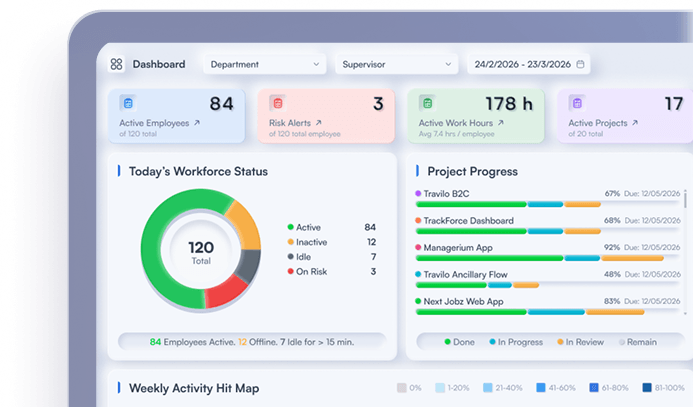
A PIP lives or dies on evidence, and that evidence has to cover the whole plan. TrackForce records working hours, task efficiency, workload status, and project progress for each person, so the day-one baseline, the weekly check-ins, and the final review all draw on the same data.
Workload sits beside output, which answers the most common challenge to a PIP: whether the target was fair given what the person was carrying. That is why TrackForce describes itself as performance appraisal software that opens with evidence, not a blank form.
TrackForce supports the plan. It does not replace the conversation, the support, or the manager's judgment. TrackForce offers a free 30-day trial to test it with one team.
Frequently Asked Questions
What is a performance improvement plan?
A performance improvement plan is a written plan that names a specific performance gap, sets measurable goals, lists the support an employee will receive and fixes a period and review date for improvement. It follows informal support, not replaces it.
How long does a performance improvement plan last?
There is no single legal length. The US Office of Personnel Management gives a typical duration of 30 business days, while Acas asks for a reasonable timeline. The plan should cover enough cycles of the work for a real trend to show.
Does a PIP mean an employee will be dismissed?
No. A fair PIP has three possible outcomes: the plan closes because the standard is met, it is extended because progress is clear, or it moves to a formal capability stage. Dismissal should be a last resort.
What should a performance improvement plan include?
The specific performance gap with examples, the expected standard, the support provided, the check-in schedule, how progress is measured, the start and end dates, and the possible outcomes. The employee should receive a written copy.
Can a performance improvement plan be extended?
Yes. Where an employee shows clear progress but has not yet met the standard, extending the plan is often the fairer step. Both Acas and the US Office of Personnel Management treat extension as an option.
This guide describes general practice and is not legal advice. Take advice from an employment specialist in the relevant country before formal action.
Similar blog you can explore
How to Increase Employee Productivity: A Manager's Playbook
Lattice vs 15Five vs TrackForce: Process, Opinion or Evidence?
Employee Performance Management in South Africa: Poor Performance and Fair Process
Start Your 30-Day
Free TrackForce Trial