How to Increase Employee
Productivity: A Manager's Playbook
2026-11-03
•
Author: TrackForce Team
•
~1 min read
•
Updated November 3, 2026
- Quick Answer: How Can Managers Increase Employee Productivity?
- What Employee Productivity Actually Means
- How to Increase Employee Productivity: Diagnose First
- 1. Define Valuable Output for Every Role
- 2. Establish a Balanced Baseline
- 3. Reduce Competing Priorities
- 4. Remove Recurring Workflow Blockers
- 5. Protect Focus and Reduce Switching
- 6. Balance Workload and Improve the Tools
- 7. Give Feedback While It Can Still Help
- 8. Review Trends and Run Small Experiments
- A 30-Day Manager Playbook
- Common Productivity Mistakes Managers Should Avoid
- —Measuring Busyness
- —Increasing Targets Without Removing Friction
- —Comparing Different Roles With One Score
- —Ignoring Employee Context
- —Rewarding Unsustainable Hours
- How TrackForce Supports Employee Productivity
- How to Increase Employee Productivity Sustainably
- Frequently Asked Questions
- —What is the fastest way to increase employee productivity?
- —How can managers improve employee productivity?
- —Which metrics should managers track?
- —Can employee monitoring increase productivity?
- —How long does productivity improvement take?
- Editorial Verification Notes
Managers often try to improve productivity by asking people to work faster. That usually creates more visible activity, not more valuable output. Messages increase, calendars fill and employees spend longer online while deadlines, quality and customer outcomes barely move.
Learning how to increase employee productivity starts with a different question: what prevents capable people from completing valuable work at a sustainable rate?
The answer may be unclear priorities, repeated interruptions, overloaded employees, missing information, slow approvals or weak feedback. A manager's job is to find that constraint and improve the work system around it.
This playbook gives managers eight actions and a 30-day plan. It applies to office, remote and hybrid teams, but each measure should reflect the role and applicable requirements.
Quick Answer: How Can Managers Increase Employee Productivity?
To increase employee productivity:
- Define the valuable output each role should produce.
- Establish a balanced baseline before changing targets.
- Limit competing priorities.
- Remove recurring workflow blockers.
- Protect uninterrupted focus time.
- Balance workload and improve access to tools.
- Give specific feedback and practical coaching.
- Review trends, keep what works and stop what does not.
The goal is not maximum activity. It is consistent output at the expected quality without creating unsustainable workload.
What Employee Productivity Actually Means
A basic productivity formula is:
Productivity = Useful output divided by resources used
The formula is simple, but “useful output” varies by role. A support team may measure resolved cases and customer satisfaction. An operations team may use completed orders, accuracy and cycle time. A creative team may track accepted deliverables, deadlines and avoidable revisions.
Hours, active time and application use are inputs or context. They do not prove that the work was correct, valuable or complete.
The U.S. Office of Personnel Management recommends clear, realistic and measurable standards, commonly covering quality, quantity, timeliness and cost-effectiveness. That is a stronger foundation than one universal productivity score.
How to Increase Employee Productivity: Diagnose First
Before deciding how to improve employee productivity, identify where work slows down. Review the previous four to eight weeks and ask:
- Are expected outcomes clear?
- Which commitments were missed?
- Did quality or rework change?
- Where does work wait for approval or information?
- Is workload concentrated on a few people?
- Are meetings and messages fragmenting focus?
- Do employees have the skills and tools required?
- Which problems affect the whole team rather than one person?
Compare task, output, quality, workload and activity evidence. Then speak with employees. Data may show that cycle time increased, but the people doing the work can explain whether the cause was overload, a new system, unclear requirements or another dependency.
TrackForce's guide to measuring employee productivity without micromanaging explains how to use activity as diagnostic context instead of a verdict.
1. Define Valuable Output for Every Role
“Be more productive” is not an actionable expectation. Translate it into results an employee can understand and influence.
For each role, define:
- the main output;
- the required quality;
- the expected deadline or service level;
- important constraints; and
- the customer or business impact.
For example, replace “process more applications” with “complete assigned applications within two working days while maintaining the agreed accuracy threshold.” The employee now understands both speed and quality.
The CIPD performance management guidance notes that employees need clear expectations, resources and support, and that objectives should reflect the nature of the work. Complex work may require learning or behavioural goals instead of rigid output targets.
2. Establish a Balanced Baseline
Do not set a 20 percent improvement target before measuring current performance. Build a baseline using three to five relevant indicators across several weeks.
| Dimension | Example measure | Guardrail |
| Output | Cases, orders or milestones completed | Weight complexity where needed |
| Quality | Accuracy, first-pass acceptance or rework | Agree on the standard first |
| Timeliness | On-time delivery, SLA or cycle time | Record changed scope and dependencies |
| Workload | Work in progress, overtime or assigned capacity | Do not treat overload as low effort |
| Impact | Customer satisfaction, resolution or business result | Account for shared outcomes |
TrackForce's guide to employee performance metrics provides formulas and limitations for a balanced scorecard.
3. Reduce Competing Priorities
Employees cannot focus when every request is urgent. Managers should define one critical outcome, two supporting priorities and a short queue of lower-value work for each day or week.
Also clarify who can change the order. If several stakeholders assign work independently, the employee spends time negotiating priorities instead of completing them.
Use a simple weekly conversation:
- What must be completed?
- What can wait?
- What is blocked?
- What changed since the plan was agreed?
This creates focus without taking control of every working minute.
4. Remove Recurring Workflow Blockers
One repeated process problem can waste more time than an individual performance gap. Common blockers include delayed approvals, missing access, duplicate data entry, unclear ownership, unreliable software and information spread across several locations.
Ask every team member: “What slowed you down more than once this week?” Record the answer, frequency and time lost. Fix the highest-cost blocker first.
If several employees slow down after the same change, investigate the process first. Managers learning how to increase employee productivity must redesign work, not only coach people.
5. Protect Focus and Reduce Switching
Complex work needs uninterrupted attention. Constant meetings, notifications and task switching increase restart time and make errors more likely.
Managers can protect focus by:
- creating meeting-free blocks;
- defining reasonable response expectations;
- using asynchronous updates for routine status;
- grouping similar administrative work;
- inviting only necessary meeting participants; and
- documenting decisions and owners.
Focus time should match the job. A service team may need shorter protected blocks than a developer, analyst or writer. The principle is to design concentration around the work, not force one schedule on everyone.
6. Balance Workload and Improve the Tools
Low productivity may mean too much work, too little meaningful work or the wrong work assigned to the wrong person. Review assigned tasks, work in progress, complexity, overtime, dependencies and rework together.
Move tasks before deadlines fail. Simplify unnecessary approval stages. Provide reliable equipment, current instructions and access to the systems employees need.
The employee task tracking guide explains why raw completion counts need workload, quality, blocked time and complexity context.
7. Give Feedback While It Can Still Help
Annual feedback is too late for a problem that began months earlier. Give feedback close to the event and make it specific.
Use four parts:
- Observation: What happened?
- Impact: Why did it matter?
- Expectation: What should happen next time?
- Support: What does the employee need?
For example: “The project risk was identified on Tuesday but shared on Friday, which reduced the team's response time. Next time, flag delivery risks within one working day. Do you need a clearer escalation route?”
Feedback should also identify practices worth repeating. Recognition is more useful when it names the behaviour and result rather than offering general praise.
Acas performance-management guidance recommends regular feedback and check-ins alongside formal reviews, with objectives that are fair and reflect the employee's usual tasks and workload.
8. Review Trends and Run Small Experiments
One productive day or missed deadline does not establish a pattern. Review several weeks, compare multiple measures and let employees add context.
Treat each improvement as an experiment. For example, introduce two weekly focus blocks for one month, then compare cycle time, quality and employee feedback with the baseline. Keep the change if it helps. Adjust or stop it if it creates more administration than value.
This is the answer to how to increase employee productivity sustainably: improve one constraint, measure the result and repeat.
A 30-Day Manager Playbook
| Week | Manager actions | Evidence to review |
| 1: Baseline | Define outputs, quality and priorities. Map workload and blockers. | Delivery, quality, cycle time and employee input |
| 2: Redesign | Remove one recurring blocker. Protect focus. Clarify task ownership. | Waiting time, interruptions and work in progress |
| 3: Coach | Give specific feedback. Rebalance work. Provide missing support. | Trend changes, rework and workload distribution |
| 4: Evaluate | Compare with baseline. Ask what helped. Keep only useful changes. | Outcomes, quality, sustainability and team feedback |
Do not introduce eight new policies at once. A narrow test makes it easier to identify which change produced the result.
Common Productivity Mistakes Managers Should Avoid
Measuring Busyness
Clicks, messages and hours may explain work patterns, but they do not prove output or quality.
Increasing Targets Without Removing Friction
A higher quota does not fix delayed approvals, broken tools or unclear requirements.
Comparing Different Roles With One Score
Measures should reflect responsibilities, complexity and outcomes employees can reasonably influence.
Ignoring Employee Context
Data can show what changed, but employees may know why. Investigate before making a judgement.
Rewarding Unsustainable Hours
Repeated overtime may indicate overload or a broken process. Sustainable productivity includes recovery and realistic capacity.
For a wider set of practical improvements, see TrackForce's guide on how to improve work performance.
How TrackForce Supports Employee Productivity
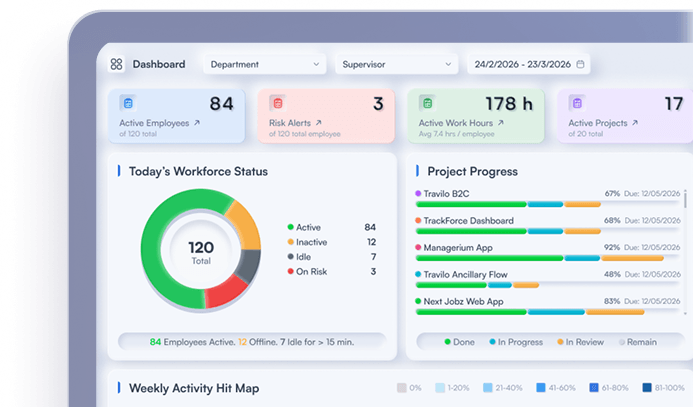
TrackForce brings working hours, active and idle time, application and website use, tasks, workload and productivity trends into one view. Managers can use that visibility to identify focus patterns, uneven allocation and workflow friction without relying only on status messages or memory.
The data should start a conversation, not automatically decide performance. Combine activity and time signals with completed work, quality, deadlines and business results. Explain what is collected, why it is needed, who can access it and how employees can correct inaccurate information.
Explore TrackForce employee productivity software and test the approach with one defined team, transparent measurement rules and a baseline that both managers and employees understand.
How to Increase Employee Productivity Sustainably
Managers who understand how to increase employee productivity do not chase constant activity. They define valuable work, remove friction, protect focus, balance capacity and use evidence to improve decisions.
Start with one team and one constraint. Establish the baseline, make a practical change and review the outcome after 30 days. Sustainable improvement grows from a better work system, not permanent pressure.
Frequently Asked Questions
What is the fastest way to increase employee productivity?
Start by clarifying the most important outcome and removing the largest recurring blocker. This often improves delivery faster than adding new targets or monitoring.
How can managers improve employee productivity?
Managers can set clear outcomes, limit competing priorities, protect focus time, balance workloads, improve tools, remove blockers and give timely feedback supported by relevant evidence.
Which metrics should managers track?
Use three to five role-specific measures covering output, quality, timeliness, workload or impact. Activity and time data should provide context rather than become the complete score.
Can employee monitoring increase productivity?
It can improve visibility when the purpose is clear, collection is proportionate and data is connected to outcomes. Excessive or unexplained monitoring can produce mistrust and misleading conclusions.
How long does productivity improvement take?
Managers may see operational changes within a few weeks, but sustainable improvement requires repeated measurement and adjustment. A 30-day pilot is a useful starting point, not a final verdict.
Editorial Verification Notes
- TrackForce internal links and current product positioning were checked on 3 November 2026.
- External guidance comes from OPM, CIPD and Acas.
- The requested /employee-productivity-software URL did not resolve during verification, so the live TrackForce homepage is used for the main CTA.
- Employment, privacy and monitoring requirements vary by jurisdiction and require qualified review.
Similar blog you can explore
Lattice vs 15Five vs TrackForce: Process, Opinion or Evidence?
Employee Performance Management in South Africa: Poor Performance and Fair Process
Best Performance Management Software in 2026: 8 Tools Compared
Start Your 30-Day
Free TrackForce Trial