Lattice vs 15Five vs TrackForce:
Process, Opinion or Evidence?
2026-11-01
•
Author: TrackForce Team
•
~1 min read
•
Updated November 1, 2026
- Quick Verdict
- What Each Platform Is Designed to Do
- —Lattice: Structure the Performance and Talent Process
- —15Five: Strengthen the Manager and Employee Conversation
- —TrackForce: Bring Work Evidence Into the Review
- Lattice vs 15Five vs TrackForce Comparison
- Process, Opinion and Evidence Are All Necessary
- —Process Creates Consistency
- —Opinion Adds Human Context
- —Evidence Makes Reasoning Inspectable
- Which Lattice Alternatives Fit Each Buyer?
- —Choose 15Five When Manager Effectiveness Is the Priority
- —Choose TrackForce When Reviews Lack Evidence
- —Keep Lattice When the Broader Talent Suite Is Essential
- Can TrackForce Work With Lattice or 15Five?
- 8 Questions to Ask in Every Demo
- Fair Measurement Matters More Than More Data
- Final Verdict on Lattice Alternatives
- Frequently Asked Questions
- —What is the best Lattice alternative?
- —Is 15Five better than Lattice?
- —Does TrackForce replace Lattice?
- —Can activity data determine an employee rating?
- —What should buyers test before choosing performance software?
- Editorial Verification Notes
Lattice, 15Five and TrackForce all appear in employee performance conversations, but they do not begin from the same problem.
Lattice helps HR teams structure reviews, goals, feedback and talent decisions. 15Five combines performance cycles with check-ins, coaching and manager effectiveness. TrackForce captures work activity and converts longer-term patterns into evidence managers can use during a review.
That difference matters when evaluating Lattice alternatives. A company that needs to organise a complex review cycle has a different problem from a company that already has review forms but cannot explain the ratings with reliable evidence.
This Lattice alternatives comparison uses current public product pages as of 1 November 2026. Confirm every requirement in a live demonstration and written proposal.
Quick Verdict
- Choose Lattice when HR needs a broad performance and talent-management process covering reviews, goals, feedback, calibration and related people decisions.
- Choose 15Five when continuous check-ins, manager coaching, OKRs, reviews and employee development are central to the performance model.
- Choose TrackForce when the missing layer is objective work context across the review period, including productivity trends, workload, time allocation and consistency.
- Consider combining tools when HR needs a formal people process and managers also need operational evidence behind the discussion.
None of the three should turn one number into an automatic judgement. Performance decisions still require agreed expectations, relevant measures, context and employee input.
What Each Platform Is Designed to Do
Lattice: Structure the Performance and Talent Process
The official Lattice Performance page positions the platform around performance reviews, talent reviews, performance improvement plans, succession planning, one-to-ones, updates and feedback. It also supports custom review cycles, templates, dashboards and AI-assisted drafts grounded in Lattice data.
Lattice gives HR a strong process for designing cycles, collecting feedback, calibrating ratings and connecting performance information with talent decisions. The outcome still depends on the quality and completeness of the information entered or integrated.
15Five: Strengthen the Manager and Employee Conversation
The official 15Five Perform page lists AI-assisted performance reviews, 360 feedback, calibration, a talent matrix, OKRs, goals, career paths, reporting and compensation connections. Its separate check-in tools are designed to surface progress, challenges and wins regularly.
15Five creates a recurring rhythm of check-ins, feedback, goals and manager conversations. That rhythm may be its primary value for companies building manager capability.
Self-reports, manager notes and peer input remain interpretations, so buyers should test how delivery, quality and workload evidence enters those conversations.
TrackForce: Bring Work Evidence Into the Review
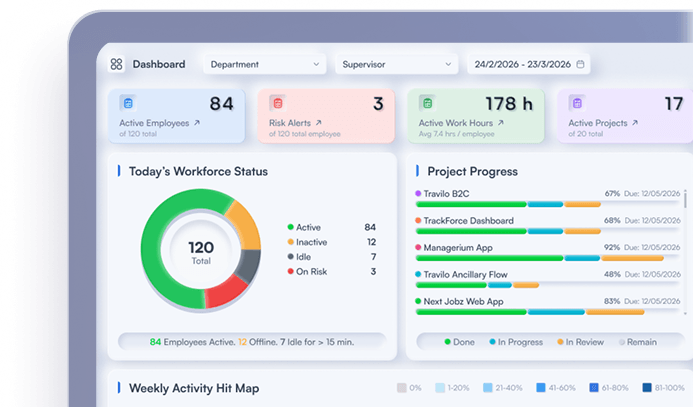
TrackForce employee performance management begins from a different gap. It captures time, applications, activity, workload and productivity patterns, then shows trends across the review period.
The purpose is not to replace manager judgement or an HR system. It is to make the starting point less dependent on recent memory. Managers and employees can see the same trend, discuss what it means and connect it to goals, quality and outcomes.
TrackForce fits organisations asking:
- Did performance improve across the full quarter?
- Was a delivery problem connected to overload?
- Does the rating match the full-period evidence?
Activity alone does not prove performance. TrackForce data is most useful when combined with output, quality, timeliness and business impact.
Lattice vs 15Five vs TrackForce Comparison
| Decision area | Lattice | 15Five | TrackForce |
| Primary orientation | HR performance and talent process | Manager effectiveness and continuous performance | Operational evidence and performance trends |
| Review cycles | Core capability | Core capability | Evidence-supported review workflow |
| Goals and OKRs | Yes | Yes | Contextual performance measures rather than a full OKR suite |
| Feedback and one-to-ones | Strong focus | Strong focus | Evidence supports coaching conversations |
| 360 feedback | Available | Available | Not the main product position |
| Talent planning | Reviews, PIPs and succession tools | Talent matrix, development and career tools | Not the primary use case |
| Automatically captured work signals | Not the main public positioning | Not the main public positioning | Core capability |
| Multi-month productivity trends | Depends on entered or integrated data | Depends on entered or integrated data | Core capability |
| Best fit | HR teams formalising performance and talent processes | Organisations developing managers and feedback habits | Teams that need evidence behind performance discussions |
This is a comparison of product emphasis, not an absolute feature boundary. Test the exact workflow you need.
Process, Opinion and Evidence Are All Necessary
The title presents three ideas, but a fair performance system needs all three.
Process Creates Consistency
A documented cycle defines who reviews whom, when feedback is collected, which scale applies and how ratings are calibrated. Without process, two managers may assess similar work differently.
Lattice and 15Five both offer strong process capabilities. The right choice depends on the desired workflow, talent scope, manager experience and existing HR stack.
Opinion Adds Human Context
Managers, peers and employees see work that a dashboard cannot fully interpret. They can explain judgement, collaboration, problem-solving, changing priorities and customer impact.
Opinion becomes risky when it is vague, inconsistent or based on recent memory. It should be recorded as an interpretation, not presented as an unquestionable fact.
Evidence Makes Reasoning Inspectable
Evidence connects a conclusion to observable work. It may include completed projects, quality results, deadlines, customer feedback, goal progress, workload and relevant activity trends.
TrackForce focuses on supplying part of this evidence automatically. The wider method is explained in TrackForce's guide to employee performance metrics, which recommends balancing delivery, quality, timeliness, workload and impact.
The strongest review uses process to structure the decision, opinion to interpret it and evidence to support or challenge it.
Which Lattice Alternatives Fit Each Buyer?
Choose 15Five When Manager Effectiveness Is the Priority
15Five is a logical Lattice alternative when the organisation wants frequent employee check-ins, manager coaching, goals, reviews and development in one connected experience. It may suit teams that view better conversations and stronger managers as the main route to improved performance.
During a demo, test how a weekly check-in becomes evidence in a quarterly review. Ask how goals, peer feedback, one-to-one notes and rating calibration remain connected.
Choose TrackForce When Reviews Lack Evidence
TrackForce is a different kind of Lattice alternative. It is relevant when HR already has a review process but managers still open the form with a blank page, recall only recent events or cannot explain why two employees received different ratings.
Ask the TrackForce team to show a complete review period rather than one day of activity. Test role-specific measurement controls, employee visibility, workload context and how a manager connects trends to actual outcomes.
Keep Lattice When the Broader Talent Suite Is Essential
A Lattice alternatives search does not guarantee an upgrade. Replacing reviews, calibration, PIPs, succession planning and connected talent workflows with a narrower evidence tool may create new gaps.
The better design may be to keep the HR process in Lattice and add an evidence layer where appropriate. TrackForce itself states that it can sit alongside an existing HR setup.
Can TrackForce Work With Lattice or 15Five?
Conceptually, yes. One platform can run the formal review workflow while TrackForce supplies relevant work patterns for the review period. The operational design should be tested before purchase because integrations, exports and permissions determine how cleanly the tools work together.
A combined workflow could look like this:
- HR defines expectations and the review cycle.
- Managers and employees record goals, feedback and check-ins.
- TrackForce builds trends across relevant work signals.
- The manager connects those trends to delivery, quality and outcomes.
- The employee reviews the same evidence and adds context.
- The formal rating and development plan remain in the chosen HR platform.
Avoid copying every available metric into the review. Use only data that is relevant, accurate, proportionate and explained in policy.
8 Questions to Ask in Every Demo
When comparing Lattice alternatives, ask each vendor to demonstrate the following:
- What information appears when a manager opens a review?
- Which parts are entered by people, imported or captured automatically?
- Can every rating link to goals, examples or measurable evidence?
- How does the system reduce recency and manager-rating bias?
- Can employees see, explain and challenge the information used?
- How are different roles measured without forcing one universal score?
- What integrations, exports and retention controls are available?
- Can we pilot one real team and one full review cycle before committing?
Also review implementation, privacy, security, support, total cost and contract terms. Use live quotes rather than pricing copied from an old comparison page.
Fair Measurement Matters More Than More Data
Objective data can strengthen a review, but active time, application use or keyboard activity cannot prove quality, collaboration or business impact alone.
TrackForce's guide to performance review bias recommends separating fact, interpretation and decision. That is a useful rule for all three platforms.
For every important conclusion, document:
- what happened;
- which source supports it;
- what context affected it;
- what the manager believes it means; and
- what decision or next step follows.
Employees should know what is measured and how to correct errors. HR should review applicable employment, privacy and consultation requirements before data affects consequential decisions.
Final Verdict on Lattice Alternatives
Lattice is strongest when the buyer needs a structured HR performance and talent process. 15Five is compelling when manager habits, check-ins, goals and development conversations are the centre of the programme. TrackForce stands apart when the missing ingredient is automatically captured work evidence across the review period.
The right Lattice alternatives decision is not simply process versus opinion versus evidence. A credible system needs fair process, informed judgement and evidence employees can understand.
For a broader category framework, compare the options in TrackForce's best performance management software guide, then test your shortlist with one real review cycle.
Frequently Asked Questions
What is the best Lattice alternative?
The best alternative depends on the gap. Choose 15Five for continuous check-ins, manager effectiveness and performance workflows. Choose TrackForce when reviews need objective work trends and evidence from the full period.
Is 15Five better than Lattice?
Not universally. Both support performance reviews, goals and feedback, but their product emphasis and workflow differ. Test each against your review design, talent needs and manager experience.
Does TrackForce replace Lattice?
Not always. TrackForce can support evidence-based performance discussions and may sit beside an existing HR system. Organisations needing broader talent workflows may retain Lattice or another performance platform.
Can activity data determine an employee rating?
No. Activity data provides context, not a complete performance verdict. Ratings should also consider goals, output, quality, timeliness, workload, behaviour and business impact.
What should buyers test before choosing performance software?
Test a real review cycle, the evidence behind ratings, employee visibility, role-specific measurement, calibration, integrations, privacy controls, implementation and total cost.
Editorial Verification Notes
- Product positioning was checked against official Lattice, 15Five and TrackForce pages on 1 November 2026.
- The article compares publicly documented product emphasis and does not claim feature exclusivity.
- Features, packaging, integrations and prices should be reconfirmed directly with each vendor before publication.
- Employment and privacy requirements vary by jurisdiction and should receive qualified review.
Similar blog you can explore
How to Increase Employee Productivity: A Manager's Playbook
Employee Performance Management in South Africa: Poor Performance and Fair Process
Best Performance Management Software in 2026: 8 Tools Compared
Start Your 30-Day
Free TrackForce Trial