Employee Performance Management in South Africa:
Poor Performance and Fair Process
2026-10-25
•
Author:
•
~1 min read
•
Updated October 25, 2026
- What Performance Management in South Africa Involves
- The 2025 Code of Good Practice: Dismissal
- Setting a Standard Employees Can Meet
- Probation Under the New Code
- Regular Check-ins and Reviews
- Poor Performance After Probation: The Fair Process
- Poor Performance, Ill Health or Misconduct?
- The Records South African Managers Should Keep
- Where TrackForce Fits
- Checklist for South African Managers
- Frequently Asked Questions
- —What is the Code of Good Practice: Dismissal 2025?
- —Can an employer dismiss an employee for poor performance in South Africa?
- —Is a performance improvement plan required in South Africa?
- —Do senior employees need a warning before dismissal for poor performance?
- —How long can probation last in South Africa?
Employee performance management in South Africa follows the Code of Good Practice: Dismissal, in force since 4 September 2025. Before dismissing for poor performance, an employer should set a clear standard, give appropriate evaluation, instruction, training, guidance or counselling, allow a reasonable period to improve, and let the employee respond.
Most South African performance disputes turn on process, not on the result. Was the standard clear? Was there real support? Did the employee get a chance to answer? This guide covers each step, from probation to a fair poor performance process, with the records to keep along the way. TrackForce supplies the work evidence behind those steps through its employee productivity software for South African teams and its employee performance management software.
What Performance Management in South Africa Involves
A sound performance process runs through the whole employment relationship:
- Agree a clear, achievable standard for the role.
- Use probation to assess performance and suitability.
- Hold regular check-ins and structured reviews.
- Give evaluation, instruction, training, guidance, or counselling when performance falls short.
- Allow a reasonable period to improve, then hear the employee before any decision.
Each step leaves a record. If a dismissal is challenged, that record is what shows the process was fair.
The 2025 Code of Good Practice: Dismissal
The Minister of Employment and Labour published the new Code on 4 September 2025, with immediate effect, according to Webber Wentzel. It brings misconduct, poor performance, ill health and operational requirements into one framework.
The Code sets guidelines, not rigid rules. DLA Piper notes that departures are allowed in exceptional circumstances, but an employer "will need to justify non-compliance if the procedural fairness of the dismissal is challenged." It also recognises that smaller businesses may use simpler, less formal processes.
Setting a Standard Employees Can Meet
Every fair performance process starts with the standard. Item 20(1) of the Code asks whether the employee "was aware or could reasonably be expected to have been aware of the required standard," as summarised by Vermeulen Attorneys. The standard must also be reasonably achievable.
Achievable includes the hours available. Under the Basic Conditions of Employment Act, ordinary hours are capped at 45 a week (section 9), and overtime needs an agreement and is limited to 10 hours a week and 12 hours of work on any day (section 10). From 1 May 2026, employees earning above R269,600.90 a year fall outside most of those hours rules, so one team can include both groups.
Good standards in practice:
- name a measurable result, not an activity
- match the role and its contracted hours
- account for each person's current workload
- are written down and shared with the employee
For a starting set of measures, see the guide to key performance indicators for employees.
Probation Under the New Code
The Code widens the purpose of probation. DLA Piper reports that it now exists "not only to assess performance but also to assess suitability for employment." Reasons for ending employment during probation may be less compelling than reasons after it.
RSM South Africa highlights three practical points:
- The probation period must be agreed before the employee starts, and its length must be reasonable for the nature of the job.
- Employers "must actively provide employees with reasonable guidance," which may include instruction, training or counselling, proportionate to the size of the operation.
- Before ending or extending probation, the employee must be allowed to make representations, and the employer must genuinely consider them.
Regular Check-ins and Reviews
The Code does not set an appraisal format, but regular, recorded reviews are the simplest evidence that an employee knew the standard and how they were doing against it. Short check-ins also stop the formal review from resting on the manager's memory of recent weeks.
The guide on how to write a performance review sets out a structure, and the guide to performance review bias covers the recency and recall problems that regular notes prevent. For appraisals that open with evidence instead of a blank form, see TrackForce's performance appraisal software.
Poor Performance After Probation: The Fair Process
Item 19(1) of the Code expects "appropriate evaluation, instruction, training, guidance or counselling" and "a reasonable period of time for improvement" before a dismissal for poor performance. Item 19(2) adds that the employee should get "an opportunity to respond to the allegations of unsatisfactory performance."
| Step | What happens | Record to keep |
| 1. Confirm the standard | Check the employee knew the standard and that it was achievable | Job standards, objectives, hours |
| 2. Evaluate | Assess performance against the standard, with specific examples | Dated evaluation notes and data |
| 3. Support | Give instruction, training, guidance or counselling | What was offered, and when |
| 4. Reasonable period | Allow time for improvement, with regular check-ins | Start and end dates, check-in notes |
| 5. Hear the employee | Put the concerns to the employee and record the response | Meeting notes, employee's response |
| 6. Decide | Decide on the outcome, considering alternatives to dismissal | Written outcome with reasons |
The Code does not prescribe a set period or require a formal performance improvement plan. Vermeulen Attorneys notes that such a plan is still a practical way to show each step happened.
Senior employees. Item 20(2) says an employer "may not be required to warn an employee that dismissal may follow" in some cases. This can apply to managers and senior staff whose knowledge and experience let them judge their own performance. It depends on the facts, and a job title alone does not decide it.
Poor Performance, Ill Health or Misconduct?
The Code treats these as separate grounds, and each has its own route.
- Poor performance: the employee is not meeting the standard. The route is support, a reasonable period, and a hearing.
- Ill health: a health condition prevents the employee from working to standard. This follows the Code's incapacity guidance, not the poor performance steps.
- Misconduct: the employee breaks a rule. This follows the disciplinary route.
Mixing them up is a common reason a process fails. If a drop in performance may have a health cause, deal with that first.
The Records South African Managers Should Keep
For each employee, keep:
- the agreed standard and any changes to it
- probation notes and the probation decision
- check-in and review notes
- the evaluation, instruction, training, guidance or counselling given
- the improvement period, meeting notes and the employee's response
- the written outcome and reasons
If data from workplace tools feeds a review, POPIA expects staff to be told what is collected and why, and collection to stay within what the purpose needs. Capture that can reach communications also falls under RICA. Both are covered in the guide to employee monitoring in South Africa.
Where TrackForce Fits
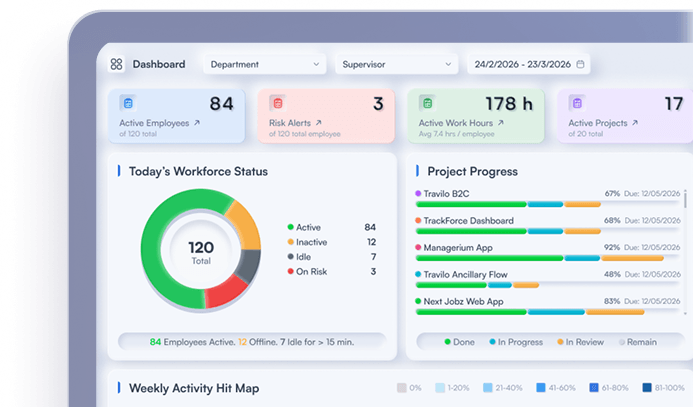
TrackForce records working hours, task efficiency, workload status, and project progress for each person, across the whole review period. That gives a manager the evidence the Code's steps depend on: a dated record of performance against the standard, the workload behind it, and progress during the improvement period.
Hours sit beside output, so a standard can be checked against the time actually available. Activity capture, such as screenshots, is set per device, so a team can run on output and hours data alone.
TrackForce is performance management software for the evidence layer. It does not replace the guidance, the hearing or the manager's judgement the Code expects. TrackForce offers a free 30-day trial to test it with one South African team.
Checklist for South African Managers
- Standards are written, shared, and achievable within contracted hours.
- Probation length is agreed before the start date and suits the role.
- Guidance during probation is real and recorded.
- Check-ins and reviews happen regularly, with notes.
- Poor performance gets evaluation and support before any formal step.
- The improvement period is reasonable and has check-in dates.
- The employee responds to the concerns before any decision.
- Ill health and misconduct follow their own routes.
Frequently Asked Questions
What is the Code of Good Practice: Dismissal 2025?
It is the guidance on fair dismissal in South Africa, published on 4 September 2025 with immediate effect. It covers misconduct, poor performance, ill health and operational requirements in one framework, and employers must justify departures from it if a dismissal is challenged.
Can an employer dismiss an employee for poor performance in South Africa?
Yes, if the process is fair. The Code expects a clear and achievable standard, appropriate evaluation, instruction, training, guidance or counselling, a reasonable period to improve, and an opportunity for the employee to respond before any decision.
Is a performance improvement plan required in South Africa?
No. The Code does not prescribe a formal performance improvement plan or a fixed period. A written plan is still a practical way to show that the standard, the support, the improvement period and the hearing all took place.
Do senior employees need a warning before dismissal for poor performance?
Not always. The Code says an employer may not be required to warn an employee that dismissal may follow where, for example, a manager's knowledge and experience let them judge their own performance. It depends on the facts, not the job title.
How long can probation last in South Africa?
The Code does not set a fixed maximum. The probation period should be agreed before the employee starts and be reasonable for the nature of the job. Before ending or extending probation, the employee must have a chance to make representations.
This guide describes South African employment practice in general terms and is not legal advice. Seek advice from a labour law specialist on individual cases.
Similar blog you can explore
How to Increase Employee Productivity: A Manager's Playbook
Lattice vs 15Five vs TrackForce: Process, Opinion or Evidence?
Best Performance Management Software in 2026: 8 Tools Compared
Start Your 30-Day
Free TrackForce Trial