How to Improve Work Performance:
12 Changes That Hold
2026-09-24
•
Author: TrackForce Team
•
~1 min read
•
Updated September 24, 2026
- Quick Answer: How Can You Improve Work Performance?
- What Does Improving Work Performance Actually Mean?
- 1. Turn Broad Expectations Into Measurable Outcomes
- 2. Limit the Number of Daily Priorities
- 3. Protect Uninterrupted Focus Time
- 4. Match Workload to Real Capacity
- 5. Remove Recurring Workflow Blockers
- 6. Make Meetings Shorter and More Purposeful
- 7. Give Feedback While It Is Still Useful
- 8. Make Essential Information Easier to Find
- 9. Standardize the Tools and Processes That Matter
- 10. Measure Outcomes Alongside Activity
- 11. Build Recovery Into the Workday
- 12. Review Trends, Not Isolated Days
- A Simple 30-Day Work Performance Improvement Plan
- —Week 1: Establish the baseline
- —Week 2: Redesign the workday
- —Week 3: Improve the management rhythm
- —Week 4: Review the evidence
- Common Mistakes When Trying to Improve Employee Performance
- —Measuring busyness instead of results
- —Setting too many goals
- —Ignoring workload and dependencies
- —Waiting too long to give feedback
- —Using data as a verdict
- —Changing the system every week
- How TrackForce Helps Improve Work Performance
- Frequently Asked Questions
- —What are the best ways to improve work performance?
- —How can an employee improve work performance?
- —How can managers improve employee performance?
- —What causes poor work performance?
- —Should work performance be measured with employee monitoring software?
- Final Thoughts
Improving work performance does not mean squeezing more activity into every hour. It means making it easier for people to focus on valuable work, complete it to the expected standard, and repeat that result without burning out.
That distinction matters. An employee can look busy all day while projects remain stalled. Another may have fewer visible activities but consistently complete high-value work on time. Reliable performance comes from the design of the work—not constant pressure or isolated bursts of motivation.
If you are trying to understand how to improve work performance, start by examining five areas: expectations, priorities, focus, workload, and feedback. The following 12 changes address those areas and are practical enough to hold after the initial enthusiasm fades.
Quick Answer: How Can You Improve Work Performance?
To improve work performance:
- Define measurable outcomes.
- Limit daily priorities.
- Protect uninterrupted focus time.
- Match tasks to employee capacity.
- Remove recurring workflow blockers.
- Make meetings shorter and more purposeful.
- Give timely, specific feedback.
- Improve access to information.
- Use tools consistently.
- Measure outcomes alongside activity.
- Build recovery into the workday.
- review performance trends regularly.
The objective is not simply to make employees work faster. It is to create a work system in which good performance becomes easier to sustain.
What Does Improving Work Performance Actually Mean?
Work performance is the quality, consistency, and business value of the results produced by an individual or team.
Depending on the role, performance may include:
- Work completed on time
- Quality and accuracy
- Customer satisfaction
- Sales or revenue contribution
- Project progress
- Schedule adherence
- Response and resolution time
- Collaboration
- Workload management
- Reliability over time
Therefore, improving performance requires more than monitoring hours or computer activity.
Hours show how long someone worked. Activity data shows how the workday was used. Tasks and project records show what moved forward. Quality and business outcomes show whether that work created value.
Managers need these signals together. Our guide to workforce performance measuring software explains why no single metric can provide a complete view of employee performance.
1. Turn Broad Expectations Into Measurable Outcomes
“Be more productive” is not a useful performance target. It does not tell an employee what needs to change or how success will be assessed.
Replace broad instructions with observable outcomes.
For example:
- “Improve customer service” becomes “Respond to priority support tickets within one hour.”
- “Complete projects faster” becomes “Deliver the first review draft by Thursday.”
- “Communicate better” becomes “Flag blockers within one working day.”
- “Improve quality” becomes “Reduce avoidable rework during the next four-week cycle.”
Good outcomes should define the result, expected quality, deadline, and any important constraints.
This gives employees a clear finish line and gives managers a fair basis for reviewing progress.
2. Limit the Number of Daily Priorities
When everything is marked urgent, employees spend the day switching between tasks instead of finishing the work that matters most.
A practical daily structure is:
- One critical outcome
- Two supporting priorities
- A short list of lower-value administrative tasks
This does not mean employees can only complete three things. It means they know which work should survive when unexpected requests arrive.
Managers should also clarify who can change priorities. Otherwise, employees may receive competing instructions from different people and waste time deciding whose request comes first.
At the beginning of each day or shift, ask:
- What must be completed today?
- What can wait?
- What is currently blocked?
- Has anything new changed the order of priorities?
This small routine can prevent hours of misdirected effort.
3. Protect Uninterrupted Focus Time
Concentration is difficult to maintain when work is repeatedly interrupted by messages, meetings, emails, and application switching.
Microsoft’s Work Trend Index found that 68% of people said they did not have enough uninterrupted focus time during the workday. Inefficient meetings and unclear goals were also among the leading reported productivity disruptors.
Teams can protect focus by:
- Creating meeting-free time blocks
- Turning off nonessential notifications
- Establishing agreed response-time expectations
- Grouping similar administrative tasks
- Using asynchronous updates where possible
- Avoiding unnecessary status-check messages
A two-hour focus block will not solve every performance problem. However, it creates the conditions required for complex work such as analysis, coding, writing, planning, or quality review.
4. Match Workload to Real Capacity
Poor performance is not always an effort problem. It may be a capacity problem.
An overloaded employee may miss deadlines and make avoidable mistakes. An underutilized employee may appear less active because they have not been given enough meaningful work. In both situations, increasing pressure treats the symptom instead of addressing the cause.
Managers should review:
- Assigned versus completed tasks
- Planned versus actual time
- Number of simultaneous projects
- Overtime patterns
- Active and idle time trends
- Dependencies outside the employee’s control
- Work repeatedly returned for revision
A workforce analytics platform can make these patterns easier to identify. However, the numbers should begin a conversation—not replace one.
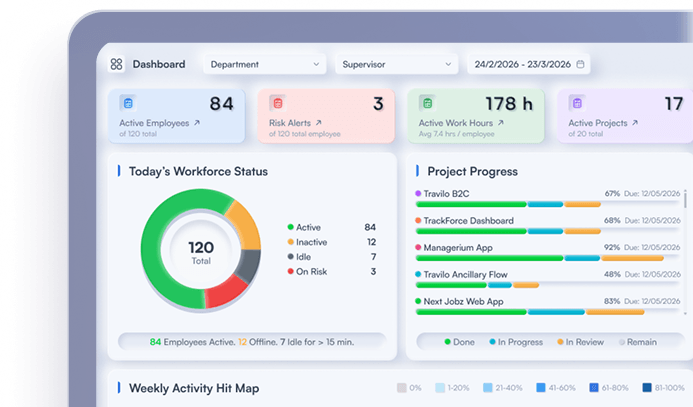
TrackForce brings work hours, activity patterns, workload, and productivity reporting into one view, helping managers distinguish low effort from poor allocation, unclear requirements, or blocked workflows.
5. Remove Recurring Workflow Blockers
Small obstacles become expensive when they occur every day.
Common blockers include:
- Waiting for approvals
- Missing access permissions
- Unclear ownership
- Incomplete instructions
- Slow devices or software
- Duplicate data entry
- Unnecessary review stages
- Information spread across too many systems
Ask employees a simple question each week:
What slowed you down more than once this week?
Then track the answers. A blocker that affects several employees deserves more attention than an isolated inconvenience.
Managers often try to improve work performance by coaching individuals while leaving broken processes untouched. Removing one recurring operational bottleneck can produce a larger improvement than asking everyone to work faster.
6. Make Meetings Shorter and More Purposeful
Meetings should help work move. They should not become a substitute for the work itself.
Before scheduling a meeting, determine whether the purpose is to:
- Make a decision
- Resolve a blocker
- Coordinate dependent work
- Generate ideas
- Deliver information that genuinely requires discussion
Every meeting should have an owner, a clear agenda, required attendees, and a documented next step.
Consider reducing 30-minute meetings to 25 minutes and 60-minute meetings to 50 minutes. The remaining time gives employees space to record decisions, prepare for the next task, and mentally reset.
Microsoft research also found that short breaks between meetings can reduce accumulated stress and support focus.
If a meeting ends without a decision, owner, or next action, its purpose probably needs to be reconsidered.
7. Give Feedback While It Is Still Useful
Annual reviews are too late for many performance corrections.
Effective feedback should be:
- Timely
- Specific
- Connected to an observable action
- Focused on impact
- Clear about the next step
Instead of saying, “Your communication needs improvement,” say:
“The project risk was identified on Tuesday but was not shared until Friday. Next time, flag a delivery risk within one working day so the team can respond before the deadline is affected.”
This approach removes ambiguity and gives the employee something practical to change.
According to Gallup, 80% of employees who said they had received meaningful feedback in the previous week were fully engaged.
Feedback should also recognize what worked. Employees need to know which effective behaviors they should repeat, not only which mistakes they should avoid.
8. Make Essential Information Easier to Find
Employees cannot perform efficiently if they spend a large part of the day searching for documents, instructions, passwords, decisions, or the latest version of a file.
Create one reliable location for:
- Standard operating procedures
- Project requirements
- Templates
- Ownership information
- Decision records
- Frequently asked questions
- Training resources
- Current files
Every important resource should have an owner and a review date.
The goal is not to document everything. It is to document the information employees repeatedly need to complete work correctly without waiting for someone else to answer the same question again.
9. Standardize the Tools and Processes That Matter
Too many tools create fragmented work. Too little structure creates inconsistent work.
Define which systems employees should use for:
- Tasks
- Communication
- File storage
- Time tracking
- Project updates
- Approvals
- Performance reporting
Then establish simple rules.
For example:
- Tasks belong in the project management system, not private messages.
- Final documents belong in the shared workspace, not personal folders.
- Project blockers are recorded against the relevant task.
- Time and activity records are reviewed using the same reporting period.
Standardization reduces confusion and makes performance easier to evaluate across teams.
10. Measure Outcomes Alongside Activity
Activity can provide useful operational context, but it is not the same as performance.
High keyboard or application activity does not automatically mean valuable work was completed. Low digital activity may be normal for an employee who spends part of the day planning, speaking with customers, reviewing physical materials, or working away from a computer.
A balanced performance review may combine:
| Measurement area | Example signals |
| Time | Working hours, attendance and schedule adherence |
| Activity | Active time, idle time and application usage |
| Output | Tasks completed, cases resolved or units produced |
| Quality | Error rate, rework and customer feedback |
| Delivery | Milestones reached and deadlines met |
| Capacity | Workload distribution and overtime |
| Development | Skills improved and responsibilities expanded |
This is also where the distinction between analytics and surveillance becomes important. Workforce analytics and employee monitoring are related, but they do not serve exactly the same purpose.
Monitoring records selected work-related signals. Analytics connects signals over time so managers can understand patterns, compare workload with outcomes, and make better decisions.
11. Build Recovery Into the Workday
Sustainable performance requires recovery.
An employee who works at maximum intensity without breaks may appear productive for a short period, but concentration, judgment, and quality can decline as fatigue increases.
Encourage employees to:
- Take short breaks between focused work sessions
- Avoid stacking meetings without transition time
- Use their full lunch period
- End work at a reasonable and predictable time
- Take appropriate leave when unwell
- Raise unsustainable workload early
The American Psychological Association notes that short breaks can help maintain attention and productivity.
Managers also influence whether employees feel able to take those breaks. A written wellbeing policy means little if employees are praised for responding at midnight or working through every lunch.
12. Review Trends, Not Isolated Days
One difficult day does not define an employee’s performance.
A late start, an extended idle period, or a missed deadline may have a reasonable explanation. Decisions become more reliable when managers review patterns across several weeks and compare multiple measures.
A useful review rhythm might include:
- Daily attention to urgent blockers
- Weekly review of priorities and workload
- Monthly review of performance trends
- Quarterly discussion of development and role expectations
Look for changes such as:
- Gradually increasing completion time
- Repeated work outside scheduled hours
- Rising rework
- A sustained activity decline
- Uneven allocation across a team
- One project consistently consuming more time than planned
Trend-based reviews reduce overreaction and create space for a fair conversation about what is causing the pattern.
For remote and hybrid teams, see our guide to remote employee monitoring without micromanaging.
A Simple 30-Day Work Performance Improvement Plan
The 12 changes above do not need to be introduced simultaneously. A focused 30-day plan is more likely to hold.
Week 1: Establish the baseline
- Define the outcomes that matter.
- Review current workload and priorities.
- Identify recurring blockers.
- Record baseline delivery, quality, and activity measures.
Week 2: Redesign the workday
- Introduce protected focus blocks.
- Remove or shorten low-value meetings.
- Clarify where tasks and project updates should be recorded.
- Balance work across available capacity.
Week 3: Improve the management rhythm
- Begin short weekly performance conversations.
- Give specific, timely feedback.
- Address unresolved blockers.
- Recognize behaviors worth repeating.
Week 4: Review the evidence
- Compare results with the baseline.
- Look for trends rather than isolated events.
- Ask employees which changes helped.
- Keep the practices that improved results.
- Adjust or remove anything that created unnecessary administration.
The goal after 30 days is not perfection. It is a repeatable system that creates better visibility and more consistent outcomes.
Common Mistakes When Trying to Improve Employee Performance
Measuring busyness instead of results
More clicks, hours, or messages do not necessarily mean better performance. Always connect activity to output, quality, and business outcomes.
Setting too many goals
A long improvement plan can leave employees uncertain about where to begin. Focus on one or two changes at a time.
Ignoring workload and dependencies
Employees cannot solve problems caused by missing approvals, conflicting priorities, or unrealistic capacity.
Waiting too long to give feedback
A quarterly or annual review should not be the first time an employee hears about a recurring issue.
Using data as a verdict
Workforce data can show that something changed. It may not explain why. Use the evidence to ask better questions.
Changing the system every week
Performance habits need enough time to become normal. Constantly replacing processes can create more confusion than improvement.
How TrackForce Helps Improve Work Performance
TrackForce helps managers understand how work happens across remote, hybrid, and in-office teams.
Its centralized workforce visibility can help organizations review:
- Working hours
- Active and idle time
- Attendance
- Application and website usage
- Workload patterns
- Employee activity
- Productivity trends
- Performance reports
The purpose is not to reduce an employee to a single score. It is to give managers enough context to see where work is moving, where it is becoming blocked, and where an employee or team may need support.
When activity information is combined with task, workload, and outcome data, performance conversations can become more specific and less dependent on assumptions.
Explore TrackForce to see how workforce analytics and productivity visibility can support more informed performance decisions.
Frequently Asked Questions
What are the best ways to improve work performance?
The most effective ways to improve work performance are to clarify expected outcomes, limit competing priorities, protect focus time, balance workloads, remove recurring blockers, and provide frequent, specific feedback.
How can an employee improve work performance?
An employee can improve performance by identifying the most important daily outcome, reducing distractions, communicating blockers early, asking for feedback, documenting progress, and reviewing which work habits produce the best results.
How can managers improve employee performance?
Managers can improve employee performance by setting clear expectations, assigning realistic workloads, making essential information accessible, addressing process problems, giving timely feedback, and reviewing multiple performance indicators rather than relying on one metric.
What causes poor work performance?
Poor performance may result from unclear goals, excessive workload, insufficient training, repeated interruptions, outdated tools, weak processes, personal challenges, low engagement, or a mismatch between the employee’s responsibilities and skills.
Should work performance be measured with employee monitoring software?
Monitoring software can provide useful information about working hours and activity patterns, but it should not be the only measure. Performance assessments should also consider completed work, quality, deadlines, customer outcomes, workload, and the context surrounding the data.
Final Thoughts
Learning how to improve work performance begins with a shift in perspective.
Sustainable improvement does not come from watching employees more closely or filling every minute with activity. It comes from designing work around clear outcomes, realistic capacity, focused execution, useful feedback, and reliable evidence.
Start with one or two of the 12 changes. Measure what improves, listen to the people doing the work, and make the successful practices part of the normal operating rhythm.
Similar blog you can explore
Employee Performance Metrics: The 9 That Predict Results
Workforce Analytics vs Employee Monitoring: Where the Line Sits
Workforce Performance Measuring Software: What It Is and What It Actually Measures
Start Your 30-Day
Free TrackForce Trial