The form starts empty
Every cycle begins from nothing. The manager becomes the data source, and memory is a poor one.
Appraisal season starts with an empty template and six months nobody fully remembers. TrackForce fills the appraisal with real work data before the manager writes a word, so HR closes the cycle faster and every rating holds up.
Built for HR leaders, People Operations and department heads running formal appraisal cycles.
Free 30-day trial | No credit card required | Cancel anytime
Trusted by teams at



Listed on



Appraisal software made the form faster to submit. It did not make the content any more accurate. Managers still reconstruct six months from memory, which is why the cycle drags and the rating gets argued.
Spent by the average manager each year preparing performance reviews. Most of it goes on reconstructing what already happened.
Engagedly researchOf HR leaders agree traditional reviews are not enough to form an accurate picture of day-to-day performance.
LinkedIn Talent SolutionsOf employees strongly agree their performance management system motivates them to do outstanding work.
Gallup, Re-Engineering Performance ManagementEvery cycle begins from nothing. The manager becomes the data source, and memory is a poor one.
A problem raised in April surfaces in the December review. By then the year is spent and nothing can be corrected.
With nothing to anchor a score, managers rate to avoid conflict. Everyone lands near the middle and the cycle loses meaning.
A rating tied to an increment or bonus invites challenge. Without evidence, the conversation becomes opinion against opinion.
Last year's ratings sit in a folder with nothing behind them. Progression cannot be shown, only asserted.
Each manager applies a private standard. Calibration across teams becomes guesswork at the exact moment pay depends on it.
The appraisal is a moment. Performance is a year. When the record builds continuously, the review stops being an investigation and becomes a conversation about something both people already know.
Every appraisal platform competes on workflow: forms, cycles, reminders, 360 feedback, calibration screens. All of it assumes the manager already knows what happened. That assumption is the gap.
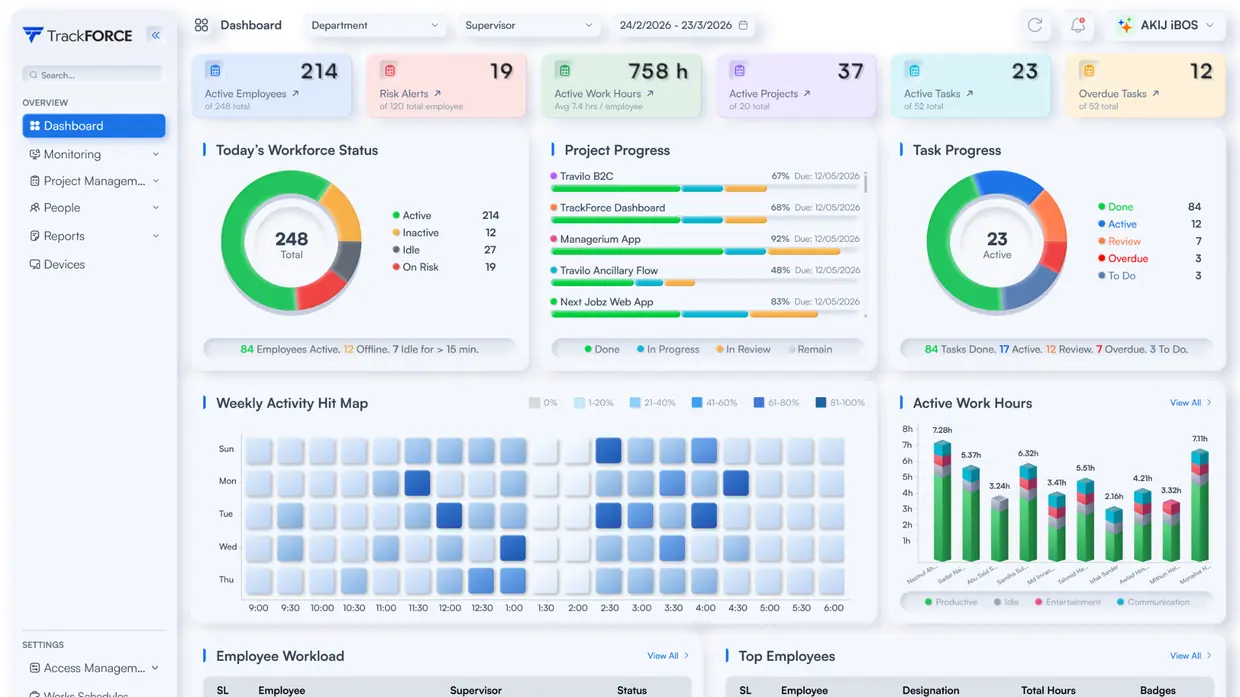
TrackForce captures time, activity, workload, and delivery across the team from day one. Nothing to fill in, no timesheets to chase.
When appraisal season arrives, delivery consistency, productivity trend, and workload context are already there for the full period.
Preparation shifts from reconstructing the past to interpreting it. The rating carries a reason the employee can see.
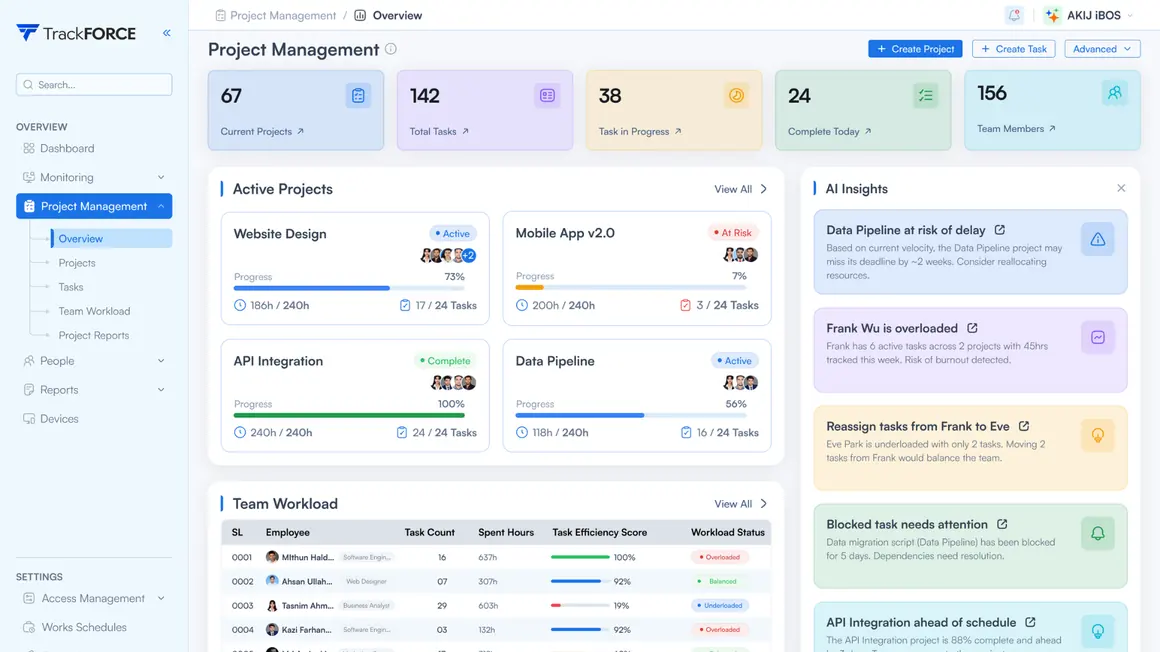
This is the screen an appraisal draws from. Efficiency score and workload status sit next to every name, so a missed target under an overloaded flag reads very differently from the same target missed while underloaded.
Each capability exists to answer one appraisal question: what actually happened over this period, and can the rating be defended.
The whole appraisal window in one view, so the last three weeks stop deciding the whole score.
See who carried more than their share. A missed deadline under double load is a different appraisal conversation.
Reliability measured across the period, not inferred from the projects a manager happens to remember.
Where the effort actually went. Useful when an employee's real contribution sat outside their headline objectives.
Calibrate across managers using the same measures, so a rating means the same thing in every department.
Each organisation decides what counts toward an appraisal and what stays private. Policy leads, software follows.
An appraisal cycle has three people in it, and each one needs something different from the same evidence.
"I need appraisal cycles that are fair and defensible."
Consistent measures across every department, so a rating means the same thing in sales as it does in operations. Calibration stops being guesswork, and a contested increment has a record behind it.
"I need to know where my team stands before I review them."
The full period in one view instead of six months of recall. Preparation drops from reconstruction to review, and overload shows up while there is still time to act on it.
"I want to be judged on what I actually did."
The same trend the manager sees, visible throughout the year. Recognition lands on real contribution, and a rating arrives with a reason attached rather than a surprise.
| Capability | TrackForce | HR appraisal platforms | Spreadsheets |
|---|---|---|---|
| Review frequency | Continuous record, formal cycle | Once or twice yearly | Once or twice yearly |
| Appraisal form and cycle | Yes | Yes | Manual |
| Objective work data underneath | Yes | No | No |
| Fields pre-filled before the manager starts | Yes | No | No |
| Full-period trend, not recent memory | Yes | Partial | No |
| Workload context behind a rating | Yes | No | No |
| Employee sees the same evidence | Yes | Partial | Rarely |
| Annual minimum contract | None | Common | None |
| Appraisal history across cycles | Yes | Ratings only | No |
| Time to first insight | Within a day | Weeks | Manual |
Based on publicly listed capabilities at the time of writing. Confirm current details with each vendor.
TrackForce holds an Excellent rating on Trustpilot across 456 reviews, alongside listings on AlternativeTo, Clutch, GoodFirms and SoftwareSuggest.
"TrackForce gives us clearer visibility into daily work and helps us manage team productivity more effectively."
"TrackForce makes employee activity easier to understand, helping us keep work focused and operations on track."
"With TrackForce, we get better work visibility and can manage team performance with greater clarity."
No. The process stays. TrackForce supplies the evidence that goes into it, so the form arrives populated rather than empty. Organisations running appraisals in an HR system keep that system and feed it better inputs.
An annual cycle is exactly where this matters most. Twelve months is far beyond reliable recall, which is why the record needs to build continuously even if the appraisal happens once.
Employees see their own trends, the same view the manager uses, and each organisation sets what is measured. In practice, shared evidence reduces appraisal disputes because the rating stops being one person's opinion.
Yes. Because the record is continuous, each cycle sits on top of the last. HR can show an employee's trend across appraisal periods instead of comparing two ratings with nothing behind them.
The trial runs 30 days with no credit card and no annual commitment. Long enough to build a real record and run a full appraisal conversation on it before deciding.
Performance appraisal software helps organisations run formal employee reviews, record ratings and document outcomes. TrackForce adds the layer most tools miss, which is objective work data, so each appraisal opens with evidence already in place instead of a blank form.
Most appraisal tools speed up the paperwork. The content is still written from memory. TrackForce supplies the performance record itself, so the appraisal is faster to prepare and the rating can be defended with facts.
Research from Engagedly puts manager preparation at around 210 hours a year. Most of that is spent reconstructing what happened. When the performance record already exists, preparation shifts from recall to review.
No. TrackForce supplies the performance evidence an HR or appraisal system cannot produce on its own. It runs alongside the existing setup and feeds the appraisal with facts. See employee performance management for the wider cycle.
Employees see their own productivity trends, the same view the manager uses, and each organisation sets custom controls over what is measured. Shared evidence usually reduces appraisal disputes rather than creating them.
Yes. The performance record is continuous, so each appraisal period sits on top of the last. HR can show progression across cycles with the evidence attached, rather than comparing two ratings with nothing behind them.
Most HR appraisal software covers the cycle itself: forms, rating scales, reminders, calibration and a record of outcomes. What decides whether a review holds up is the evidence underneath it. A complete setup pairs the cycle with a continuous work record, so the rating has something behind it when an employee asks why.
Yes. The problem employee appraisal software solves is recall, and recall becomes unreliable long before a company reaches a hundred people. TrackForce carries no annual minimum contract, so a team of fifteen can run the same evidence-backed cycle as a department of five hundred.
Yes. The trial runs 30 days with no credit card required and can be cancelled any time. See pricing for plan details.
TrackForce begins building the performance record from day one. Start now and the next appraisal opens with months of evidence already in the form.
Free 30-day trial | No credit card required | Cancel anytime