Performance Appraisal Software: How
to Choose in 2026
2026-10-06
•
Author: TrackForce Team
•
~1 min read
•
Updated October 6, 2026
- What Is Performance Appraisal Software?
- Performance Appraisal Software vs Employee Monitoring
- 10 Questions to Ask Before Choosing a Platform
- —1. Can it support your real review cycle?
- —
- —2. Can goals and standards vary by role?
- —
- —3. Does the review start with evidence or a blank form?
- —
- —4. Can employees see and challenge the record?
- —
- —5. Does it support regular feedback between formal reviews?
- —
- —6. How does it make ratings consistent?
- —
- —7. Does it measure trends across the whole period?
- —
- —8. Are privacy, access and retention configurable?
- —
- —9. What can HR learn across teams?
- —
- —10. What is the complete cost of ownership?
- A Practical Vendor Demo
- How TrackForce Fits the Appraisal Workflow
- Final Checklist
- Frequently Asked Questions
- —What is performance appraisal software?
- —What features should performance appraisal software include?
- —Is performance appraisal software the same as employee monitoring software?
- —How often should performance appraisals happen?
- —Can TrackForce replace an HRIS?
Performance appraisal software helps organisations plan review cycles, assess employees against agreed expectations, document feedback and turn each appraisal into follow-up action. The best systems do more than move a paper form online. They connect goals, role-specific measures, evidence, manager judgement, employee input and development plans in one review record.
A platform can offer attractive templates and reminders while leaving managers to write ratings from recent memory. Another can collect detailed activity data but provide no fair way to interpret it. Buyers need software that supports both the review process and the evidence behind it.
What Is Performance Appraisal Software?
Performance appraisal software is a digital system for evaluating employee performance during a defined period. It typically manages review schedules, objectives, competencies, self-assessments, manager ratings, approvals, feedback and development actions.
It may be a standalone appraisal tool, part of a wider HR platform or connected to workforce analytics. Depending on the product, it can support:
- probation, quarterly, mid-year and annual reviews;
- role-specific goals and competency frameworks;
- employee self-assessments;
- manager and multi-rater feedback;
- rating scales and calibration;
- supporting evidence and review notes;
- development plans and follow-up actions; and
- reporting across employees, teams and cycles.
The CIPD performance-reviews factsheet treats appraisal as part of a broader performance-management process that includes measurement, feedback and the role of line managers. Software should support that process; it cannot replace the manager’s judgement or conversation.
Performance Appraisal Software vs Employee Monitoring
Appraisal and monitoring systems answer different questions.
Monitoring or workforce analytics shows how work happens: time patterns, application use, workload, focus, attendance or activity. Appraisal software structures the formal decision: what was expected, what results were achieved, how performance is rated and what happens next.
Neither dataset is a complete verdict. Activity does not prove quality or value, while a rating entered without evidence may reflect bias, recency or inconsistent standards. A stronger approach connects operational evidence to role-specific outcomes and lets the manager and employee discuss the context.
TrackForce’s guide to employee performance metrics explains why delivery, quality, timeliness, workload and business impact should be considered together. Its guide to workforce analytics software shows what work data can, and cannot, measure.
10 Questions to Ask Before Choosing a Platform
1. Can it support your real review cycle?
Start with the process, not the feature list. Map who launches a cycle, who contributes, who approves ratings and what follows the meeting. Ask the vendor to configure one of your real workflows: a probation review, quarterly check-in or annual appraisal.
Check whether HR can create different cycles for departments, locations, employment types and review dates. The system should handle late reviews, manager changes, leave and incomplete records without losing history.
2. Can goals and standards vary by role?
A salesperson, developer, support agent and finance analyst should not be assessed with the same scorecard. The platform should support role-specific goals, measures, weightings and competency expectations.
The US Office of Personnel Management advises that performance standards should be objective, measurable, realistic and clearly recorded, covering dimensions such as quality, quantity, timeliness and cost-effectiveness. See its official guidance on developing performance standards.
Look for version control. If a role or priority changes halfway through the cycle, the system should show what changed, when and who approved it.
3. Does the review start with evidence or a blank form?
Ask what the manager sees when opening a review. A blank comment box encourages recall bias. A better system brings the agreed goals, progress, prior check-ins, work samples and relevant trends into the review period.
Evidence should be traceable. A rating should link to the goal, result, example or trend supporting it. Managers must still interpret that information; the software should not convert one activity score into an automatic appraisal.
TrackForce’s employee KPI guide recommends a small balanced set covering delivery, quality, timeliness, workload and impact rather than whatever is easiest to count.
4. Can employees see and challenge the record?
Transparent systems give employees access to their goals, progress, feedback and relevant evidence. They should be able to add context, correct factual errors and acknowledge the final review without being forced to agree with every conclusion.
Test the dispute or comment workflow. Can an employee identify inaccurate data? Can HR see whether the manager responded? Is the original record preserved in the audit history?
5. Does it support regular feedback between formal reviews?
An annual form should not be the first time an employee hears about a problem. The software should support lightweight check-ins, notes, recognition, coaching actions and progress updates throughout the cycle.
Acas performance-management guidance recommends regular informal feedback and check-ins alongside formal reviews. It also advises that objectives should be fair, reflect usual work and be specific, measurable, achievable, relevant and time-bound.
During a demo, create a follow-up action in one check-in and confirm that it appears in the next review.
6. How does it make ratings consistent?
Rating scales alone do not create consistency. The product should let HR define each rating level, attach behavioural or outcome-based examples and run calibration before ratings are finalised.
Useful controls include manager guidance, required evidence for extreme ratings, distribution views and approval steps. Calibration should identify unexplained differences between reviewers, not force every team into a predetermined curve.
7. Does it measure trends across the whole period?
One unusually productive week or one recent mistake should not define six months of performance. Look for trend views that cover the entire review period and can distinguish a sustained change from a short-term event.
TrackForce’s employee performance management platform is positioned around this problem: turning months of time, activity, workload and productivity data into evidence that managers and employees can review together. It should be treated as evidence supporting judgement, not as an automatic rating engine.
8. Are privacy, access and retention configurable?
Appraisal records contain sensitive employment information. Ask who can see raw data, manager notes, peer feedback, salary-related decisions and historical reviews. Confirm encryption, role-based access, audit logs, retention settings, deletion procedures, data location and export options.
If monitoring data feeds the appraisal, collect only what is needed for a defined purpose. The UK Information Commissioner’s Office guidance on monitoring workers emphasises data minimisation, accuracy and allowing workers to see or challenge information used in potentially adverse decisions.
9. What can HR learn across teams?
The reporting layer should answer operational questions, not simply count completed forms. Useful reports include review completion, rating distribution, goal progress, performance trends, development actions, overdue follow-ups and patterns by team or role.
Segmentation needs safeguards. Small groups can expose individual information, while unadjusted comparisons can penalise teams with different workloads or task complexity. Ask how the vendor controls access and explains calculated scores.
10. What is the complete cost of ownership?
Compare more than the per-user subscription. Include implementation, configuration, training, integrations, support, data migration, custom reports, minimum contract terms and exit costs.
Ask how long it takes to produce the first useful review. A lower licence price can become expensive if HR must build scorecards manually, chase managers and export data into spreadsheets every cycle.
A Practical Vendor Demo
Give each shortlisted vendor the same scenario: a six-month appraisal for an operations employee whose delivery improved while workload increased and quality remained stable.
Ask the vendor to:
- configure three role-specific goals and rating definitions;
- import or attach evidence covering all six months;
- show the employee and manager views;
- add a self-assessment and manager rating;
- challenge one inaccurate data point;
- run an approval or calibration step;
- create a development action with a due date; and
- display the result in an HR report.
Then change the manager halfway through the cycle. If the product cannot preserve the goals, evidence, comments and access history, it will struggle with real organisational change.
How TrackForce Fits the Appraisal Workflow
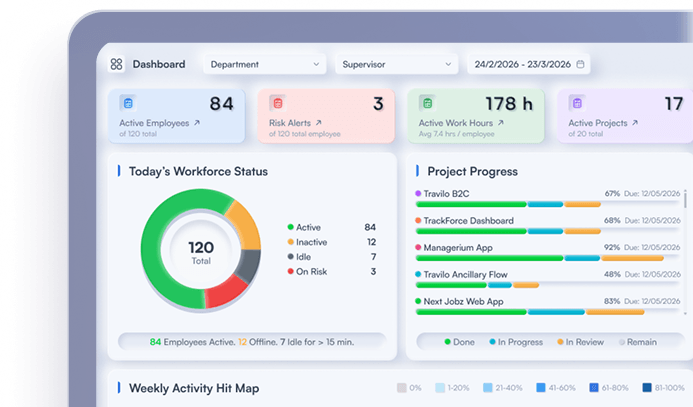
TrackForce connects automatic time and activity records with multi-month productivity trends, workload patterns and employee-visible evidence. Instead of asking a manager to reconstruct six months from memory, it provides context covering the complete period.
That makes TrackForce relevant when an organisation wants performance appraisal software grounded in observable work patterns. It does not remove the need for role-specific outcomes, qualitative judgement, coaching or HR governance. Nor does it necessarily replace an HRIS that manages compensation, employee records or broader talent workflows.
Explore TrackForce employee performance management and test it with one defined team, transparent measurement rules and a real review cycle.
Final Checklist
Choose a platform only if it can:
- reproduce your actual review and approval process;
- use role-specific goals and clear standards;
- bring evidence into the complete review period;
- keep activity data separate from final performance judgement;
- support employee input and factual challenges;
- make rating definitions and calibration transparent;
- protect sensitive information with granular access;
- turn reviews into dated development actions;
- report useful trends without misleading comparisons; and
- export your records if you leave.
The best performance appraisal software is not the product with the longest form or the most automated score. It is the system that helps managers make fairer decisions, helps employees understand those decisions and turns the review into better work after the meeting.
Frequently Asked Questions
What is performance appraisal software?
Performance appraisal software is a system for planning employee reviews, setting goals and standards, collecting evidence and feedback, recording ratings and tracking follow-up actions. It may operate independently or as part of a wider performance-management or HR platform.
What features should performance appraisal software include?
Core features include configurable review cycles, role-specific goals, self and manager assessments, rating definitions, evidence attachments, employee comments, approvals, calibration, development plans, reminders, reporting, access controls and audit history.
Is performance appraisal software the same as employee monitoring software?
No. Monitoring software records aspects of work activity and time, while appraisal software manages evaluation and development. Work data can provide useful context, but it should be connected to quality, delivery and outcomes and should not become an automatic rating by itself.
How often should performance appraisals happen?
The formal schedule depends on the organisation, but employees should receive feedback throughout the year. Many organisations use quarterly or mid-year check-ins alongside an annual summary review so goals and support can change before the period ends.
Can TrackForce replace an HRIS?
Not necessarily. TrackForce provides work evidence, productivity trends and review context. An HRIS may still manage payroll, compensation, benefits, recruitment and the broader employee record. Evaluate whether TrackForce should operate as the performance evidence layer alongside those systems.
Similar blog you can explore
TrackForce vs Time Doctor for Performance Reviews
How to Measure Employee Productivity Without Micromanaging
Productivity Tracking Software for Hybrid Employees
Start Your 30-Day
Free TrackForce Trial