Employee Performance Management in the UK:
A Practical Guide for 2026
2026-10-25
•
Author:
•
~1 min read
•
Updated October 25, 2026
- What Employee Performance Management in the UK Involves
- Setting Objectives That Hold Up
- Regular Feedback, Not Only Annual Reviews
- When Performance Falls Short: Capability or Conduct?
- Running a Fair Capability Process
- What Is Changing: January 2027 and a New Acas Code
- The Records UK Managers Should Keep
- Managing Performance in Hybrid Teams
- Where TrackForce Fits
- Checklist for UK Managers
- Frequently Asked Questions
- —Is there a legal requirement to do performance reviews in the UK?
- —Does the Acas Code of Practice apply to poor performance?
- —Can an employer dismiss an employee for poor performance in the UK?
- —What changes in UK unfair dismissal law in 2027?
- —How should performance management work for a disabled employee?
Employee performance management in the UK means setting clear objectives, giving regular feedback, supporting people who fall short, and following a fair, documented process before any formal action. Acas guidance sets that standard, and from 1 January 2027 far more employees will be able to challenge a dismissal at tribunal.
Most UK disputes about performance turn on two questions: was the expectation clear, and was the process fair? This guide covers both, from objective setting to capability procedures, with the records a manager should keep at each stage. TrackForce supplies the work evidence behind those conversations through its employee productivity software for UK teams and its employee performance management software.
What Employee Performance Management in the UK Involves
UK performance management is a cycle, not a single annual meeting. The CIPD's performance reviews factsheet notes that annual reviews have lost some favour, yet "structured performance reviews remain an important element of the performance management cycle."
A typical cycle has five stages:
- Agree objectives that fit the role and the workload.
- Hold regular informal check-ins.
- Run a structured review at set points in the year.
- Offer support, training or adjustments where performance falls short.
- Use a formal capability process only when support has not worked.
Each stage leaves a record. If a case ever reaches a tribunal, that record is what shows the process was fair.
Setting Objectives That Hold Up
ACAS guidance on performance management recommends objectives that are specific, measurable, achievable, relevant and time-bound. It adds that "objectives should be fair and reflect the employee's usual tasks and workload."
That second point matters more than it looks. A target set without regard to workload is hard to defend later. If one person carries twice the tasks of a colleague, the same output target is not a fair comparison.
Good objectives in practice:
- name a measurable result, not an activity
- match the role, not a company-wide template
- account for the person's current workload
- carry a date for review
For a starting set of measures, the guide to key performance indicators for employees covers delivery, quality, timeliness, workload and impact.
Regular Feedback, Not Only Annual Reviews
Acas says that alongside formal reviews, managers "should still talk to employees informally about their performance regularly." An annual review should never be the first time an employee hears about a problem.
Short, frequent check-ins also make the formal review easier to write. Notes from each conversation become the evidence for the review, instead of whatever the manager remembers from the last few weeks. The guide on how to write a performance review sets out the structure, and the guide to performance review bias covers the recall and recency problems that regular notes prevent.
When Performance Falls Short: Capability or Conduct?
Acas guidance on capability procedures starts with a simple instruction: "If there are problems with someone's performance at work, employers should try to understand why." The first task is to decide which kind of problem it is.
- Capability: the person cannot do the job to the required standard. The response is support: coaching, mentoring or training.
- Conduct: the person can do the job but behaves in a way that falls short. The response starts with an informal conversation, unless it is serious or gross misconduct.
Before any formal step, Acas says employers must provide "adequate resources" for the employee to do the job. Employers should also check whether a health condition or impairment lies behind the problem. Where a disability is involved, Acas guidance on capability when someone is disabled says the employer "must make sure they have done all they reasonably can to support the disabled person" first. Adjusted targets are one of the examples it gives.
Running a Fair Capability Process
Capability is one of the potentially fair reasons for dismissal under section 98 of the Employment Rights Act 1996, assessed "by reference to skill, aptitude, health" or other qualities. A fair reason is not enough on its own. The process must be fair too.
The ACAS Code of Practice on disciplinary and grievance procedures states that "disciplinary situations include misconduct and/ or poor performance." Tribunals can adjust awards by up to 25 per cent for unreasonable failure to follow it.
| Stage | What happens | Record to keep |
| 1. Informal conversation | Discuss the gap, the cause, and the support available | Date, points discussed, support agreed |
| 2. Performance improvement plan | Set specific objectives, a reasonable timeline, and the training or support offered | The written PIP, shared with the employee |
| 3. Formal meeting | Tell the employee in writing what the concern is and its possible consequences, with copies of the evidence | Invitation letter, evidence pack, meeting notes |
| 4. Right to be accompanied | The employee may bring a colleague or trade union representative where a warning could follow | Who attended |
| 5. Decision | Decide whether action is justified and confirm it in writing | Outcome letter |
| 6. Appeal | Heard impartially, ideally by a manager not involved before | Appeal notes and outcome |
Acas is clear that dismissal "should be a last resort." Where some improvement shows but not enough, extending the PIP timeline is often the fairer step.
What Is Changing: January 2027 and a New Acas Code
Two changes make a documented process more important from 2027.
Unfair dismissal rules. The Employment Rights Act 2025 commencement regulations (SI 2026/559) bring the changes into force on 1 January 2027. According to Forbes Solicitors, the qualifying period for an unfair dismissal claim falls from two years to six months, and the cap on the compensatory award is removed. Both apply where the effective date of termination falls on or after 1 January 2027.
In practice, almost every employee past six months' service will be able to challenge a performance dismissal, with no upper limit on compensation. A weak paper trail becomes a much larger risk.
A new Acas Code. Acas has consulted on a revised Code, the first major revision since 2009. Lewis Silkin reports that the draft asks employers to "consider an informal conversation before treating a performance or conduct issue as a formal disciplinary matter." Consultation closed on 23 September 2026, and the final Code has not been published yet.
The Records UK Managers Should Keep
A fair process that was never written down is hard to prove. Keep, for each employee:
- the agreed objectives and any changes to them
- notes from check-ins and reviews
- the support, training and adjustments offered
- the PIP and progress against it
- letters, meeting notes and outcomes from any formal stage
If data from workplace tools feeds a review, its accuracy matters. The ICO's guidance on monitoring workers says accuracy "particularly applies if you are using the information to make potentially adverse decisions about workers," and names performance reviews as an example. Workers should also be able to see and challenge monitoring results. The wider rules are covered in the guide to UK employee monitoring law.
Managing Performance in Hybrid Teams
According to the ONS, 28% of workers in Great Britain were hybrid workers between 8 January and 30 March 2025. For those teams, a manager sees less of the work as it happens, so performance judgements rest more on what gets delivered.
That makes output evidence more important than presence. Completed work, workload and progress against plan give a fairer picture than hours online or time seen in the office. The guide on how to measure productivity without micromanaging sets out which signals to use.
Where TrackForce Fits
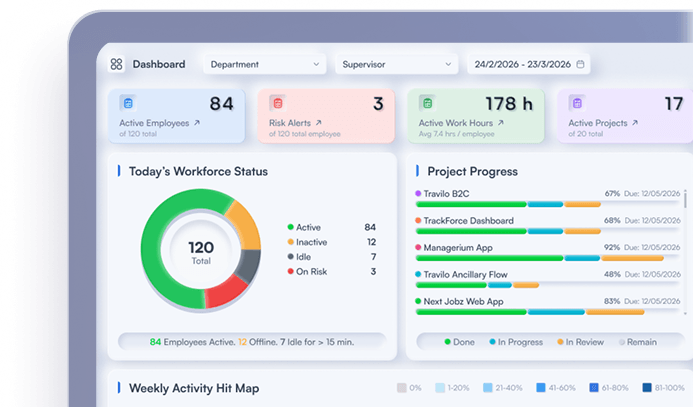
TrackForce records working hours, task efficiency, workload status and project progress for each person, across the whole review period. A manager opens a check-in or review with months of evidence in view, instead of a recollection of the last few weeks.
That supports three parts of the UK process: objectives that reflect real workload, reviews based on the full period, and records that show what support was offered and what changed. Activity capture, such as screenshots, is set per device, so a UK team can run on output data alone.
TrackForce is performance management software for the evidence layer. It does not replace the manager's judgement, the conversation, or the fair procedure Acas expects. TrackForce offers a free 30-day trial to test it with one UK team.
Checklist for UK Managers
- Objectives are SMART and reflect each person's usual tasks and workload.
- Informal check-ins happen regularly, with short notes.
- Reviews draw on evidence from the whole period, not recent memory.
- Capability and conduct problems are handled differently.
- Support, training and reasonable adjustments come before any formal step.
- Any PIP has specific objectives, a reasonable timeline and named support.
- Formal meetings follow the Acas Code, including the right to be accompanied and an appeal.
- Every stage is recorded, ready for the January 2027 rules.
Frequently Asked Questions
Is there a legal requirement to do performance reviews in the UK?
No UK law requires annual appraisals. Acas recommends regular informal conversations alongside formal reviews, and a documented process becomes essential if performance concerns ever lead to formal action or dismissal.
Does the Acas Code of Practice apply to poor performance?
Yes. The Acas Code of Practice on disciplinary and grievance procedures states that disciplinary situations include misconduct and poor performance. Employment tribunals can adjust awards by up to 25 per cent where an employer unreasonably fails to follow it.
Can an employer dismiss an employee for poor performance in the UK?
Yes, capability is a potentially fair reason for dismissal under the Employment Rights Act 1996. The employer must also follow a fair procedure, offer support first and treat dismissal as a last resort.
What changes in UK unfair dismissal law in 2027?
From 1 January 2027, the qualifying period for unfair dismissal claims falls from two years to six months, and the cap on the compensatory award is removed. Both apply where the effective date of termination is on or after that date.
How should performance management work for a disabled employee?
ACAS guidance says the employer must first do all it reasonably can to support the disabled person, including reasonable adjustments such as adjusted targets. A capability procedure should follow only after that support has been tried.
This guide describes UK employment practice in general terms and is not legal advice. Take advice from an employment specialist on individual cases.
Similar blog you can explore
How to Increase Employee Productivity: A Manager's Playbook
Lattice vs 15Five vs TrackForce: Process, Opinion or Evidence?
Employee Performance Management in South Africa: Poor Performance and Fair Process
Start Your 30-Day
Free TrackForce Trial