Remote Employee Monitoring: How to Monitor
Remote Employees Without Losing Productivity Visibility
2026-08-19
•
Author:
•
~1 min read
•
Updated August 19, 2026
- Remote Employee Monitoring Should Focus on Productivity Visibility
- Set Clear Expectations Before Monitoring Remote Employees
- Use Remote Employee Time Tracking to Understand Work Patterns
- Use Employee Activity Monitoring for Better Context
- Track Website and Application Usage Without Micromanaging
- Turn Remote Employee Monitoring Data Into Productivity Reports
- Use Employee Productivity Monitoring to Detect Workload Problems
- Use Role-Based Access in Employee Monitoring Software
- Balance Remote Employee Monitoring With Employee Privacy
- How TrackForce Supports Remote Employee Monitoring
- Remote Employee Monitoring Checklist
- onclusion: Use Remote Employee Monitoring Without Micromanaging
Remote employee monitoring should help managers understand how work is progressing, not turn remote work into constant surveillance. When teams work outside a shared office, managers lose many informal signals about workload, collaboration, and day-to-day progress.
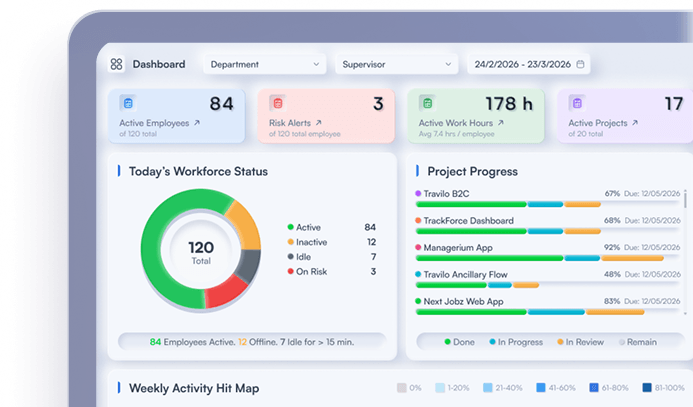
TrackForce supports this model with work-hour tracking, active and idle time, screenshots, website and application monitoring, reports, employee management, and role-based access.
Remote Employee Monitoring Should Focus on Productivity Visibility
The goal of remote employee monitoring is useful visibility.
Managers need answers to practical questions: Are employees working expected hours? Is one team overloaded? Are recurring idle periods linked to a process problem? Are productivity trends improving or declining?
A single data point rarely answers those questions. Someone can be active for hours while another employee may spend productive time reading documentation or working away from the keyboard.
That is why remote employee monitoring should focus on patterns, context, and results rather than isolated actions.
Set Clear Expectations Before Monitoring Remote Employees
Employee monitoring works better when expectations are defined first.
Set working hours, break rules, availability windows, and measurable outcomes. Employees should understand what successful work looks like before managers interpret monitoring data.
Also explain what is being tracked, such as work hours, active and idle time, application usage, website activity, screenshots, or productivity reports.
Transparency matters. Monitoring information should be used for legitimate business purposes, with access limited to people who need it.
Use Remote Employee Time Tracking to Understand Work Patterns
Time tracking gives managers a basic view of the remote workday.
TrackForce is designed to record working hours, active time, idle time, break counts, clock-in information, and total session duration. These metrics help managers compare work patterns across employees and teams.
Active time can show system engagement, while idle time can reveal unusual inactivity. But neither should be treated as a complete performance score.
A recurring trend matters more than one unusual afternoon. Compare time data with workload, role expectations, and actual output before drawing conclusions.
Use Employee Activity Monitoring for Better Context
Time data becomes more useful when paired with employee activity monitoring.
TrackForce includes employee snapshots that can be filtered by employee, department, and date range. Screenshots are organized chronologically, helping managers review a specific period when more context is needed.
This may help explain a productivity anomaly or reveal a blocked workflow.
Screenshots should support investigation, not replace management. Selective review creates context; constant review creates noise.
Track Website and Application Usage Without Micromanaging
Website and application usage can reveal how employees actually work.
TrackForce records website data such as site name, URL, visit count, and duration. It also records application information including employee, timestamp, active window, and duration.
This can help identify frequently used tools, inefficient workflows, or unusual browsing patterns.
Context is essential. A developer may spend hours in documentation. A marketer may work heavily in social platforms.
The better question is not, “Did this employee visit this website?” It is, “Does this activity make sense for the work they are expected to do?”
Turn Remote Employee Monitoring Data Into Productivity Reports
Raw monitoring data becomes more useful when converted into reports.
TrackForce includes daily workload, daily report, monthly report, and risk-related reporting. These reports can combine work hours, active time, productive time, workload, attendance, idle periods, and utilization.
Reports can reveal overloaded teams, changing productivity, attendance issues, or uneven work distribution while reducing manual reporting.
Use Employee Productivity Monitoring to Detect Workload Problems
Low productivity is not always caused by low effort. Sometimes the problem is workload imbalance.
TrackForce's Daily Work Load reporting is designed to show work hours, active time, utilization, and workload levels. Managers can use this information to identify employees who appear consistently overloaded or underutilized.
A sudden drop in activity may indicate a blocked workflow. Consistently high activity may signal unrealistic workload.
Productivity visibility should help managers improve allocation before small issues become missed deadlines, burnout, or quality problems.
Use Role-Based Access in Employee Monitoring Software
Employee monitoring data should not be visible to everyone.
TrackForce defines separate access levels for Super Admins, Admins, Managers, Team Leads, and Employees. Managers are mainly limited to department-level data, while Team Leads receive narrower team-level visibility.
The principle is simple: give people access to the monitoring information required for their responsibilities, and no more.
Role-based access makes employee monitoring software more secure and easier to manage.
Balance Remote Employee Monitoring With Employee Privacy
Remote employee monitoring is more sustainable when employees understand the rules.
Explain what information is collected, why it is needed, who can access it, and how it will be used. Organizations should also define retention policies and limit monitoring to legitimate workplace purposes.
Managers should avoid treating every idle period, website visit, or unusual activity log as proof of poor performance.
Data can highlight something worth discussing. It cannot always explain why it happened.
How TrackForce Supports Remote Employee Monitoring
TrackForce is designed to centralize remote employee monitoring and productivity visibility in one system.
Its specified capabilities include work-hour tracking, active and idle time, break tracking, employee snapshots, website and application monitoring, search activity, file activity, online meeting monitoring, screen records, productivity reports, employee management, device information, and role-based access controls.
This gives managers clearer visibility into work patterns, workload, tool usage, and performance trends without relying on fragmented manual reporting.
Want to improve productivity visibility across your remote workforce? Explore TrackForce to see how employee monitoring, time tracking, activity analytics, and workforce reporting can support your team.
Remote Employee Monitoring Checklist
- Define the productivity outcomes you want to measure.
- Set clear working hours and break expectations.
- Explain what employee activity will be monitored.
- Track work hours, active time, and idle-time trends.
- Review website and application usage in context.
- Monitor workload distribution across teams.
- Restrict monitoring data with role-based permissions.
- Discuss unusual patterns before making performance judgments.
onclusion: Use Remote Employee Monitoring Without Micromanaging
Remote employee monitoring works best when it supports better management rather than constant observation.
Combine time tracking, activity data, workload information, and productivity reports. Focus on recurring patterns instead of isolated incidents. Restrict sensitive information appropriately, and use monitoring insights to improve workflows, conversations, and resource allocation.
The objective is not to watch employees more closely. It is to understand remote work more clearly.
Ready to improve remote workforce visibility without slipping into micromanagement? Book a demo of TrackForce to see how time tracking, activity monitoring, productivity reports, and workforce analytics can help you manage remote teams more effectively.
Similar blog you can explore
Team Productivity Dashboards: 9 Metrics Managers Should Actually Track
Best Workforce Analytics Software: 7 Platforms Compared
Performance Appraisal Software: How to Choose in 2026
Start Your 30-Day
Free TrackForce Trial