Employee Monitoring Software for In-Office
Employees: A Practical Guide
2026-08-20
•
Author:
•
~1 min read
•
Updated August 20, 2026
- What Employee Monitoring Software Does in an Office
- Where In-Office Monitoring Creates Practical Value
- —1. Track Work Time and Breaks
- —2. Understand Application and Website Usage
- —3. Compare Workload Across Employees and Teams
- —4. Investigate Specific Operational or Security Concerns
- What Should You Monitor?
- How to Use Monitoring Without Damaging Trust
- —Be Transparent About the Purpose
- —Limit Access by Role
- —Review People, Not Just Scores
- —Avoid Covert Monitoring as the Default
- How to Choose Employee Monitoring Software for an In-Office Team
- A Simple Rollout Process
- Final Step: How TrackForce Supports Growing Teams
Employee monitoring is often discussed as a remote-work issue, but in-office teams can have the same management problem: being physically present does not show how work is distributed, which tools consume time, whether workloads are balanced, or where processes are getting stuck. The useful role of employee monitoring software is not to prove that people are “busy.” It is to give HR, administrators, managers, and team leads reliable work data for better decisions. Microsoft’s research on workplace productivity has also highlighted the gap between visibility and actual confidence about productivity.
That distinction matters. A meta-analysis of electronic performance monitoring covering 94 independent samples and 23,461 workers found no evidence that monitoring by itself improves worker performance. Another meta-analysis found a small decrease in job satisfaction and a small increase in stress associated with electronic monitoring. Monitoring should therefore be treated as a management input, not a substitute for goals, coaching, process improvement, or human judgment.
What Employee Monitoring Software Does in an Office
For in-office employees, monitoring software can combine time records, active and idle periods, application use, website use, screenshots, keystroke activity, and reporting. The exact information collected depends on the product and the employer’s configuration. The ICO recognizes technologies such as timekeeping systems, screenshots, productivity tools, internet tracking, and keystroke monitoring as forms of worker monitoring.
The strongest use case is visibility. Managers may already know who came to the office, but physical attendance alone does not explain how work is distributed or whether employees have the right tools and workload. Monitoring data can provide additional context, but it still needs to be connected to real tasks and outcomes rather than treated as a complete measure of performance.
Time tracking can also support accurate recordkeeping. For example, the U.S. Department of Labor states that covered employers must keep certain records related to non-exempt employees’ hours and wages. Employers can use different timekeeping methods as long as their records are complete and accurate. Requirements differ by country, worker type, and jurisdiction, so businesses should verify the rules that apply to them.
Where In-Office Monitoring Creates Practical Value
1. Track Work Time and Breaks
A time record becomes more useful when managers can see when work started, how long work continued, and where breaks or inactive periods occurred. Accurate time information can support attendance reviews, payroll processes, scheduling, and workload discussions. Official U.S. and UK guidance both recognize the importance of maintaining accurate working-time records in relevant employment contexts.
Activity data still needs context. A designer reading a brief, an analyst thinking through a difficult problem, or a manager speaking with a colleague may be doing legitimate work without generating continuous mouse or keyboard activity. Research has not established that electronic performance monitoring itself produces better employee performance, which is why activity levels should not be treated as an outcome metric on their own.
2. Understand Application and Website Usage
Application and website data can help answer operational questions such as: Which tools dominate a team’s working day? Are employees switching repeatedly between systems? Is a browser-based process consuming more time than expected?
This information is most useful when reviewed for a defined business purpose. The ICO advises employers to clearly establish why monitoring is necessary, use the least intrusive method that can reasonably achieve that purpose, and avoid collecting additional employee information simply because the technology makes it possible.
3. Compare Workload Across Employees and Teams
Work-hour, active-time, application-use, and project data can make differences between employees or departments easier to investigate. A large variation does not automatically mean one person is more productive than another. It can instead prompt managers to examine task allocation, process complexity, training requirements, or resource availability.
Monitoring data should begin the conversation, not end it. Research on electronic monitoring shows that measurement and performance are not the same thing, so managers still need job context and human review before drawing performance conclusions.
4. Investigate Specific Operational or Security Concerns
Detailed monitoring such as screenshots, file-transfer records, keystroke logs, or screen recordings can provide additional evidence when an organization is examining a defined operational, compliance, or security issue. These methods are also more intrusive than basic work-hour or application tracking.
The ICO specifically identifies screenshots, timekeeping technologies, keystroke monitoring, productivity tools, and internet-activity monitoring as workplace-monitoring methods. Its guidance emphasizes necessity, proportionality, lawful processing, data minimization, transparency, and security when employers use these technologies.
What Should You Monitor?
A practical starting point is to collect the minimum information needed to solve the identified business problem. This reflects the data-minimization approach recommended in official data-protection guidance.
If inaccurate attendance records are the problem, start with clock-in, clock-out, and work-hour data. If the concern is software adoption, application usage may be sufficient. If management needs better workload planning, time and team-level reports may provide the necessary information. Moving immediately to screen recording or keystroke collection could gather substantially more information than the original purpose requires.
CIPD offers similar practical guidance. It recommends explaining clearly what is being monitored and why, consulting employees so monitoring measures are relevant and necessary, and remembering that monitoring technology is not a replacement for effective leadership.
How to Use Monitoring Without Damaging Trust
Be Transparent About the Purpose
Employees should understand what information is being collected, why it is needed, when monitoring takes place, and who has access to the resulting information. The ICO says workers should be made aware of monitoring and notes that a lack of clarity can negatively affect trust as well as workers’ data-protection rights.
Limit Access by Role
Monitoring information should only be available to people who genuinely require it for their responsibilities. UK government data-protection guidance similarly recommends restricting staff information so that only appropriate personnel can access the records they need.
Review People, Not Just Scores
Automated classifications such as “idle,” “low activity,” or “risk user” should not automatically become performance conclusions. The ICO’s guidance on automated monitoring specifically addresses the need to consider human oversight when automated monitoring processes affect decisions about workers.
Avoid Covert Monitoring as the Default
Some monitoring technologies can operate without employees seeing them, but technical capability does not automatically make covert monitoring appropriate. The ICO says covert monitoring is unlikely to be justifiable in most normal circumstances and may only be appropriate in exceptional cases, such as a specific investigation where notifying workers would undermine the investigation.
How to Choose Employee Monitoring Software for an In-Office Team
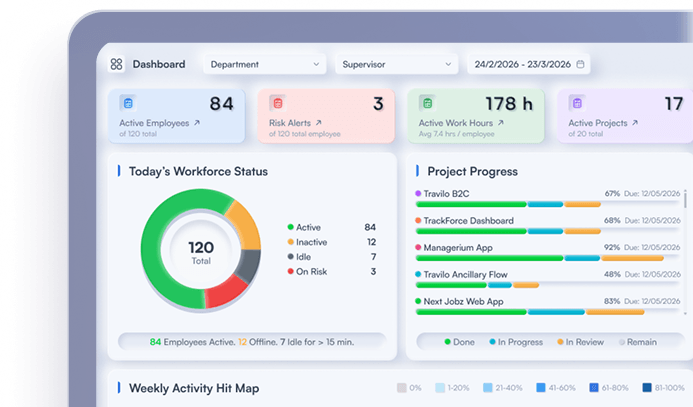
Start with the management decision you need to make, then evaluate features against that need. For time management, check whether the system can distinguish work time, active time, idle time, breaks, start times, and stop times. For larger organizations, look for employee and department filters so managers can focus on the teams they actually supervise.
Role-based permissions are also important when monitoring data contains detailed employee information. Reporting should help managers identify patterns without requiring them to examine raw logs continuously, while configuration controls should allow the organization to limit collection to information that serves the stated monitoring purpose. These principles align with the ICO’s recommendations on data minimization, transparency, necessity, and appropriate access to monitoring information.
The best configuration is therefore not necessarily the configuration that tracks the most information. It is the one that provides enough reliable data to solve a defined operational problem while avoiding unnecessary collection.
A Simple Rollout Process
Start by defining the business purpose in one sentence, such as “improve the accuracy of employee work-hour reporting.” Then identify only the data needed for that purpose, establish who can access it, document the employee monitoring notice or policy, and test the system with a limited group before expanding it. This approach is consistent with the ICO’s worker-monitoring checklist and CIPD recommendations on necessity and employee communication.
During the pilot, challenge assumptions created by activity metrics. High active time does not automatically demonstrate high-quality work, and low keyboard activity does not automatically demonstrate poor performance. Microsoft’s 2022 Work Trend Index found a significant perception gap: 87% of surveyed employees reported being productive, while 85% of leaders said the shift to hybrid work made it difficult to feel confident that employees were productive. Monitoring information is more useful when connected to agreed outputs and responsibilities.
Final Step: How TrackForce Supports Growing Teams
TrackForce helps businesses manage both in-office and remote teams through time tracking, activity monitoring, application and website usage, workload reports, employee management, and role-based access. These features give managers a centralized view of employee activity and work patterns.
For growing digital businesses, this can reduce manual reporting and make it easier to manage larger teams with clearer visibility into attendance, workload, and productivity data. Organizations should configure monitoring according to their business needs, employee policies, and applicable privacy requirements.
Similar blog you can explore
Team Productivity Dashboards: 9 Metrics Managers Should Actually Track
Best Workforce Analytics Software: 7 Platforms Compared
Performance Appraisal Software: How to Choose in 2026
Start Your 30-Day
Free TrackForce Trial