Employee Task Tracking: 9
Signals That Reveal Performance
2026-10-18
•
Author: TrackForce Team
•
~1 min read
•
Updated October 18, 2026
- What Is Employee Task Tracking?
- Employee Task Tracking at a Glance
- 1. Weighted Task Completion
- 2. On-Time Delivery
- 3. Cycle Time
- 4. Throughput Trend
- 5. Work in Progress
- 6. Blocked Time
- 7. Rework and First-Pass Quality
- 8. Estimate Accuracy
- 9. Workload Balance
- How to Build a Fair Employee Task Tracking System
- —1. Define what a completed task means
- —2. Capture only the fields that support decisions
- —3. Record context when work changes
- —4. Combine task signals with work patterns
- —5. Review trends, exceptions and outcomes
- —6. Let employees see and correct the record
- Common Employee Task Tracking Mistakes
- How TrackForce Supports Employee Task Tracking
- Final Takeaway
- Frequently Asked Questions
- —What is employee task tracking?
- —Can task completion measure employee productivity?
- —What should an employee productivity tracker measure?
- —How often should managers review task data?
- —How do you track tasks without micromanaging employees?
- Editorial Verification Notes
- Rank Math Checklist
Employee task tracking becomes useful when it answers more than “How many tasks did this person close?” A task list can show ownership, status and deadlines, but those fields do not automatically explain performance.
One employee may close twenty routine tasks while another completes three complex assignments. A completed task may return twice for correction, while a missed deadline may reflect an external dependency.
The right approach connects task data with quality, timeliness, workload, complexity and work patterns. That turns a project record into a management signal without treating every click or status change as a performance verdict.
What Is Employee Task Tracking?
Employee task tracking is the process of recording assigned work, ownership, priority, progress, deadlines, dependencies and completion. An employee productivity tracker may add time, activity, application use, attendance, workload and trend data to explain how the work moved.
The distinction matters:
- A task record shows what work was expected and what happened to it.
- Activity data shows how working time was used.
- Performance evidence shows whether useful work was delivered to the required standard.
No single layer is enough. Task data can reward volume, activity data can reward visible busyness and outcome data can hide unsustainable workloads.
Employee Task Tracking at a Glance
| Signal | What it can reveal | Essential guardrail |
| Weighted completion | Progress on important work | Do not count every task equally |
| On-time delivery | Reliability against commitments | Record changed scope and dependencies |
| Cycle time | Speed from start to completion | Compare similar task types |
| Throughput trend | Sustainable delivery capacity | Pair volume with quality |
| Work in progress | Focus and overload risk | Account for necessary parallel work |
| Blocked time | Process and dependency friction | Do not assign every delay to the owner |
| Rework rate | First-pass quality | Define what counts as avoidable rework |
| Estimate accuracy | Planning reliability | Separate poor estimates from scope changes |
| Workload balance | Distribution of responsibility | Weight work by effort and complexity |
These signals should start a conversation. They should not produce an automatic final rating.
1. Weighted Task Completion
A raw completion count assumes every task carries the same value. That is rarely true. Add a simple weighting system based on priority, effort or business impact.
Weighted completion rate = completed task points / task points due x 100
Keep the scale simple and agree on the weight before work begins so it cannot be changed to justify a later judgment.
Weighted completion shows progress more fairly, but it still needs quality and deadline measures.
2. On-Time Delivery
On-time delivery measures whether agreed work was completed by its valid due date.
On-time delivery rate = tasks completed on time / completed tasks x 100
Store the original deadline, approved revisions and the reason for each change. If a client delayed approval or a manager changed the priority, that context should not disappear.
The U.S. Office of Personnel Management identifies timeliness alongside quality, quantity and cost-effectiveness as a general performance measure. The deadline therefore matters, but it is only one dimension.
3. Cycle Time
Cycle time measures how long a task takes from active start to completion. A rising trend can expose approval delays, unclear requirements, excessive handoffs or too much work in progress.
Compare similar work. A routine data check should not share the same baseline as a complex investigation. Use medians where a few exceptional tasks would distort the average.
For employee task tracking, the trend is usually more useful than one isolated result. A stable four-week increase deserves investigation even if every task remains technically within deadline.
4. Throughput Trend
Throughput is the number of comparable work items completed during a period. It can help forecast team capacity when tasks are reasonably standardised.
The important word is trend. A single busy week may reflect overtime, unusually easy tasks or work pulled forward from another period. Review four to twelve weeks and pair throughput with rework, customer results or another quality measure.
TrackForce's guide to employee performance metrics explains why output needs to sit beside quality, timeliness, reliability and business impact.
5. Work in Progress
Work in progress, or WIP, is the number of tasks started but not finished. High WIP can reveal fragmented attention, changing priorities or a manager assigning new work before current work can close.
Do not assume that high WIP is an employee discipline problem. It may be a workflow-design problem. Review how long each task has remained open and whether the employee controls the next action.
A practical dashboard shows active WIP, ageing WIP and tasks waiting on someone else.
6. Blocked Time
Blocked time records how long a task cannot move because of a dependency, decision, system issue or missing input. It turns a vague delay into an operational signal.
Use clear blocker categories such as waiting for approval, waiting for customer, technical issue or cross-team dependency. Managers can then find repeated bottlenecks across many tasks instead of blaming individual owners.
This is where an employee productivity tracker adds value. Workload and activity patterns can show whether the employee moved to other useful work while a task was blocked.
7. Rework and First-Pass Quality
A task marked complete is not necessarily finished well. Track whether it passed the first review, required correction or reopened after delivery.
Rework rate = tasks returned for avoidable correction / completed tasks x 100
Define avoidable correction carefully. New customer requests, changed scope and reviewer preference should not be recorded as employee error.
The latest CIPD performance-management factsheet describes task performance as how effectively core job activities are carried out. Effectiveness requires more than counting completed boxes.
8. Estimate Accuracy
Estimate accuracy compares planned effort or duration with the result. It helps teams improve scheduling and reveals work that is repeatedly underestimated.
Do not turn every variance into a penalty. Discovery work, emergencies and changing requirements naturally create uncertainty. Review patterns by task type and team, then improve the planning process.
If one category regularly takes twice the estimate, the useful response may be better scoping, training or automation rather than pressure on the employee.
9. Workload Balance
Task ownership should reveal whether responsibility is distributed fairly. Compare weighted assignments, active WIP, urgent work, due dates and blocked items across the team.
An employee with fewer completed tasks may be carrying the hardest workload. Another with high throughput may be handling repeatable requests. Fair employee task tracking makes both situations visible.
The TrackForce guide to team productivity dashboards shows how workload, outcome, quality and activity measures can share one management view.
How to Build a Fair Employee Task Tracking System
1. Define what a completed task means
Specify the deliverable, quality standard, owner and acceptance condition. “Prepare report” is vague. “Submit the approved monthly revenue report with reconciled figures by Friday” is measurable.
2. Capture only the fields that support decisions
Start with owner, priority, type, due date, status, dependency and acceptance result. Add complexity or effort only when the team can use it consistently.
3. Record context when work changes
Preserve deadline changes, scope changes, reassignments and blocker reasons. Editing the final date without history destroys the evidence needed for a fair review.
4. Combine task signals with work patterns
Time, activity and application data can help explain delay, overload or fragmentation. They cannot prove output quality on their own. The article on measuring productivity without micromanaging provides a practical boundary.
5. Review trends, exceptions and outcomes
Use weekly operational reviews for blockers and capacity. Use monthly trends for process improvement. Use a longer period for performance conversations so one difficult week does not define an employee.
6. Let employees see and correct the record
Show people the task and productivity data used in discussions. Provide a way to add context or correct errors. Shared evidence supports coaching more effectively than hidden scoring.
Common Employee Task Tracking Mistakes
Avoid these five mistakes:
- Ranking people by completed task count. This rewards small tasks and discourages complex work.
- Using activity as the result. Active time can explain a work pattern but cannot prove value.
- Comparing unlike roles. Designers, analysts and support agents need different task definitions.
- Ignoring teamwork. Assistance, reviews and unblocking others may not appear as owned tasks.
- Automating the final judgment. Dashboards identify patterns. Managers still need context and human review.
How TrackForce Supports Employee Task Tracking
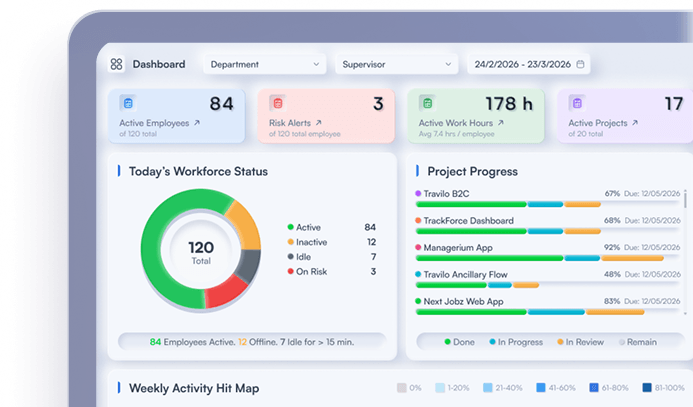
TrackForce connects task and project context with working hours, active and idle time, application and website use, workload information, reports and productivity trends. This creates a fuller picture than a standalone checklist.
Managers can investigate why delivery changed, whether workload became uneven or whether repeated tool switching indicates workflow friction. The data should guide a question, not declare a verdict.
Explore TrackForce employee productivity software to see how work visibility and performance context can support a transparent tracking process.
Final Takeaway
Good employee task tracking does not ask who closed the most boxes. It asks whether important work moved, arrived on time, met the expected standard and was completed under a sustainable workload.
Use weighted completion, delivery, cycle time, throughput, WIP, blocked time, rework, estimate accuracy and workload balance together. Then add employee context and business outcomes before making a performance decision.
That is how a task list becomes a useful performance signal without becoming a shortcut for micromanagement.
Frequently Asked Questions
What is employee task tracking?
Employee task tracking records assigned work, ownership, priority, status, deadlines, dependencies and completion. A fair system also considers complexity, quality, workload and circumstances that affected delivery.
Can task completion measure employee productivity?
Task completion is one productivity signal, but it cannot measure performance alone. Tasks differ in complexity and value, and completion counts do not show quality, rework, dependencies or customer impact.
What should an employee productivity tracker measure?
An employee productivity tracker should combine role-specific outcomes with quality, timeliness, workload and relevant work-pattern data. It should avoid treating active time, screenshots or task volume as a complete performance score.
How often should managers review task data?
Review blockers and workload weekly, broader trends monthly and performance over a longer representative period. The right schedule depends on the work cycle and the decisions the data must support.
How do you track tasks without micromanaging employees?
Define outcomes clearly, collect only necessary data, explain the purpose, review trends instead of every action and let employees see and correct their records. Use the information to remove blockers and improve work design.
Editorial Verification Notes
- TrackForce product descriptions and related internal content were checked on 18 October 2026.
- Performance-measurement guidance was checked against current OPM and CIPD resources.
- The requested money page https://trackforce.io/employee-productivity-software was not accessible to the verification crawler. Confirm that it returns HTTP 200 before publication. If unavailable, use https://trackforce.io/ temporarily.
- Formulas are management examples and should be adapted to each role, policy and jurisdiction.
Rank Math Checklist
- Set the focus keyword exactly as employee task tracking.
- Focus keyword begins the SEO title and H1.
- Focus keyword appears in the slug, meta description, opening paragraph, subheadings, body, conclusion, FAQ and image alt text.
- SEO title includes the number 9 and an action-oriented promise.
- Add the hero image with the supplied alt text.
- Keep at least one authoritative external link as DoFollow.
- Add Article and FAQ schema after the final URL, publication date and image URL are confirmed.
Similar blog you can explore
Apploye Alternatives: TrackForce vs Apploye in 9 Areas
How to Write a Performance Review: 8 Proven Steps
Employee Monitoring South Africa: 9 Essential POPIA and RICA Rules
Start Your 30-Day
Free TrackForce Trial