Employee Performance Management in the UAE:
Rules and Practice for 2026
2026-10-25
•
Author:
•
~1 min read
•
Updated October 25, 2026
- What Employee Performance Management in the UAE Involves
- Probation: The First Performance Review
- Objectives That Fit the Contract and the Hours
- Regular Check-ins and Annual Reviews
- When Performance Falls Short: Warnings and Investigation
- The Records UAE Managers Should Keep
- Mainland, DIFC and ADGM
- Where TrackForce Fits
- Checklist for UAE Managers
- Frequently Asked Questions
- —How long can probation last in the UAE?
- —Can an employer dismiss an employee for poor performance in the UAE?
- —Is a written investigation required before dismissal without notice?
- —Do working hours change during Ramadan in the UAE?
- —Does the UAE Labour Law apply in DIFC and ADGM?
Employee performance management in the UAE follows Federal Decree-Law No. 33 of 2021. It sets a probation period of up to six months, ties performance to the duties in the employment contract, and requires a written investigation and two warnings before dismissing an employee without notice for poor performance.
Most performance disputes in the UAE come down to paperwork: were the duties clear, was the employee warned, and was it all in writing? This guide covers probation, fair targets through Ramadan, warnings, and the records to keep. TrackForce supplies the work evidence behind those steps through its employee productivity software for UAE teams and its employee performance management software.
What Employee Performance Management in the UAE Involves
For a mainland private-sector employer, performance management follows the employment relationship from the first day:
- Set objectives that match the duties in the employment contract.
- Review performance before probation ends.
- Hold regular check-ins and a structured annual review.
- Address shortfalls with support first, then written warnings.
- Use formal termination steps only when the documented process supports it.
DIFC and ADGM have their own employment laws, so entities licensed there follow a different rulebook. The rules below apply to mainland employers under the federal Labour Law.
Probation: The First Performance Review
Under Article 9 of the Labour Law, an employer may set a probation period of no more than six months, and only once in each employment. As Khaleej Times sets out, an employer that ends employment during probation must give 14 days' prior written notice.
Probation is the cheapest point to get performance management right:
- Agree measurable objectives in the first week.
- Hold a mid-probation check-in and note the outcome.
- Decide before the period ends, leaving time for the 14-day notice.
A probation decision based on clear objectives and dated notes is far easier to explain than one based on a general impression.
Objectives That Fit the Contract and the Hours
UAE performance targets have to work within two limits: the duties in the contract and the hours the law allows. According to u.ae, "private sector workers are required to work 8 hours per day or 48 hours per week." Overtime is capped at two extra hours a day, paid at the hourly rate plus 25%, or plus 50% between 10 pm and 4 am.
Ramadan changes the maths. "During the holy month of Ramadan, working hours are reduced by 2 hours every day." An 8-hour day becomes 6 hours, so a monthly target set for a normal month reads about 25% short in Ramadan unless it is adjusted. Ramadan 2027 is expected to begin on 8 February 2027, subject to moon sighting.
Good UAE objectives in practice:
- name a measurable result linked to a duty in the contract
- account for current workload, not a company-wide average
- adjust for Ramadan hours before the month starts
- carry a date for review
For a starting set of measures, see the guides to key performance indicators for employees and employee performance metrics.
Regular Check-ins and Annual Reviews
The Labour Law does not set an appraisal format, so the review cycle is for the employer to design. What it does reward is a clear record. Short, regular check-ins give managers dated notes on progress, support offered, and problems raised.
Those notes also make the annual review fairer. A review built from a year of notes covers the whole period, rather than the last few weeks a manager happens to remember. The guide on how to write a performance review sets out a structure, and the guide to performance review bias covers the recency and recall problems that regular notes prevent.
When Performance Falls Short: Warnings and Investigation
The Labour Law gives employers a specific route for persistent poor performance. Article 44 allows dismissal without notice only "after conducting a written investigation" with the employee. Its fourth ground, quoted in the Dubai Development Authority's Labour Law summary, covers an employee who "fails to perform his main duties as set out in the Employment Contract," where the failure continues "despite conducting a written investigation with him for such reason and after being served with two warnings of dismissal."
| Stage | What happens | Record to keep |
| 1. Clarify duties | Confirm the duties and targets the employee is measured against | Contract duties, agreed objectives |
| 2. Support | Discuss the gap, the cause, and the training or help on offer | Dated note of the conversation |
| 3. Written investigation | Investigate the shortfall in writing, with the employee's side recorded | Investigation minutes |
| 4. First warning of dismissal | Warn the employee in writing that continued failure may lead to dismissal | Signed warning |
| 5. Second warning of dismissal | Repeat in writing if the failure continues | Second signed warning |
| 6. Decision | Dismiss only if the failure is repeated after both warnings, with a written, justified notice | Dismissal letter with reasons |
During a disciplinary investigation, u.ae notes that an employer may suspend the worker for up to 30 days at half wage, and must pay the full wage if no case is established. Employers with 50 or more workers must also have internal work regulations covering penalties, explained in "a language they understand," and a written grievance system.
Termination with notice is the other route. The Labour Law sets a notice period of at least 30 days and no more than 90 days, given in writing for a legal reason. Termination is treated as unlawful when it follows a serious complaint by the employee to the Ministry, or a lawsuit later proven valid. In those cases, a court sets compensation, capped at three months' wage.
The Records UAE Managers Should Keep
In a UAE dispute, the written record carries the case. Gulf Today notes that a dismissal notice under Article 44 must be in writing, justified, and delivered to the employee. Keep, for each employee:
- the contract duties and agreed objectives, with any changes
- probation notes and the probation decision
- check-in and annual review notes
- Ramadan target adjustments
- investigation minutes, signed warnings and outcome letters
If data from workplace tools feeds a review, it needs a documented purpose and staff should know it is collected. The duties under the federal data protection law, and the separate DIFC and ADGM regimes, are covered in the guide to UAE employee monitoring rules under the PDPL.
Mainland, DIFC and ADGM
Many UAE groups run entities in more than one jurisdiction. A mainland company follows the federal Labour Law. An entity licensed in DIFC or ADGM follows that free zone's own employment law, with its own rules on probation, notice and termination.
For performance management, that means one group may need more than one process. Objectives and reviews can share a format, but warnings, notice and termination steps should follow the law of the entity that employs the person.
Where TrackForce Fits
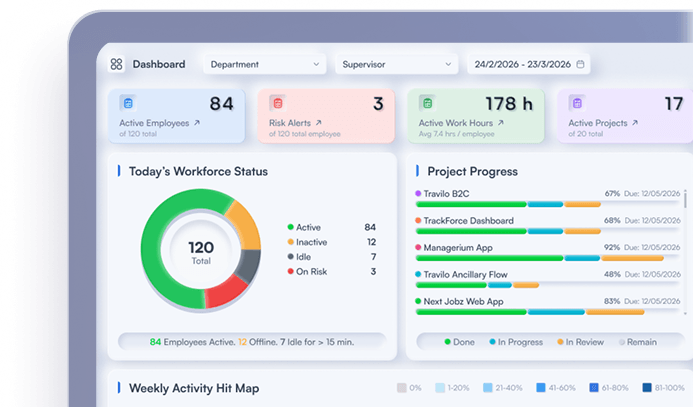
TrackForce records working hours, task efficiency, workload status, and project progress for each person, across the whole review period. A manager opens a probation check-in or annual review with months of evidence in view, instead of a recollection of recent weeks.
That supports the parts of the UAE process that depend on facts: targets that reflect real workload, a Ramadan month read against the shorter working day, and a dated record of performance before any warning is issued. Activity capture, such as screenshots, is set per device, so a team can run on output and hours data alone.
TrackForce is performance management software for the evidence layer. It does not replace the written investigation, the warnings, or the manager's judgement that the Labour Law expects. TrackForce offers a free 30-day trial to test it with one UAE team.
Checklist for UAE Managers
- Objectives link to the duties in each employment contract.
- Probation reviews happen early enough to give 14 days' written notice.
- Targets are adjusted for Ramadan hours before the month begins.
- Check-ins and reviews are noted and dated.
- Any shortfall gets support first, then a written investigation.
- Two written warnings of dismissal come before any dismissal without notice.
- Every decision is written, justified, and delivered to the employee.
- DIFC and ADGM entities follow their own employment law.
Frequently Asked Questions
How long can probation last in the UAE?
Under Article 9 of Federal Decree-Law No. 33 of 2021, probation can last up to six months and can be applied only once in each employment. An employer who ends employment during probation must give 14 days' prior written notice.
Can an employer dismiss an employee for poor performance in the UAE?
Yes. Article 44 allows dismissal without notice where an employee fails to perform the main duties in the employment contract, and the failure continues after a written investigation and two written warnings of dismissal. Employers can also terminate with 30 to 90 days' written notice for a legal reason.
Is a written investigation required before dismissal without notice?
Yes. Article 44 allows dismissal without notice only after a written investigation with the employee. The dismissal notice must also be in writing, justified, and delivered to the employee.
Do working hours change during Ramadan in the UAE?
Yes. For private-sector workers, working hours are reduced by two hours every day during Ramadan. Performance targets set for a normal month should be adjusted to the shorter day.
Does the UAE Labour Law apply in DIFC and ADGM?
No. DIFC and ADGM have their own employment laws. A mainland company follows the federal Labour Law, while an entity licensed in DIFC or ADGM follows its free zone's rules on probation, notice, and termination.
This guide describes UAE employment practice in general terms and is not legal advice. Seek advice from a UAE employment specialist on individual cases.
Similar blog you can explore
How to Increase Employee Productivity: A Manager's Playbook
Lattice vs 15Five vs TrackForce: Process, Opinion or Evidence?
Employee Performance Management in South Africa: Poor Performance and Fair Process
Start Your 30-Day
Free TrackForce Trial