Time Tracking App for Small Business: A Practical
Guide to Improving Productivity and Employee Performance
2026-09-16
•
Author: TrackForce Team
•
~1 min read
•
Updated September 20, 2026
- What to Look For in the Best Time Tracking Software for Small Business
- —The Four Types of Time Tracking Tools
- —The Eight Criteria That Actually Matter
- What an Employee Time Tracking App Should Actually Measure
- —Attendance, Schedules, and Working Hours
- —Active and Idle Work Visibility Explained Responsibly
- Connecting Tracked Time to Tasks, Projects, and Delivery
- —A Workflow Example From Dashboard to Review
- Employee Productivity Tracking Without the Surveillance Framing
- Remote Team Time Tracking for Hybrid and Distributed Teams
- —Time Tracking Apps for Startups and Small Teams
- How to Track Employee Hours Without a Heavy Rollout
- Reporting and Workforce Analytics for Small Businesses
- How to Choose the Right Fit for Your Business
- Frequently Asked Questions
- —How Do I Track Employee Hours in a Small Business?
- —Is Employee Activity Monitoring Legal in the United States?
- —What Is the Best Time Tracking App for a Small Team?
- —Can I Track a Remote Team’s Hours Without Monitoring Them Constantly?
- —Do I Need Workforce Analytics if I Only Have a Few Employees?
- Getting Started With TrackForce
Most small businesses do not have a time problem. They have a visibility problem.
A 12-person software team in Austin can log 480 hours in a week and still miss a client deadline, because nobody could see that two of those hours per person were being absorbed by unplanned support tickets. The hours were captured. The reason for the miss was not.
That is the gap this guide closes. Choosing a time tracking app for small business is not about finding the tool with the most features—it is about finding one that connects working hours to tasks, projects, and workload, so you can make staffing and delivery decisions with evidence instead of instinct. This is a practical, US-market guide to making that decision and getting live quickly, without an enterprise rollout.
What to Look For in the Best Time Tracking Software for Small Business
The US search results for “best time tracking software for small business” are dominated by vendor roundups—comparison posts that rank ten tools and rarely explain how the types of tools differ. Before you compare brands, decide which category you are actually buying. That single decision eliminates most of the shortlist.
The Four Types of Time Tracking Tools
| Tool typeWhat it doesBest forWhat it will not tell you | |||
| Simple timer | Start/stop timer and manual entries | Freelancers and single-project work | Attendance, schedules, and workload |
| Timesheet software | Weekly timesheets, approvals, and payroll export | Teams that bill by the hour | How time maps to task progress |
| Basic monitoring tool | Activity and idle signals | IT and compliance review | Project or delivery context |
| Workforce intelligence platform | Time, activity, attendance, tasks, projects, and workload in one system | Small businesses managing delivery and hybrid teams | Nothing, but it requires more setup and policy planning |
Most small businesses start with the first two types and outgrow them within a year, once headcount passes roughly fifteen people and delivery questions become more urgent than payroll questions.
The Eight Criteria That Actually Matter
Work through these in order. The first four are non-negotiable. The last four are what separate a tool you will still be using in two years from one you abandon in three months.
- Time capture that fits the work. Automatic timers, manual entry, and editable timesheets—different roles need different defaults.
- Task and project linkage. Time should attach to a task, and a task to a project. Hours in isolation cannot tell you why a deadline slipped.
- Attendance and scheduling. This is especially important for hybrid and shift-based teams.
- Role-based access. Supervisors, managers, and HR should see different views. This matters more than most buyers expect.
- Reporting you will actually read. Daily and monthly summaries beat a raw data export.
- Workload visibility. Can you see who is overloaded before they burn out or miss a date?
- Setup time. Ask how long it takes to get a team of ten live. Anything measured in weeks is a red flag for a small business.
- Pricing model. Confirm per-user costs and contract terms directly with the vendor. Pricing changes and is not something a guide can quote reliably.
What an Employee Time Tracking App Should Actually Measure
An employee time tracking app earns its place in your stack by answering three questions: who worked, on what, and how much of that time was productive work rather than idle time or administrative overhead.
That means going beyond clock-in and clock-out. A useful system captures total hours, active and idle time, attendance patterns, and—critically—which task or project each block of time belongs to.
The business outcome behind each of those data points is simple: better staffing decisions, earlier delivery warnings, and fairer performance conversations built on evidence.
Attendance, Schedules, and Working Hours
For a small business without a dedicated HR operations function, attendance should be a byproduct of normal work, not a second job.
Look for scheduling that lets a team lead set shifts or flexible windows, and attendance that derives from actual activity rather than a separate check-in ritual people forget to complete.
Hybrid teams make this harder and more important. A structured schedule paired with attendance records tells you whether your Tuesday office day is actually being used, without anyone having to chase answers in a chat thread.
Active and Idle Work Visibility Explained Responsibly
Active and idle visibility is the feature small businesses are most nervous about, and rightly so. The responsible way to implement it is with a written policy, role-based access, and a stated purpose that everyone understands.
Here is the framing that works:
- The policy comes first. Document what is tracked, who can see it, and why. Share it before you switch anything on.
- Access is role-based. A team lead sees their team’s workload and task movement. Raw activity detail belongs with the roles that have a legitimate review reason.
- The purpose is workload understanding, not policing. If a team member’s idle time jumps from 45 minutes to three hours a day, the useful question is not “What were they doing?” It is “Is this person blocked, over-assigned, or waiting on someone else?”
Read that way, active and idle data is a workload signal. Read any other way, it damages trust and you lose the tool’s value entirely.
Connecting Tracked Time to Tasks, Projects, and Delivery
This is where most time tracking setups stop being useful. Hours go into a timesheet, timesheets go to payroll, and the project timeline is managed in a completely separate place by someone copying numbers between two systems.
Connecting activity and time information to tasks, projects, and workload is the difference between knowing your team was busy and knowing whether they are going to deliver.
When a task carries both a status and the time logged against it, three things become visible that were previously guesswork:
- Where time is really going. Planned project work versus unplanned interruptions versus internal administration—often the largest hidden cost in a small team.
- Which tasks are stalling. A task that is 80% complete with no logged time this week is a delivery risk, not a status update.
- Who is carrying too much. Workload spread across the team, expressed in both assigned tasks and actual hours, shows the imbalance before it turns into a missed deadline.
This is the piece small businesses most often describe as the thing that finally made their tracking data useful, rather than a monthly chore.
A Workflow Example From Dashboard to Review
Here is an illustrative example for a 14-person US digital agency running client projects. The numbers are illustrative only, not a product statistic.
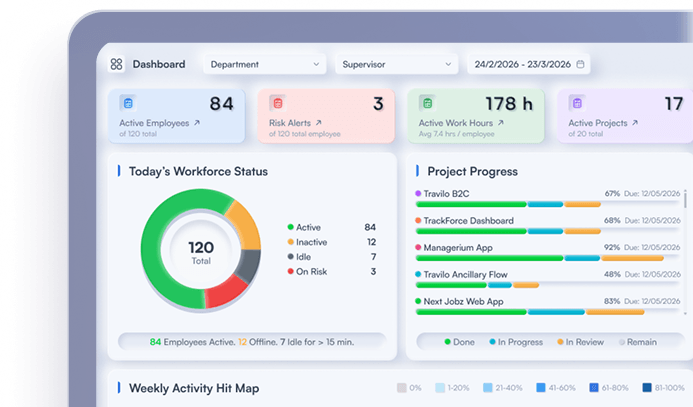
Monday, 9:00 a.m.—Dashboard: The operations manager opens the weekly view. The percentage of time against client-billable projects is down slightly from last week. Administrative and internal time is up.
9:10 a.m.—Task progress: Drilling in, one client project accounts for most of the increase. Two tasks on that project are marked in progress but show minimal logged time in the last three days.
9:25 a.m.—Workload: The two people assigned to those tasks are also carrying the highest active workload across the team this week. One has been pulled onto support work, which explains the missing project time.
9:40 a.m.—Review: The manager reassigns one task to a team member with a lighter load, confirms that the support queue needs a rotation, and flags the project for a short check-in. No deadline moved.
Four steps, forty minutes, and one avoided escalation—with every decision traceable to a dashboard rather than a hallway guess.
Employee Productivity Tracking Without the Surveillance Framing
Employee productivity tracking works when it is structured, periodic, and fair. It fails when it is continuous, opaque, and punitive.
Small businesses that get this right treat productivity review as a scheduled management routine, not a background monitor.
A workable structure for a small business includes:
- Daily: Team leads scan task movement and flag blockers. Five minutes, not a report.
- Weekly: Managers review workload balance and project progress together. This is where staffing decisions get made.
- Monthly: Leadership reviews trends such as billable versus non-billable time, delivery timeliness, and workload distribution alongside the numbers the business already tracks.
Two principles keep this on the right side of the line.
First, the data reviewed should be the same data employees can see for themselves.
Second, the review should lead to a change—rebalanced work, a removed blocker, or a clearer priority—not just a scorecard.
Productivity tracking that produces no action is measurement for its own sake, and teams recognize it quickly.
Remote Team Time Tracking for Hybrid and Distributed Teams
Remote team time tracking breaks the assumptions built into office-based tools. There is no shared hallway, no visible desk, and no informal signal that someone is heads-down on a hard problem.
What remote and hybrid teams need is not more monitoring. It is more context.
Three practices make the difference:
- Anchor time to tasks, not presence. In a distributed team, hours online tell you very little. Hours logged against a task tell you a great deal.
- Keep schedules explicit. Clearly stated working windows, especially where teams span US time zones, reduce the “Are they available?” churn that eats a manager’s day.
- Review asynchronously by default. A daily written summary of task movement and blockers handles most of what an office would have handled in person, and it creates a record the whole team can see.
Time Tracking Apps for Startups and Small Teams
A startup founder usually has no HR function, no operations manager, and no appetite for a two-week implementation.
The requirement is narrower and simpler: hours, tasks, and workload visible from day one, with the option to add attendance, schedules, and reporting as the team grows.
If you are choosing a time tracking app for startups, prioritize setup speed and task-level visibility over reporting depth. You can add sophistication later. You cannot recover the first six months of delivery decisions you made without data.
How to Track Employee Hours Without a Heavy Rollout
You can be live in an afternoon. The setup order matters more than the tool. Get the structure right and the data becomes useful immediately.
- Decide what you are measuring and say so. Write one page explaining what is tracked, who sees it, and what it is for. Share it with everyone before setup.
- Set up your team structure first. Create your people, teams, and reporting lines, and assign roles such as team member, supervisor, manager, and administrator.
- Define projects and create the tasks inside them. Resist the urge to import everything. Start with the work currently in progress.
- Turn on time capture. Set defaults that fit each role—automatic for project work and manual for support and administrative tasks.
- Configure schedules and attendance. Match them to your team’s actual working patterns, including hybrid working windows.
- Set the reporting cadence before you need it. Configure daily, weekly, and monthly views from the start, not in a panic at the end of the month.
- Run a two-week review and adjust. Expect to change task naming and project structure once you see real data. That is normal, not failure.
The most common mistake is treating setup as a one-off IT task. It is a management task, and the businesses that get value from it are the ones where a manager, not an administrator, owns the structure.
Reporting and Workforce Analytics for Small Businesses
Workforce analytics for small businesses does not need to be complex. It needs to be read.
A handful of reports reviewed on a schedule will outperform a sophisticated analytics suite nobody opens. Reading those reports is where a time tracking app for small business turns raw hours into delivery decisions.
The reports that earn their place in a small business include:
- Daily activity and task summary: What moved, what stalled, and who is blocked.
- Weekly time by project and task: Where hours actually went compared with where you planned them.
- Attendance and schedule adherence: Particularly useful for shift-based, hybrid, and client-facing teams.
- Workload distribution: Assigned tasks against logged hours, per person and per team.
- Monthly productivity and delivery report: Trends rather than snapshots, including billable ratios, on-time delivery, and workload changes over time.
The value is in the combination.
A monthly report showing that delivery slipped is useful. The same report showing that it slipped because one team’s workload doubled while another’s halved is actionable.
AI-assisted summaries and insights can help by surfacing patterns in a dashboard before anyone has time to build the chart manually. The final decision, however, stays with the manager.
How to Choose the Right Fit for Your Business
Bring the category decision back into focus. Match the tool type to where your business is now:
- Solo founders or project-based teams of two or three: A simple timer is enough. Do not overbuy.
- Businesses billing clients by the hour: Choose timesheet software with detailed client reporting and payroll needs in mind.
- Businesses focused on IT or compliance review: Consider a monitoring tool with role-based access, but understand that it will not help you manage projects on its own.
- Businesses managing teams, delivery timelines, and hybrid work: Consider a workforce intelligence platform. This is the point at which linking time, tasks, workload, and projects stops being a nice-to-have and starts helping you predict delivery.
Whichever category fits, confirm the specifics directly with the vendor. Pricing, contract terms, and setup assistance can change, and a guide written today should not be your only source for them.
Frequently Asked Questions
How Do I Track Employee Hours in a Small Business?
Use an employee time tracking app that captures hours against specific tasks and projects rather than a standalone timesheet.
Set clear defaults for each role—automatic timing for project work and manual entry for administrative and support tasks—and review the data on a fixed weekly schedule.
Hours tied to tasks give you delivery insight. Hours in a spreadsheet only give you payroll information.
Is Employee Activity Monitoring Legal in the United States?
Employee monitoring in the United States is primarily governed by state law, and requirements vary meaningfully between states.
In general, businesses should have a written policy, notify employees, and limit access on a role-based basis.
This guide is not legal advice. Confirm your specific obligations for your state with qualified counsel before implementing monitoring or activity visibility.
What Is the Best Time Tracking App for a Small Team?
The best fit depends on the type of tool your business needs.
Small teams billing by the hour may need timesheet software. Teams managing delivery and hybrid work need time tracking linked to tasks, projects, and workload.
Compare tools based on setup time, task-level visibility, and role-based access rather than feature count. Run a free trial using your real project structure before committing.
Can I Track a Remote Team’s Hours Without Monitoring Them Constantly?
Yes. Anchor time to tasks and projects rather than presence, keep working windows explicit, and review progress asynchronously through scheduled daily and weekly summaries.
This gives managers the delivery and workload visibility they need while keeping the focus on output and blockers instead of continuous activity observation.
Do I Need Workforce Analytics if I Only Have a Few Employees?
Once you are making staffing or delivery decisions—reassigning work, planning capacity, or deciding whether to hire—you can benefit from basic workforce analytics.
Start with a daily task summary, a weekly time-by-project view, and a monthly trend report. That is enough structure for most small businesses, and it scales as you add people.
Getting Started With TrackForce
TrackForce is a workforce intelligence and productivity management platform built for the situation this guide describes: a small team where hours, tasks, projects, and workload need to be visible in one place without an enterprise rollout.
It connects employee activity monitoring and time tracking with project management, task progress, workload analysis, attendance and schedules, application and website activity, workforce dashboards, and role-based access.
TrackForce also provides daily and monthly reporting, AI Summary, AI Insights, and AI-assisted review. Access is role-based, so supervisors, managers, and HR teams see what their roles require and nothing more.
The practical path for a small business is straightforward: set up your team structure, define your projects and tasks, turn on time capture, and review the dashboard at the end of your first week. Most of the value becomes visible during that first review.
Start your free trial of TrackForce and run your next weekly review from a dashboard instead of a hallway guess.
Similar blog you can explore
Employee Performance Metrics: The 9 That Predict Results
How to Improve Work Performance: 12 Changes That Hold
Workforce Analytics vs Employee Monitoring: Where the Line Sits
Start Your 30-Day
Free TrackForce Trial