The 10 Most Scalable Employee Monitoring
Platforms for Enterprises in 2026
2026-08-16
•
Author:
•
~1 min read
•
Updated August 19, 2026
- What makes an employee monitoring platform scalable?
- Quick comparison
- The 10 most scalable employee monitoring platforms
- —1. TrackForce: best for fast enterprise deployment across multiple entities
- —2. Teramind: best for regulated industries and deployment flexibility
- —3. DTEX Systems: best for very large enterprises
- —4. Forcepoint: best for fast agent rollout in security-led programmes
- —5. ActivTrak: best for productivity analytics
- —6. Syteca (formerly Ekran System): best for privileged user monitoring
- —7. Hubstaff: best for field and distributed teams
- —8. Time Doctor: best for client billing and project time
- —9. Insightful: best for privacy-conscious deployments
- —10. DeskTime: best for automatic productivity classification
- Deployment at scale: the part most guides skip
- The storage cost nobody models
- Compliance across multiple countries
- A phased rollout plan for 1,000+ seats
- How to choose
- Frequently asked questions
- Start your enterprise deployment
Choosing employee monitoring software for a 50-person team is easy. Choosing one for 5,000 people across four offices and three countries is a completely different problem.
At enterprise scale, the features listed on a pricing page stop mattering. What matters is how fast you can get agents onto thousands of machines, whether your regional managers can be stopped from seeing each other's data, how much your storage bill grows in year two, and whether the platform can handle different legal requirements in different countries without you running separate deployments.
This guide ranks the 10 most scalable employee monitoring platforms for 2026, explains what scalability actually means in this category, and covers the practical parts of enterprise deployment that most comparison articles skip entirely.
What makes an employee monitoring platform scalable?
Every vendor claims to support unlimited users. Seat count is not the constraint. Enterprise deployments run into trouble on seven specific things:
Deployment speed. How long it takes to get agents onto every machine. A platform that supports silent installation through Microsoft Intune, Group Policy or SCCM can be rolled out to 3,000 endpoints in an afternoon. One that requires manual installation costs you weeks of IT time.
Organisational hierarchy. Whether the platform can model entities, departments and teams properly, and whether permissions actually hold at each level. A flat user list with tags is not a hierarchy.
Administrative overhead. How many admin hours are needed per 1,000 seats once the system is live. This cost grows with headcount and never appears in a pricing table.
Data economics. Screenshots and video recordings generate enormous volumes of data. Storage cost, not licence cost, is what surprises enterprise buyers in year two.
Query performance. Whether dashboards and reports stay fast when filtering across thousands of endpoints, or slow to a crawl.
Identity integration. SSO for login, SCIM for automatic account creation and removal. Automated deprovisioning matters most: a departed employee whose agent keeps reporting is a data protection breach.
Jurisdictional flexibility. Whether monitoring settings and consent can differ by country inside a single deployment. For multinational companies this is a hard requirement, not a nice-to-have.
The best platform for you depends on which of these seven your organisation is actually constrained by.
Quick comparison
| Platform | Best for | Deployment | Multi-entity | Standout strength |
| TrackForce | Fast enterprise rollout | Silent via Intune / GPO | Yes | Three consent modes per entity |
| Teramind | Regulated industries | Cloud, private cloud, on-premise | Yes | Deployment flexibility |
| DTEX Systems | Very large enterprises | Cloud, lightweight agent | Yes | Proven at massive scale |
| Forcepoint | Security-led programmes | Cloud, 30MB agent | Yes | Fastest agent install |
| ActivTrak | Productivity analytics | Cloud | Partial | Reporting dashboards |
| Syteca (Ekran) | Privileged user monitoring | Cloud and on-premise | Yes | Session recording depth |
| Hubstaff | Distributed and field teams | Cloud | Limited | GPS and payroll |
| Time Doctor | Client billing | Cloud | Limited | Project time reports |
| Insightful | Privacy-conscious teams | Cloud | Limited | Configurable privacy |
| DeskTime | Automatic classification | Cloud | Limited | Productivity scoring |
The 10 most scalable employee monitoring platforms
1. TrackForce: best for fast enterprise deployment across multiple entities
TrackForce is built around the two problems that actually slow enterprise rollouts down: getting the software installed, and handling organisations that are not one single company.
Silent deployment at scale. TrackForce provides a hidden-mode installer distributed from the Super Admin panel and deployed through the tooling you already run, including Microsoft Intune and Group Policy:
TrackForceSetup.exe /silent /org=YourCompany /mode=hidden
The agent installs in the background, starts on system boot, and shows no desktop icon or interface. For an estate already managed through Intune, a 3,000-machine rollout becomes a scripted job rather than a month of desk visits.
Three consent modes, set per entity. This is TrackForce's most useful enterprise capability and it is genuinely uncommon. The platform offers hidden mode (no interface, monitoring from boot), passwordless mode (employee gets a one-time link and sees the app with their employee ID), and login-based mode (employee signs in once and starts monitoring manually).
Most platforms force one setting across the whole company. TrackForce lets you vary it. A German subsidiary under works council agreement can run visible, employee-initiated monitoring while a contact centre elsewhere runs silent mode, all inside one deployment. Without this, multinational companies are forced either into the most restrictive setting everywhere or into separate deployments per region.
True multi-tenancy. The Super Admin tier creates and manages separate organisations, each with its own admin. For a holding company with six operating entities, that is one deployment instead of six.
Five-tier scoped permissions. Super Admin, Admin, Manager, Team Lead and Employee, with real scope boundaries. Managers see their own department only and cannot query across departments. At thousands of seats across multiple legal entities, that boundary is a compliance control, not a convenience.
Bulk onboarding. Excel and CSV import plus distributable self-registration links, with departments created and users assigned before monitoring starts.
Fleet visibility. The device list shows per-machine RAM, CPU usage, IP address, OS, MAC address and installed agent version. Agent version drift is one of the most common silent failures in large deployments, where a group of machines quietly stops reporting after an OS update and nobody notices for weeks. Version-level visibility is how you catch it.
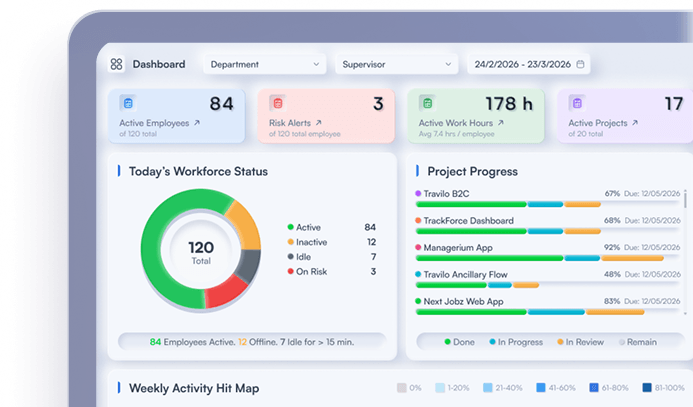
Monitoring depth. Screenshots, screen recording, application and website tracking, keystrokes, file transfer logs, search history, instant messaging and online meeting capture, with daily, monthly and risk-user reports.
Pros
- Silent mass deployment through Intune, GPO and command line
- Consent posture configurable per entity, rare at any price point
- Genuine multi-tenant architecture with delegated admin
- Five-tier RBAC with enforced departmental scope
- Bulk CSV onboarding and self-registration links
- Agent-level fleet inventory including version tracking
Cons
- Windows-first agent coverage
- No SAML SSO or SCIM provisioning currently, so user lifecycle is handled through CSV import rather than directory sync
Best for: organisations between roughly 500 and 5,000 seats that need to deploy quickly, operate as multiple entities or regions, and want monitoring settings that vary by jurisdiction.
Start free with TrackForce and deploy to your first department in an afternoon.
2. Teramind: best for regulated industries and deployment flexibility
Teramind is the most established enterprise platform in this category and its main scalability advantage is choice of deployment model. It runs as cloud, private cloud on Azure, or fully on-premise, with support for VMware ESXi, Hyper-V and Nutanix.
Its documentation notes that deployments under roughly 1,000 concurrent users can run on a single all-inclusive server, with multi-node architecture for larger estates. SSD-class storage is required for the primary volume above 500 users. Its hidden agent buffers data locally during network outages and uploads at a throttled pace once reconnected, with a configurable buffer size.
Pros: on-premise and private cloud options, deep policy and rules engine, strong DLP and insider threat features, offline recording
Cons: significant configuration effort, higher administrative overhead, video retention drives storage cost quickly
Best for: government, healthcare, finance and other regulated sectors that require data to stay on their own infrastructure.
3. DTEX Systems: best for very large enterprises
DTEX takes a fundamentally different architectural approach. Instead of recording screens or logging keystrokes, it collects lightweight behavioural metadata, several hundred signal types, and processes it in the cloud rather than on the endpoint.
The company states its platform has been proven in environments with up to 800,000 users. That scale is possible precisely because it avoids the storage and endpoint load that screen-capture platforms carry. It covers Windows, Mac, Linux and Citrix endpoints, and pseudonymises identities until an investigation requires unmasking, which makes it easier to approve in strict European jurisdictions.
Pros: proven at extreme scale, very low endpoint impact, no storage explosion, strong privacy design, broad OS and VDI coverage
Cons: no screenshots or video, security-focused rather than productivity-focused, enterprise pricing and procurement
Best for: organisations above 10,000 seats running a formal insider risk programme.
4. Forcepoint: best for fast agent rollout in security-led programmes
Forcepoint's Dynamic User Protection is a cloud-native user activity monitoring service. Its endpoint agent is roughly 30MB, installs in under thirty seconds with no reboot required, and self-maintains through automatic updates.
That matters more than it sounds. Requiring a reboot means scheduling a change window, and change windows are what stretch enterprise rollouts from days into weeks.
Pros: very fast agent install, no reboot needed, auto-updating agent, analytics performed on the endpoint
Cons: security orientation rather than productivity management, part of a broader Forcepoint stack, enterprise sales cycle
Best for: security teams rolling out user activity monitoring alongside existing DLP.
5. ActivTrak: best for productivity analytics
ActivTrak is the strongest option if your goal is workforce analytics rather than surveillance. Its dashboards and productivity classification are the most polished in the category.
On identity, it supports SAML SSO, and its SCIM integration with Okta has been released as a beta capability. Its own documentation notes that agent installation and uninstallation must still be handled separately from user provisioning, so even with SCIM the endpoint lifecycle remains a separate workflow.
Pros: excellent reporting and dashboards, low endpoint impact, SSO support, good productivity classification
Cons: SCIM still maturing, shallower organisational hierarchy, limited multi-entity separation
Best for: companies between 500 and 5,000 seats focused on productivity insight rather than security monitoring.
6. Syteca (formerly Ekran System): best for privileged user monitoring
Syteca focuses on session recording and privileged access monitoring, with both cloud and on-premise deployment. It is strong where the priority is auditing what administrators and third-party contractors do on critical systems.
Pros: detailed session recording, on-premise option, strong privileged access controls, good audit trail
Cons: narrower productivity feature set, interface less modern than newer platforms
Best for: organisations between 1,000 and 10,000 seats with contractor or privileged-user oversight requirements.
7. Hubstaff: best for field and distributed teams
Hubstaff combines time tracking with GPS location and payroll integration, which makes it useful for field operations, logistics and service businesses rather than office estates.
Pros: GPS tracking, payroll and invoicing integration, mobile apps, straightforward setup
Cons: limited organisational hierarchy, lighter monitoring depth, not designed for multi-entity structures
Best for: distributed and field teams under roughly 1,000 seats.
8. Time Doctor: best for client billing and project time
Time Doctor's strength is project and client time reporting, making it a common choice for agencies, consultancies and outsourcing providers who need to bill accurately against tracked work.
Pros: strong project and client reporting, useful integrations, clear billing exports
Cons: limited enterprise hierarchy, basic administrative controls at scale
Best for: service businesses under 1,000 seats that bill by time.
9. Insightful: best for privacy-conscious deployments
Insightful offers configurable privacy controls, letting organisations monitor productivity patterns without capturing content. This makes internal approval considerably easier in workplaces where employee pushback is a risk.
Pros: configurable privacy settings, clean interface, reasonable pricing
Cons: lighter security features, limited multi-entity support
Best for: mid-sized companies balancing visibility against employee trust.
10. DeskTime: best for automatic productivity classification
DeskTime automatically categorises applications and websites as productive or unproductive with minimal configuration, which reduces setup time considerably.
Pros: automatic classification, simple setup, low administrative burden
Cons: limited enterprise controls, shallow hierarchy, basic deployment tooling
Best for: teams that want productivity insight without configuration effort.
Deployment at scale: the part most guides skip
Most comparison articles cover screenshot intervals and ignore how the software actually reaches ten thousand machines. This is the phase where rollouts fail.
Ask for the exact command syntax. Every vendor says they support silent installation. The real question is which deployment tools they support and what the command line looks like. Intune, Group Policy, SCCM and Jamf are the ones that matter.
Test for EDR conflicts. Monitoring agents and endpoint detection tools such as CrowdStrike, SentinelOne and Defender frequently collide. Test in your actual security stack, not a clean virtual machine.
Check VDI and Citrix behaviour. Non-persistent desktops break agents that expect a stable machine identity. Verify this individually with every vendor.
Ask what happens offline. Field staff and travelling employees go offline for days. Find out whether the agent buffers data locally and what the buffer limit is.
Confirm OS coverage. Windows-only is a hard blocker in engineering and design teams. Ask specifically about macOS, Linux and virtual desktops.
The storage cost nobody models
Per-seat licence price is not your total cost. Storage is the line that grows quietly.
Assume screenshot capture every five minutes across an eight-hour day at roughly 250KB per image:
- 12 captures per hour, 96 per day per seat
- Around 24MB per seat per day
- Around 6GB per seat per year
| Seats | Screenshots per year | With screen recording |
| 1,000 | ~6 TB | 20-60 TB |
| 5,000 | ~30 TB | 100-300 TB |
| 10,000 | ~60 TB | 200-600 TB |
Video multiplies the figure by three to ten times depending on resolution and how much of the day you record.
Four questions to ask every vendor:
- Is retention configurable per department or entity, or is it one global setting?
- Is storage included in the per-seat price or metered separately above a threshold?
- What is the archival path for data you must keep but rarely query?
- What does the bill look like in year two when year one's data is still stored?
Compliance across multiple countries
Most guides reduce this to "check your local laws." That is not usable if you are deploying across borders.
GDPR Article 88 allows individual EU member states to set their own rules for employee data processing, which is why there is no single European answer. Germany, France and the Netherlands each differ materially.
Works council consultation is a legal prerequisite in several European countries, not a courtesy. In Germany, deploying without Betriebsrat agreement can invalidate the whole deployment. It is also a scheduling problem, because consultation takes months.
US state law varies too. Illinois BIPA governs biometric data, and Connecticut and New York require specific employee notice for electronic monitoring.
Certifications. Ask for SOC 2 Type II and ISO 27001. If a vendor holds neither, ask what compensating controls exist and get the answer in writing.
Data residency. Ask where captures are physically stored and whether you can pin them to a region. For EU deployments this is often non-negotiable.
This is the direct link back to scalability. A platform that lets consent and retention vary by entity can run one deployment across countries with different laws. One that cannot forces you into the strictest common setting everywhere, or multiple parallel deployments.
A phased rollout plan for 1,000+ seats
| Phase | Scope | Duration | What success looks like |
| Pilot | 50 seats, one willing department | 2 weeks | Agent stable, no EDR conflict, dashboards responsive, no data gaps |
| Wave 1 | 500 seats, 2-3 departments | 4 weeks | Deployment script reliable at volume, permissions verified, managers trained |
| Wave 2 | Remaining population by region | 4-8 weeks | Correct consent posture per country, storage tracking to forecast |
| Steady state | Full fleet | Ongoing | Agent version drift under 5%, monthly retention review, quarterly access audit |
The step most often skipped is employee communication before deployment rather than after. Rolling out monitoring without a published policy is the leading cause of both legal exposure and the internal backlash that gets programmes cancelled six months later. Whatever technical consent mode you choose, publish the policy.
How to choose
Under 500 seats: scalability is not your constraint. Choose on features and price.
500 to 2,000 seats: deployment speed and administrative overhead dominate. Prioritise silent installation support and departmental permissions. TrackForce and ActivTrak are the strongest fits.
2,000 to 10,000 seats: organisational structure becomes the problem. You need multi-tenancy, delegated regional administration, and settings that vary by jurisdiction. TrackForce, Teramind and Syteca fit here.
Above 10,000 seats: architecture dominates. Storage economics, query performance and SIEM integration decide it. DTEX, Forcepoint and Teramind lead this tier.
Frequently asked questions
What is the most scalable employee monitoring platform for enterprises? It depends on your size and structure. For 500 to 5,000 seats across multiple entities, TrackForce scales fastest on deployment speed and per-entity control. Above 10,000 seats with insider threat requirements, DTEX, Forcepoint and Teramind lead on architecture.
How many employees can employee monitoring software handle? Most vendors claim no seat limit, and DTEX states deployments proven up to 800,000 users. Practical limits come from storage growth, dashboard performance and administrative overhead long before any technical user cap.
How long does it take to deploy monitoring software to 5,000 employees? With silent deployment through Intune, Group Policy or SCCM, agent rollout can finish in days. Realistic end-to-end timelines run 10 to 14 weeks including pilot, phased waves, policy communication and, in Europe, works council consultation.
Do enterprise monitoring platforms support SSO and SCIM? SAML SSO is widely supported. SCIM is less consistent, and ActivTrak's Okta integration is currently in beta with agent installation handled separately from user sync. Always verify deprovisioning specifically, because that is where compliance risk sits.
How much storage does employee monitoring data need at scale? Screenshots at five-minute intervals generate roughly 6GB per seat per year, around 60TB annually at 10,000 seats. Screen recording multiplies that three to tenfold. Metadata-only platforms avoid the curve entirely.
Is employee monitoring software legal? In most countries yes, with conditions. Requirements differ by jurisdiction and typically involve employee notice, a documented policy and a legitimate business purpose. In parts of Europe, works council agreement is required before deployment.
Start your enterprise deployment
If you are deploying between 500 and 5,000 seats across multiple entities and need to move fast, TrackForce is built for that shape of rollout: silent deployment through your existing Intune or Group Policy tooling, five-tier scoped permissions, multi-tenant organisation management, and monitoring posture that can differ by region inside a single deployment.
Start your free signup and see how it handles your structure.
Similar blog you can explore
Team Productivity Dashboards: 9 Metrics Managers Should Actually Track
Best Workforce Analytics Software: 7 Platforms Compared
Performance Appraisal Software: How to Choose in 2026
Start Your 30-Day
Free TrackForce Trial