Healthcare Time Tracking Software:
A Practical Buyer's Guide
2026-08-09
•
Author:
•
~1 min read
•
Updated August 9, 2026
- What Healthcare Time Tracking Software Has to Get Right
- —Shifts That Don't Fit a Nine-to-Five Grid
- —Overtime, Breaks and Fatigue Rules
- —Credentials Tied to Logged Hours
- Where Manual Timesheets Cost Care Providers Money
- —Rounding Rules and Buddy Punching
- —Missed Breaks Nobody Recorded
- —No Audit Trail When a Regulator Asks
- Electronic Visit Verification for In-Home Care Teams
- —What Home Health Care Time Tracking Software Must Capture
- —Why Home Care Time Tracking Software Needs an Offline Mode
- —Travel and Mileage in Homecare Time Tracking Software
- How to Compare Time Tracking Software for Healthcare Industry Buyers
- —Ask for the BAA Before the Demo
- —Payroll and Scheduling Integration
- —Monitoring Settings on Clinical Workstations
- 4. Frequently Asked Questions
- —Does healthcare time tracking software need to be HIPAA compliant?
- —Is EVV required for every home care visit?
- —Can one system cover both facility staff and field caregivers?
- —How do we introduce tracking without upsetting clinical staff?
- —How long does implementation usually take?
- Conclusion
- 5. Final Step: How TrackForce Helps
A nurse clocks out fourteen minutes late because a patient needed settling. Payroll rounds it to zero. Repeat that across 200 staff for a year and you have a wage claim on your hands, not a rounding convention. Care work refuses to fit the grid payroll wants it to fit.
Healthcare time tracking software exists to close that gap. It records real hours across rotating shifts, keeps an audit trail a regulator will accept, and handles the visit verification rules governing home-based care. Below I've set out what these systems have to do, what separates the serious products, and how to judge one before you sign anything.
What Healthcare Time Tracking Software Has to Get Right
Generic workforce tools fall down in care settings for reasons that only surface after go-live. Scheduling is unusual, compliance exposure is real, and the people clocking in are often mid-shift with gloves on. A handful of requirements separate products built for care from products merely sold into it.
Shifts That Don't Fit a Nine-to-Five Grid
Twelve-hour rotations, split shifts, on-call blocks, night differentials, someone picking up a fourth shift at a sister facility. Your system needs to absorb all of that without a supervisor rebuilding the roster by hand every fortnight. Anything assuming a fixed weekly pattern will generate corrections forever.
Overtime, Breaks and Fatigue Rules
Overtime here isn't purely a cost question. Consecutive-hours limits exist because tired clinicians make errors, and several states regulate them directly. Decent software flags an approaching threshold while you can still move someone, rather than reporting the breach after payroll has run.
Credentials Tied to Logged Hours
Some shifts can only be worked by a person holding a current license. When hours and credential status sit in separate systems, an expired certification quietly keeps getting scheduled. Linking the two closes a gap that tends to surface during an audit, which is the worst possible moment.
Where Manual Timesheets Cost Care Providers Money
Paper and spreadsheets survive longer in healthcare than almost anywhere else, largely because shift leads are too stretched to fight for a replacement. The losses are steady rather than dramatic. That is exactly why nobody challenges them for years at a stretch.
Rounding Rules and Buddy Punching
A small rounding rule applied thousands of times produces a real number, and it cuts whichever way your policy happens to favor. Shared badge punches add to the total. Neither is usually malicious. Both are expensive.
Missed Breaks Nobody Recorded
Break attestation matters more than people expect. If a carer skips a meal break to cover an emergency and nothing captures it, you have no defense when the claim lands eighteen months later. Recording the exception as it happens beats any report produced afterwards.
No Audit Trail When a Regulator Asks
Reconstructing who worked which hours from memory and a paper file is grim. What you want is an immutable record with full edit history, showing the final figure alongside who changed it and when. Auditors ask that second question more often than the first.
Electronic Visit Verification for In-Home Care Teams
Home-based services carry a federal obligation that facility-based care does not, and it changes what you should be shopping for. Section 12006 of the 21st Century Cures Act made electronic visit verification mandatory for Medicaid-funded personal care and home health services delivered through an in-home visit. States risk reduced federal matching funds if they don't enforce it.
What Home Health Care Time Tracking Software Must Capture
Any EVV-capable home health care time tracking software has to electronically record six things: the service performed, who received it, who delivered it, the date, the location of delivery, and the start and end times. Deadlines ran from January 2020 for personal care and January 2023 for home health services, though the dates states actually enforced vary quite a bit.
Why Home Care Time Tracking Software Needs an Offline Mode
Rural basements and concrete apartment blocks kill mobile signal. Home care time tracking software that stalls without connectivity will have your caregivers back on paper within a week, and the compliance benefit disappears with them. Offline capture with delayed sync is the single feature that decides whether verification survives contact with the field.
Travel and Mileage in Homecare Time Tracking Software
Caregivers drive between clients, and that time is often compensable. Homecare time tracking software should log travel separately from care delivery so payroll treats each correctly. Mileage reimbursement then stops depending on a handwritten log book that nobody has time to check.
How to Compare Time Tracking Software for Healthcare Industry Buyers
Every demo looks competent. What separates products is everything sitting around the demo: the contracts, the integrations, and the settings you will be defending to your privacy officer six months in. Shortlisting time tracking software for healthcare industry needs really comes down to three questions.
| Requirement | Facility-based teams | In-home care teams |
| Clock-in method | Badge, kiosk, workstation | Mobile app, GPS or telephony |
| Federal mandate | FLSA and state wage rules | EVV under the Cures Act |
| Critical feature | Shift and overtime rules | Offline capture and sync |
Ask for the BAA Before the Demo
If a vendor's system will touch protected health information, you need a business associate agreement under HIPAA. Raise it in the first conversation. A vendor who hesitates, or who calls themselves "HIPAA compliant" without offering a signed BAA, has just told you something worth knowing.
Payroll and Scheduling Integration
Time data requiring manual re-entry into payroll will drift, and it will drift in the direction nobody notices. Confirm the integration exists for your specific payroll system, and confirm a real customer has run it, rather than accepting a logo on a partner page as proof.
Monitoring Settings on Clinical Workstations
Plenty of workforce tools bundle screenshots, keystroke capture or screen recording. On a machine displaying an EHR, those features can sweep up patient data as a side effect. If you deploy something with that capability, configure privacy exclusions first and restrict who can open the archive.
4. Frequently Asked Questions
Does healthcare time tracking software need to be HIPAA compliant?
If the system touches protected health information, yes, and you need a signed business associate agreement. A tool recording only hours and shift codes may sit outside that scope, so confirm with your privacy officer.
Is EVV required for every home care visit?
No. The federal mandate covers Medicaid-funded personal care and home health services involving an in-home visit. Privately paid work and certain waiver services fall outside it, and state rules add further variation.
Can one system cover both facility staff and field caregivers?
Some platforms manage both, though many providers run a dedicated EVV product alongside a facility system. Check that hours from each flow into a single payroll export before assuming one vendor covers everything.
How do we introduce tracking without upsetting clinical staff?
Explain it as protection for their hours and their breaks, because that is usually true. Share the reports openly. Resistance comes from surveillance framing far more often than from measurement itself.
How long does implementation usually take?
Budget six to twelve weeks at a mid-sized provider. Most of that goes on payroll mapping, shift rule configuration and training across rotations, rather than on installing anything.
Conclusion
Hours are the largest line item most providers carry, and in care settings they double as a compliance record. Good healthcare time tracking software gives you accurate payroll, an audit trail that survives scrutiny, and early warning before someone drifts into unsafe overtime. Write down your shift rules and your EVV obligations first, then judge vendors against that list instead of against their demo.
5. Final Step: How TrackForce Helps
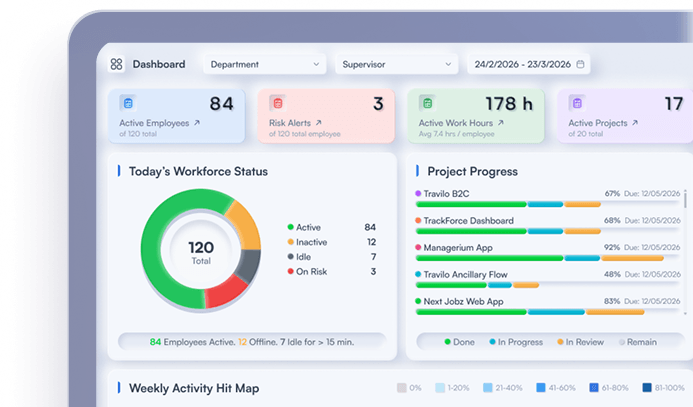
TrackForce is an employee tracking and productivity platform, and it fits one specific part of a healthcare organization well: the administrative and back-office operation. Medical billing and coding, claims processing, revenue cycle, transcription, telehealth coordination and healthcare BPO all run on desktop workstations, and that is where TrackForce works.
For those teams it counts active time and breaks automatically, separates active from idle hours per person, and reports daily and monthly workload by department. The Time Tracking module covers tasks, employee cost and task cost, so you can see what processing a claim batch actually costs. The Risk User report flags missing hours and late starts early, while role-based access keeps data contained across the super admin, admin, manager, team lead and employee hierarchy.
Two things to be straight about. TrackForce is a desktop agent, so it does not perform electronic visit verification, GPS capture or mobile caregiver clock-in — home care agencies under the Cures Act will need a dedicated EVV system for field staff. And because the platform includes screenshots and keystroke logging, any deployment near clinical systems needs privacy exclusions configured first, with a BAA in place if protected health information is in scope.
If your administrative operation is the part losing hours, book a TrackForce demo and run one payroll cycle against real data.
Similar blog you can explore
Team Productivity Dashboards: 9 Metrics Managers Should Actually Track
Best Workforce Analytics Software: 7 Platforms Compared
Performance Appraisal Software: How to Choose in 2026
Start Your 30-Day
Free TrackForce Trial