Employee Scheduling and Time Tracking Software:
How to Choose in 2026
2026-08-12
•
Author: Tanvir
•
~1 min read
•
Updated August 12, 2026
- What employee scheduling and time tracking software does
- —Scheduling, time tracking and monitoring are three different things
- —Which businesses need both
- The workflow that connects scheduling and tracking
- What schedule versus actual variance tells you
- —A worked example
- Features that matter, and features that only look good in demos
- —Shift scheduling and rosters
- —Time clock, kiosk and mobile clock-in
- —GPS and geofenced check-in
- —Attendance, time off and leave
- —Approval workflows
- —Activity and productivity insight
- —Reporting and payroll export
- One platform or two integrated tools?
- Monitoring, privacy and getting your team on side
- Compliance considerations
- What does it cost?
- Comparing the main options
- How to choose: seven questions for your shortlist
- Frequently asked questions
- See your team's time data clearly
Employee scheduling and time tracking software combines two functions in one system. Scheduling assigns who works when. Time tracking records what actually happened. The value sits in the gap between those two records.
Most buyers evaluate the two halves separately. They compare scheduling features against scheduling features, tracking features against tracking features, and miss the reason for buying them together. The reason is variance. A schedule states an intention. A timesheet states a fact. The difference between them is where labour cost leaks, where overtime accumulates unnoticed, and where a broken schedule reveals itself before it becomes a staffing problem.
This guide explains how the two systems connect, what variance data tells you, which features earn their place, and how to decide between one platform and two.
What employee scheduling and time tracking software does
Employee scheduling and time tracking software manages the full labour cycle from plan to payroll. The system publishes a schedule, records clock-in and clock-out events against that schedule, calculates worked hours, flags differences between planned and actual time, routes timesheets for approval, and exports approved hours to payroll.
Workforce monitoring adoption has made this category standard rather than optional. Roughly 78% of employers now use some form of employee monitoring or tracking software. Among organisations with remote or hybrid staff that figure rises sharply, while fully in-office organisations sit lower. Owl Labs research found that fewer than one in five workers say their employer uses no tracking software at all.
Scheduling, time tracking and monitoring are three different things
Buyers conflate these three terms. Vendors rarely correct them. The distinction determines which product you actually need.
Scheduling software assigns labour. The system builds rosters, publishes shifts, handles swaps and open shifts, manages time off, and forecasts coverage against demand.
Time tracking software records labour. The system captures clock-in and clock-out events, builds timesheets, calculates regular and overtime hours, and produces payroll-ready records.
Employee monitoring software analyses labour. The system records application and website usage, measures active versus idle time, and produces productivity and utilisation reporting.
The three overlap at the edges. Time tracking is the shared component, which is why almost every scheduling product includes a clock and almost every monitoring product includes a timer. The products differ in what they do with the hours once captured.
Which businesses need both
Four situations justify buying both capabilities.
Shift-based operations need both. Retail, hospitality, healthcare, security and logistics run variable rosters where the schedule changes weekly and payroll depends on accurate attendance.
Field and deskless teams need both. Distributed workers clock in from locations rather than desks, and the schedule is the only reference point for where they should be.
Hourly workforces need both. Payroll accuracy depends on the link between scheduled hours and worked hours.
Hybrid knowledge teams often need only one. Salaried staff on fixed hours gain little from rostering. Those teams need tracking and utilisation data, not scheduling.
If your team is salaried, works fixed hours, and never rosters, scheduling software will sit unused. Buy the tracking half and skip the rest.
The workflow that connects scheduling and tracking
The two systems form a loop. Six stages complete one cycle.
Stage one: the manager builds the schedule. Shifts are assigned against forecast demand, availability and cost limits.
Stage two: the system publishes the schedule. Employees receive shifts on mobile and confirm receipt.
Stage three: the employee clocks in. The clock event records a timestamp, and in mobile deployments a location.
Stage four: the system compares actual to planned. Every clock event is measured against the scheduled shift, and differences are flagged automatically.
Stage five: the manager reviews and approves. Exceptions surface for review. Compliant entries pass without intervention.
Stage six: approved hours reach payroll. The export carries regular hours, overtime, and any premium calculations.
Stage four is the stage most buyers ignore during evaluation. Stage four is also the stage that produces every insight in the next section. A platform that records clock events but never compares them to the schedule has automated data entry and nothing else.
What schedule versus actual variance tells you
Schedule variance is the difference between hours planned and hours worked. Variance data answers five operational questions that neither system answers alone.
Variance detects overtime before payroll runs. A manager watching accumulated hours mid-week can redistribute shifts. A manager discovering overtime at payroll has already paid for it.
Variance turns no-shows into a pattern. A single missed shift is an incident. The same employee missing Monday openings three weeks running is information you can act on.
Variance exposes early clock-ins. Employees clocking in twelve minutes before shift start, across forty staff, five days a week, produce a payroll line nobody authorised. The individual amounts are too small to notice. The aggregate is not.
Variance identifies broken schedules. Consistent overruns on the same shift usually indicate the schedule is wrong, not the employee. Two hours of overrun every Friday closing shift means the closing shift is understaffed.
Variance supports wage and hour compliance. Accurate records of scheduled versus worked time form the evidence base if a pay dispute or audit arises.
A worked example
Consider a forty-person hourly team at an average rate of $18 per hour.
Each employee clocks in an average of ten minutes early and clocks out an average of five minutes late. Neither behaviour is dishonest. Neither is authorised either.
Fifteen unscheduled minutes per person per day, across forty people, is ten hours of daily unplanned labour. At $18 per hour that is $180 per day, roughly $46,800 across a working year.
Industry estimates place total time theft, including buddy punching and timesheet inflation, at around 2.2% of gross payroll, with the
reporting that most businesses are affected in some form. Recent benchmark data found that close to half of small and mid-sized businesses caught at least one instance of falsified timesheets within a twelve month period.
Variance reporting does not require you to accuse anyone. Variance reporting requires you to notice.
Features that matter, and features that only look good in demos
Seven capabilities carry real operational weight. Each entry below states what the feature does and gives you one question to put to the vendor.
Shift scheduling and rosters
Scheduling tools build and publish shift patterns. Strong implementations support recurring templates, open shifts employees can claim, swap requests with manager approval, and availability constraints.
Ask: how long does building a typical week take once templates are set up?
Time clock, kiosk and mobile clock-in
Clock methods determine data accuracy. Shared kiosks suit fixed sites. Mobile clock-in suits distributed teams. Desktop tracking suits knowledge workers.
Ask: which clock method prevents one employee clocking in for another, and how?
GPS and geofenced check-in
Geofencing restricts clock-in to a defined location radius. The feature solves a real problem for field teams and creates a real objection for everyone else.
Mobile monitoring has grown quickly as field and delivery teams have moved onto tracked systems, and location features are among the most requested mobile capabilities. Location tracking is also the feature most likely to trigger employee resistance and legal scrutiny.
Ask: can location capture be limited to the clock-in event rather than running continuously through the shift?
Attendance, time off and leave
Leave management connects to scheduling directly. Approved leave should remove the employee from availability automatically rather than requiring a second manual step.
Ask: does an approved leave request update the roster without anyone rebuilding it?
Approval workflows
Approval routing determines administrative load. Well-designed systems surface only exceptions and pass compliant timesheets through automatically.
Ask: what percentage of timesheets require manual review in a typical deployment?
Activity and productivity insight
Activity tracking measures how time is spent rather than only how much time is spent. The category covers application and website usage, active versus idle time, and utilisation reporting across projects or departments.
Two design decisions separate useful implementations from intrusive ones. Role-based access limits who sees what. Employee-visible reporting lets staff see their own data rather than only managers seeing it.
Ask: can employees see their own activity summaries, and can individual tracking categories be switched off?
Reporting and payroll export
Reporting closes the loop. The export must match your payroll system's expected format without manual reformatting.
Integration with HR platforms has become a leading buying criterion, cited by a majority of organisations evaluating these tools.
Ask: which payroll systems have a native integration rather than a CSV export?
One platform or two integrated tools?
Two purchasing routes exist. Neither is universally correct.
| Single platform | Two integrated tools | |
| Setup effort | One implementation | Two implementations plus an integration |
| Data consistency | One record set | Two record sets synced on a schedule |
| Depth per function | Adequate in both, exceptional in neither | Best-in-class in each |
| Failure mode | Whole system down | Sync breaks quietly, records drift apart |
| Admin burden | One vendor, one login, one bill | Two of each |
| Best fit | Teams under roughly 200 staff with standard requirements | Teams with unusual scheduling complexity or an existing tool they will not replace |
The failure mode row deserves attention during evaluation. A single platform fails loudly and gets fixed. A broken integration fails silently, and the two systems drift apart until somebody notices the payroll figures do not reconcile. Ask any vendor selling an integration how sync failures are surfaced and who gets alerted.
Monitoring, privacy and getting your team on side
Activity tracking generates more resistance than any other feature in this category. Some vendors in this market position explicitly against monitoring, describing it as surveillance. Your employees will encounter that framing whether or not you raise it.
The framing is worth engaging with rather than dodging, because the criticism is sometimes correct. Monitoring deployed without disclosure, without limits, and without employee access does damage trust. Monitoring deployed transparently does not.
Four principles separate the two.
Disclose before you deploy. Tell staff what will be tracked, why, and what will not be tracked. Research consistently finds that employees accept monitoring far more readily when the purpose is explained first. Announcing after rollout converts a reasonable tool into a betrayal.
Track the minimum that answers your question. Most operational questions are answered by time and activity data. Keystroke logging and content capture answer questions most businesses are not actually asking.
Give employees their own data. Role-based visibility means executives see trends, managers see team-level patterns, and employees see their own summaries. Data visible only upward reads as surveillance. Data visible to the person it describes reads as feedback.
Write the policy down. A written monitoring policy covering scope, retention and access converts an ongoing source of anxiety into a settled question.
TrackForce is built on this model. Role-based access controls limit visibility by responsibility, and employees can view their own performance summaries where enabled. The goal is understanding how work happens rather than watching how people behave.
Compliance considerations
Working time records carry legal weight in most jurisdictions. Four categories of obligation apply broadly, though the specifics vary considerably by country.
Record keeping. Employers are generally required to retain accurate records of hours worked for a defined period.
Overtime and rest. Rules governing overtime thresholds, premium rates, daily rest and break entitlements differ by jurisdiction and sometimes by sector.
Data protection. Activity data, location data and screenshots are personal data under most modern privacy frameworks. Obligations typically include a lawful basis for processing, transparency to the data subject, proportionality, and defined retention limits.
Employee consultation. Some jurisdictions require consultation with employee representatives before monitoring is introduced.
Verify your own position with your local labour authority or an employment lawyer. Software vendors, including this one, are not a source of legal advice, and requirements in South Asia, the Gulf, the EU and North America differ enough that generic guidance is unreliable.
What does it cost?
Pricing in this category is almost universally per user per month, and the headline figure rarely represents the total.
Entry pricing has fallen substantially. Comprehensive monitoring and tracking platforms that previously cost $15 to $25 per user per month now start closer to $5. That shift is the main reason small business adoption has climbed from roughly a third of firms under 100 employees a few years ago to more than half today.
Costs outside the headline figure include implementation and onboarding, integration or API access on some plans, advanced reporting tiers, data retention beyond a default window, hardware for kiosk deployments, and support upgrades.
Model the cost at three sizes. A $6 per user platform costs $720 per year at 10 users, $3,600 at 50 users and $14,400 at 200 users. A $12 platform with a genuinely better payroll integration may cost less in total once you account for the administrative hours a poor export consumes each month.
Watch the free tier. Free plans in this category typically cap users, restrict reporting, or exclude the approval workflows that make the system useful at scale. Free is a trial mechanism, not a deployment plan.
Comparing the main options
Seven platforms cover most of this market. Depth varies significantly by half.
| Platform | Scheduling | Time tracking | Best for |
| Zoho Shifts | Strong | Moderate | Shift teams already inside the Zoho ecosystem |
| Connecteam | Strong | Strong | Deskless and field teams needing mobile-first tools |
| Homebase | Strong | Moderate | Small hourly teams in retail and hospitality |
| QuickBooks Time | Moderate | Strong | Businesses running QuickBooks payroll |
| Clockify | Light | Strong | Project time tracking on a tight budget |
| Hubstaff | Light | Strong | Distributed teams needing activity data with tracking |
| TrackForce | Not a scheduling tool | Strong | Teams whose priority is accurate time, activity and productivity visibility |
Be clear about which half you are actually buying for. If shift rostering is your primary problem, a scheduling-first platform will serve you better than a tracking-first one, and no amount of tracking depth compensates for a missing roster. If your problem is understanding how time is spent, where utilisation sits, and whether recorded hours are accurate, a tracking-first platform is the correct purchase.
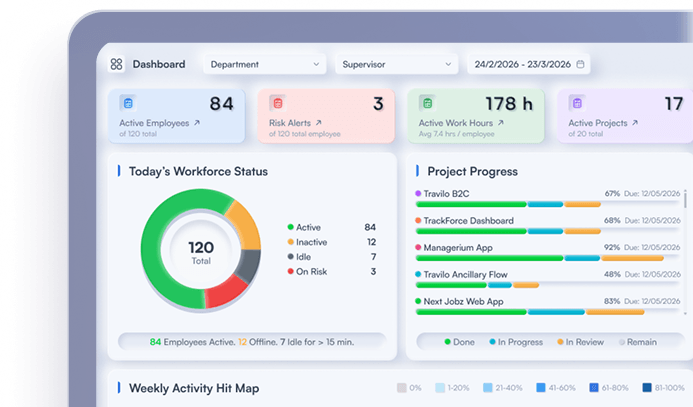
TrackForce sits firmly in the second group. The platform covers time tracking, activity and application usage, active versus idle measurement, productivity and utilisation reporting, device management, and role-based access. Scheduling is not part of it.
How to choose: seven questions for your shortlist
Ask every vendor the same seven questions and record the answers side by side.
- Which half is this product actually built for, scheduling or tracking? Every vendor claims both. The demo reveals which one received the engineering effort.
- Does the system compare actual hours to scheduled hours automatically? If not, you are buying two disconnected records.
- How does the system prevent one employee clocking in for another?
- Which tracking categories can be switched off, and can employees see their own data?
- Which payroll systems have native integrations rather than CSV exports?
- What is the total cost at three times our current headcount?
- How is the data exported if we leave, in what format, and over what period?
A vendor who answers question four vaguely is telling you something about how the product treats your employees.
Frequently asked questions
What is the difference between employee scheduling and time tracking software? Scheduling software assigns who works when. Time tracking software records what was actually worked. Scheduling produces a plan, tracking produces a record, and comparing the two produces variance data.
Can one tool do both well? Some platforms do both adequately. Most are built primarily for one half and treat the other as a secondary feature. Identify which half is your priority before evaluating, because that determines which compromise you can afford.
Is GPS tracking of employees legal? Location tracking during working hours is permitted in many jurisdictions subject to disclosure, proportionality and data protection requirements. Rules vary considerably by country. Confirm your position locally before deploying it.
How do I introduce time tracking without upsetting my team? Disclose before deployment rather than after. Explain what is tracked and why, state clearly what is not tracked, give employees access to their own data, and put the policy in writing. Employees accept monitoring at much higher rates when the purpose is explained first.
What is schedule variance? Schedule variance is the difference between scheduled hours and actual worked hours. Variance reveals unplanned overtime, early clock-ins, no-shows, and schedules that consistently under-resource a shift.
Do I need scheduling software for a small team? Teams under about ten staff on stable shift patterns usually manage with a shared calendar. Scheduling software becomes worthwhile when shifts change weekly, when staff request swaps regularly, or when coverage gaps have started costing money.
What is the difference between time tracking and employee monitoring? Time tracking measures how much time was worked. Employee monitoring measures how that time was spent, including application usage, website activity and active versus idle periods. Monitoring is broader, more useful analytically, and requires more care in how it is deployed.
See your team's time data clearly
TrackForce gives you accurate time tracking, activity and utilisation reporting, and role-based visibility that employees can see for themselves. Book a demo and we will show you what your current time data is not telling you.
Similar blog you can explore
Team Productivity Dashboards: 9 Metrics Managers Should Actually Track
Best Workforce Analytics Software: 7 Platforms Compared
Performance Appraisal Software: How to Choose in 2026
Start Your 30-Day
Free TrackForce Trial