Benefits of Time Tracking Software: What Changes When
You Actually Know Where Your Time Goes
2026-08-10
•
Author:
•
~1 min read
•
Updated August 10, 2026
- 1. You Stop Guessing About Productivity
- 2. Payroll Becomes Something You Trust, Not Dread
- 3. Remote and Hybrid Teams Stop Being a Blind Spot
- 4. You Find Out What Is Actually Taking So Long
- 5. Client Billing Becomes Transparent and Defensible
- 6. Your Project Estimates Get Better Over Time
- 7. Employees Become More Self-Aware, Not More Watched
- 8. You Can Finally Measure Productivity Objectively
- 9. Compliance and Labour Law Get a Lot Simpler
- 10. You Get Data That Actually Helps You Plan
Benefits of Time Tracking Software: What Changes When You Actually Know Where Your Time Goes
Let's be honest. Most businesses think they have a handle on productivity. Then they start tracking time and realize they really don't.
That gap, between what you think is happening and what is actually happening, is where a lot of money, energy, and growth quietly disappears. Time tracking software like TrackForce closes that gap. And the benefits are more practical than most people expect.
Here's what actually changes when you start using it.
1. You Stop Guessing About Productivity
When there is no data, everything becomes an opinion. You think Sarah is your most productive employee. You assume the dev team spends most of their time coding. You believe that project took about 40 hours.
Time tracking replaces those assumptions with numbers. Real numbers. You see exactly how many hours went into each task, each project, and each team. Once that data exists, you can actually improve things instead of just hoping they get better.
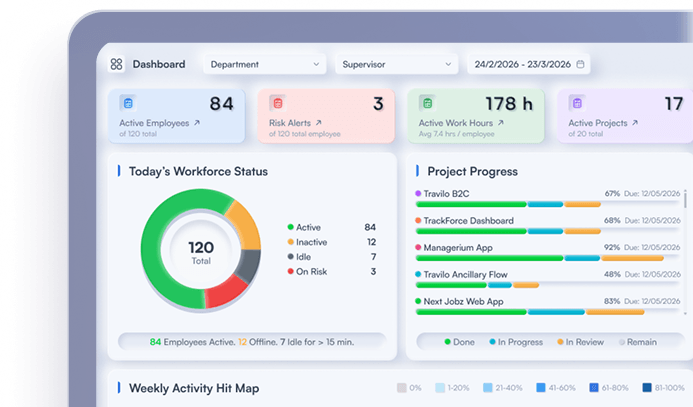
TrackForce gives you that visibility across your whole workforce, not just for one department or one project type.
2. Payroll Becomes Something You Trust, Not Dread
Manual timesheets are a mess. People forget to fill them in. They round up. They make honest mistakes. By the time payroll runs, somebody is always unhappy about something.
Automated time tracking removes the manual step entirely. Hours are logged accurately, in real time, so payroll is based on what actually happened. Fewer errors. Fewer disputes. Less time fixing things after the fact.
For businesses with hourly employees or shift-based work, this alone makes the software worth it.
3. Remote and Hybrid Teams Stop Being a Blind Spot
Managing people in the same office is one thing. Managing people across time zones, home offices, and hybrid schedules is something else.
Without a clear system, you are essentially operating on trust and hoping it works out. With time tracking software, you can see work happening in real time, understand when your team is most active, and catch problems early instead of at the end of a project.
TrackForce is built specifically for this kind of distributed workforce environment. It gives managers the visibility they need without turning into surveillance software that makes employees uncomfortable.
4. You Find Out What Is Actually Taking So Long
Ever wonder why a project that should take two weeks takes five? Time tracking data tells you.
Maybe the bottleneck is a single approval stage. Maybe one task type consistently takes three times longer than estimated. Maybe a small team is carrying a disproportionate amount of the workload.
You cannot fix what you cannot see. Once you have detailed time data broken down by task, project, and person, inefficiencies that used to hide in plain sight become obvious. And fixable.
5. Client Billing Becomes Transparent and Defensible
If you bill clients by the hour, you already know the awkward feeling of defending an invoice. A client questions the hours. You go back through emails and calendar entries trying to reconstruct what actually happened. It is not a good look.
Time tracking software gives you a detailed, accurate record of every hour worked on every client project. Billing disputes become much less frequent because your data is specific and timestamped, not reconstructed from memory.
It also helps you see which clients are actually profitable and which ones eat up far more time than they pay for.
6. Your Project Estimates Get Better Over Time
Most businesses underestimate project timelines. Repeatedly. Because they are guessing based on gut feel instead of historical data.
Time tracking fixes this over time. Once you have a record of how long similar projects actually took, your estimates become grounded in reality. Deadlines get more reliable. Clients trust you more. And you stop absorbing the cost of scope creep that was never priced in to begin with.
7. Employees Become More Self-Aware, Not More Watched
There is a common fear around time tracking: that it turns into micromanagement. In practice, when implemented well, it tends to do the opposite.
Employees who track their own time develop a much clearer sense of where their day actually goes. Most people are surprised by how much time disappears into low-value activities. That awareness, on its own, tends to shift behaviour in a positive direction.
TrackForce is designed to feel like a productivity tool for employees, not a surveillance system for managers. That distinction matters a lot for adoption and team culture.
8. You Can Finally Measure Productivity Objectively
"Is this team performing well?" is a hard question to answer without data. With time tracking, it gets measurable.
You can compare output to hours worked, track trends over weeks and months, set benchmarks, and have performance conversations that are grounded in evidence rather than impressions. That is better for managers and better for employees.
When people know that performance is measured fairly and consistently, they tend to show up differently.
9. Compliance and Labour Law Get a Lot Simpler
Depending on where your business operates, tracking employee hours is not just helpful, it is legally required. Overtime rules, break requirements, and working time regulations all need some form of documented record.
Doing this manually is painful and error-prone. Time tracking software creates those records automatically, keeps them organized, and makes audit preparation far less stressful.
10. You Get Data That Actually Helps You Plan
Growing a business requires resource planning. Which team needs more headcount? Which projects are overloading certain people? Where can you reallocate capacity?
Without time data, those decisions rely on instinct. With it, they are informed by what your workforce is actually doing. You can see capacity constraints before they become crises, and you can make a case for hiring or restructuring based on something more concrete than a feeling.
So, Is Time Tracking Software Worth It?
For most businesses, yes. Especially once the team grows past the point where you can informally keep track of everything in your head.
The real value is not in the tracking itself. It is in what you do with the data. Better decisions about hiring, pricing, project planning, and team structure all become possible when you actually know where your time is going.
TrackForce is built for teams who want that kind of clarity without a complicated setup or an invasive monitoring system. If you want to see how it works for your team, you can start a free trial today.
Similar blog you can explore
Team Productivity Dashboards: 9 Metrics Managers Should Actually Track
Best Workforce Analytics Software: 7 Platforms Compared
Performance Appraisal Software: How to Choose in 2026
Start Your 30-Day
Free TrackForce Trial