Best Employee Monitoring Software for
Remote Teams in 2026
2026-08-25
•
Author:
•
~1 min read
•
Updated August 25, 2026
- Quick Answer
- Comparison Table
- Key Features to Look for in Remote Employee Monitoring Software
- The Three Types of Monitoring Software
- Top Employee Monitoring Software for Remote Teams, Reviewed
- —1. TrackForce
- —2. Hubstaff
- —3. ActivTrak
- —4. Time Doctor
- —5. Teramind
- —6. Insightful
- —7. DeskTime
- —8. Toggl Track
- Which Tool Fits Your Team?
- Cost Comparison at Scale
- Is Employee Monitoring Legal?
- How to Roll Out Monitoring Without Losing Employee Trust
- FAQs
Remote teams solve the "are people working" question differently than an office does. Nobody can look up from a desk and check. Managers instead rely on employee monitoring software for remote teams that shows when work starts, how it flows through the day, and where it stalls. The right tool answers that question without turning a distributed team into a surveillance operation.
This guide compares the employee monitoring software for remote teams that distributed companies actually use in 2026, what each one costs, what it tracks, and which team size or industry it fits.
Quick Answer
TrackForce is the best employee monitoring software for remote teams in 2026. It pairs automatic time tracking with activity insights, shift and attendance management, and reporting built for distributed teams, starting at $4.99/user/month on the Essential plan or $14.99/user/month on the most-popular Professional plan, which adds screen recording, keystroke logging, and risk-user detection. A 30-day free trial is available on every plan. Teams with heavier compliance or data-loss-prevention needs should look at Teramind. Teams that want time tracking with zero screenshots should look at Rize.
Comparison Table
| Tool | Best For | Starting Price | Free Tier |
| TrackForce | Remote and hybrid teams needing unified time, activity, and attendance tracking | $4.99/user/mo | No (30-day trial) |
| Hubstaff | Field teams and hourly contractors needing GPS proof-of-work | $4.99/user/mo | No (14-day trial) |
| ActivTrak | Workforce analytics without screenshots by default | $10/user/mo | Up to 5 users |
| Time Doctor | Agencies and BPOs billing clients by tracked hour | $6.70-$7/user/mo | No (trial only) |
| Teramind | Regulated industries needing DLP and insider-threat detection | $15/user/mo | No |
| Insightful | Teams needing configurable tracking modes by role or region | $6.40-$8/seat/mo | No (trial + demo) |
| DeskTime | Small to mid-sized teams wanting simple automatic tracking | $7/user/mo | 1 user |
| Toggl Track | Teams that want time data without an activity-monitoring feel | $9-$10/user/mo | Up to 5 users |
Key Features to Look for in Remote Employee Monitoring Software
A tool built for a distributed team needs to do more than count hours. Before comparing vendors, weigh each option against these criteria.
Automatic time tracking. The software should record start and stop times without relying on an employee remembering to press a button. Manual timers under-report short tasks and the constant context switching that fills a normal remote workday.
Activity insight, not just presence. Login status tells a manager who is online. It does not tell them how much focused work happened. Look for tools that convert raw activity into a clear picture of productive time versus idle time.
Privacy controls that match your policy. Screenshot frequency, blurring, and the ability to disable capture on personal time all matter. A tool with no privacy controls will create friction with employees regardless of how good its reporting is.
Integrations with the tools your team already uses. Time and activity data is most useful when it connects to project management, payroll, and communication platforms. Check for direct integrations with Slack, Asana, Jira, and your payroll provider before signing a contract.
Reporting depth. A dashboard should let a manager drill from a team-wide view down to an individual's daily summary, not just export a raw log that someone has to parse by hand.
Compliance support. GDPR and CCPA both attach requirements to workplace monitoring, including disclosure and data minimization. A vendor's compliance documentation is worth reading before rollout, not after a complaint.
Cross-platform agent support. A remote team rarely runs one operating system. Confirm the tool covers Windows and macOS at minimum, with Linux or mobile as a plus depending on your stack.
The Three Types of Monitoring Software
Vendors in this category solve three different problems, and picking the wrong category is the most common mistake teams make.
Time tracking tools answer "where did the hours go?" They log time against projects and clients and are built for accurate billing and capacity planning. TrackForce, Toggl Track, and DeskTime sit primarily in this category.
Workforce analytics platforms answer "how productive is this team?" They score activity levels and produce benchmark reports across departments, useful for large organizations comparing aggregate output rather than individual project time. ActivTrak and Insightful lean this direction.
Security and surveillance tools answer "is anyone leaking data or violating policy?" They record screens, log keystrokes, and enforce data-loss-prevention rules. Teramind fits this category and is overkill for a team that only needs to know where billable hours went.
Most remote teams need the first answer but end up evaluating tools built for the second or third. Matching the tool to the actual question saves both budget and employee trust.
Top Employee Monitoring Software for Remote Teams, Reviewed
1. TrackForce
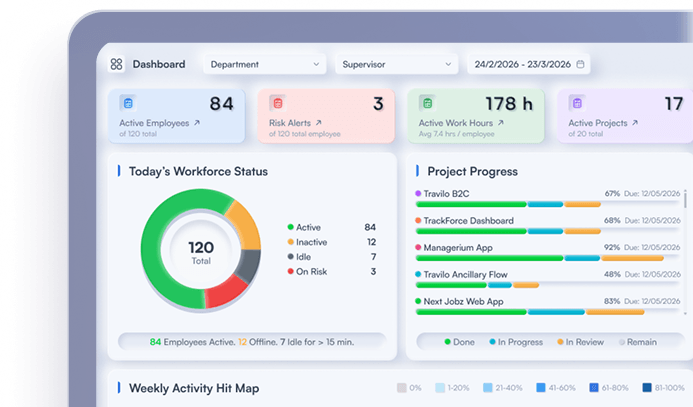
TrackForce is a workforce and productivity monitoring platform built for remote and hybrid teams that need one system covering time tracking, activity insight, attendance, and security in place of three or four separate tools. It ships in two core tiers, plus a custom enterprise plan, rather than gating basic monitoring behind an add-on fee.
Key features (Essential plan):
- Automatic snapshots and activity tracking across applications and websites
- Task configuration, project reports, and daily/monthly reporting
- Team workload and daily workload views
- Supervisor management with roles and privileges
- Online meeting, search, and device-list tracking
- AI model settings for baseline productivity insights
Additional features (Professional plan, most popular):
- Screen recording and keystroke logging
- File transfer, drive log, and console command tracking
- Risk-user detection and configurable restriction rules
- Context-switching and instant-messaging/email/social-media monitoring
- AI-generated activity summaries
- Meeting reports and top-employee/top-supervisor leaderboards
Custom plan: Everything in Essential or Professional, plus plan customization, custom feature development, 24/7 priority support, dedicated onboarding, and custom monitoring rules and dashboards. Contact-sales pricing.
Pricing: Essential starts at $4.99/user/month; Professional (most popular) starts at $14.99/user/month. A 30-day free trial is available on every plan.
Pros:
- Combines time, activity, attendance, and security monitoring in one platform, reducing tool sprawl
- Essential and Professional tiers are clearly split by depth of monitoring, so a team can start light and upgrade to screen recording and risk-user detection only when the policy calls for it
- No feature lock-ins or hidden add-on fees across either core plan
- 30-day trial is longer than most competitors on this list, giving a team a full monitoring cycle to evaluate before committing
Cons:
- Screen recording and keystroke logging sit behind the Professional tier, so teams that want that depth from day one pay roughly 3x the Essential price
- No free-forever tier; evaluation is trial-based only
Best for: Remote and hybrid teams that want unified time, activity, attendance, and security data without stitching together separate tools for each, and that want the option to scale monitoring depth up as compliance needs grow.
2. Hubstaff
Hubstaff combines manual and automatic timers with random-interval screenshots, an activity-level score based on keyboard and mouse input, and GPS tracking.
Key features:
- GPS and geofencing for field or mobile teams
- Screenshot capture at configurable intervals
- Automated payroll and invoicing
- Project budgeting and job costing
Pricing: Starts at $4.99/user/month. 14-day free trial, no free-forever plan.
Pros:
- Strong fit for hourly contractors and field service crews needing proof-of-work
- Mature integration catalog across payroll and project tools
- Lowest starting price among the full-featured options on this list
Cons:
- Activity-level scoring can undercount thinking, reading, and planning time that involves no keyboard or mouse input
- Screenshot monitoring tends to create more friction with in-house knowledge workers than with contractors
Best for: Field teams, hourly contractors, and agencies that need GPS location data and screenshot proof for client billing.
3. ActivTrak
ActivTrak tracks application and website usage through a lightweight agent and turns that data into productivity benchmarks and workload-balance reports across a department, without capturing screenshots by default.
Key features:
- Productivity benchmarking across teams and departments
- Optional screenshots, off by default
- Workload and burnout-risk alerts based on activity patterns
- Free tier for up to 5 users
Pricing: Starts at $10/user/month. Free tier available for small teams.
Pros:
- Analytics feel less invasive than screenshot-first tools since capture is optional
- Strong for HR and operations teams comparing aggregate trends rather than individual project time
- Genuinely usable free tier, not just a trial
Cons:
- No automatic categorization of time to specific projects or clients
- The background agent still runs silently, which can read as monitoring even with screenshots disabled
Best for: Larger organizations that want department-level productivity analytics rather than project-level billing data.
4. Time Doctor
Time Doctor tracks time through manual timers or a silent agent, captures screenshots at configurable intervals, and sends real-time alerts when it flags non-work website or application use.
Key features:
- Distraction alerts triggered by categorized site and app usage
- Client and project-based time reporting
- Payroll integrations including Gusto and ADP
- Work-life balance reporting on start and stop patterns
Pricing: Starts at $6.70-$7/user/month, with higher tiers up to roughly $20/user/month.
Pros:
- Strong client-billing workflow for agencies and BPOs
- Distraction alerts fit process-driven roles like call center work well
- Mature, battle-tested in outsourced operations
Cons:
- Distraction alerts produce false positives for research-heavy knowledge work
- No AI-based project categorization; billing teams often still need manual entry
Best for: Agencies, consultancies, and BPO operations billing clients by tracked, verifiable hour.
5. Teramind
Teramind is a data-loss-prevention and insider-threat-detection platform with employee monitoring built in. It records screens, logs keystrokes, tracks file transfers, and flags anomalous behavior against compliance policy.
Key features:
- Insider threat detection and behavior-based anomaly flags
- Screen recording with playback for incident review
- On-premise deployment option
- Audit trails supporting HIPAA, PCI, and SOX requirements
Pricing: Starts at $15/user/month, with enterprise and on-premise pricing on request.
Pros:
- Strongest option on this list for regulated industries with real data-loss exposure
- On-premise deployment available for organizations that cannot send employee data externally
- Detailed audit trails for compliance reviews
Cons:
- Not built for project-level time tracking or billing
- The most invasive option here (keystrokes, email, chat capture), which raises the bar for disclosure and consent
- Highest price point on this list
Best for: Regulated industries and organizations with genuine insider-threat or data-loss-prevention requirements, not general productivity tracking.
6. Insightful
Insightful, formerly Workpuls, offers configurable tracking modes ranging from fully transparent to stealth, letting a company set different policies by role or region.
Key features:
- Configurable tracking depth per team, role, or region
- App and website categorization into productive and unproductive time
- Automated screenshots and real-time monitoring
- Project-level time tracking alongside workforce analytics
Pricing: $6.40-$8/seat/month depending on plan (Productivity Management, Time Tracking, Process Improvement tiers).
Pros:
- Flexibility to run visible tracking for one team and stricter tracking for another under one account
- Granular project tracking alongside broader analytics
- Clean, drillable dashboards
Cons:
- Stealth-mode availability raises trust and disclosure questions that need a clear internal policy before use
- Smaller integration catalog and less mature mobile experience than category leaders
Best for: Companies that need different tracking policies for different roles or that operate across regions with different disclosure requirements.
7. DeskTime
DeskTime runs fully automatic time tracking in the background with no manual start or stop, paired with screenshots, project tracking, and shift scheduling.
Key features:
- Fully automatic tracking, no manual timers
- Document title and URL tracking for workflow context
- Shift scheduling and absence calendar in the same platform
- AI-generated daily summaries of team activity
Pricing: Free plan for 1 user. Paid plans start at $7/user/month.
Pros:
- Easiest onboarding on this list; little to no employee training required
- ISO 27001 and GDPR compliance documentation is public and detailed
- Useful free tier for solo users evaluating before a team rollout
Cons:
- Lighter on enterprise security features than Teramind or Insightful
- Less analytical depth than ActivTrak for large, multi-department comparisons
Best for: Small to mid-sized teams that want simple, automatic tracking without a heavy rollout process.
8. Toggl Track
Toggl Track focuses on time tracking rather than activity monitoring. There is no screenshot capture, no activity score, and no keystroke logging, just a timer, project tagging, and reporting.
Key features:
- One-click timer with manual entry option
- Project and client tagging for billing
- Calendar integration to reconstruct time retroactively
- Free tier for up to 5 users
Pricing: Free for up to 5 users. Paid plans start at $9-$10/user/month.
Pros:
- No surveillance feel, which shortens the trust conversation with employees
- Fast, well-liked interface
- Strong free tier for very small teams
Cons:
- No activity or app monitoring at all, so it will not satisfy a compliance-driven use case
- Paid tiers get expensive per seat relative to category peers as a team grows
Best for: Small teams and freelancers who want billable-time visibility without any activity-monitoring feature.
Which Tool Fits Your Team?
Early-stage startup or small team (under 20 people): DeskTime or Toggl Track. Both are fast to roll out and neither requires a heavy monitoring policy conversation.
Agency or consultancy billing clients by the hour: Time Doctor or TrackForce. Both connect time data to project and client reporting.
Distributed product or engineering team (20-100 people): TrackForce for unified time, activity, and attendance in one dashboard, or ActivTrak if the priority is department-level productivity analytics over project billing.
Field service or hourly contractor workforce: Hubstaff, for GPS and geofencing.
Regulated industry with data-loss-prevention requirements: Teramind, or Insightful if you also need standard time tracking alongside security monitoring.
Multi-region team with different disclosure rules by country: Insightful, for its configurable tracking modes by role and region.
Cost Comparison at Scale
Per-seat pricing looks similar across vendors until it is multiplied across a real team. Monthly cost at entry-tier pricing, before enterprise discounts:
| Tool | 10 seats | 25 seats | 50 seats | 100 seats |
| TrackForce (Essential) | ~$50 | ~$125 | ~$250 | ~$500 |
| TrackForce (Professional) | ~$150 | ~$375 | ~$750 | ~$1,500 |
| Hubstaff | ~$50 | ~$125 | ~$250 | ~$500 |
| ActivTrak | ~$100 | ~$250 | ~$500 | ~$1,000 |
| Time Doctor | ~$70 | ~$175 | ~$350 | ~$700 |
| Teramind | ~$150 | ~$375 | ~$750 | ~$1,500 |
| Insightful | ~$64-80 | ~$160-200 | ~$320-400 | ~$640-800 |
| DeskTime | ~$70 | ~$175 | ~$350 | ~$700 |
| Toggl Track | ~$90-100 | ~$225-250 | ~$450-500 | ~$900-1,000 |
Enterprise tiers typically add per-seat discounts above 50-100 seats, plus features like on-premise deployment or dedicated support that are not reflected in these entry-tier figures. Get a direct quote before budgeting off list price alone once a team crosses roughly 50 seats.
Is Employee Monitoring Legal?
Employee monitoring is legal in most jurisdictions when employers disclose it, but the disclosure requirements differ by region.
United States. The Electronic Communications Privacy Act permits employers to monitor communications and activity on company-owned devices when employees are given notice. Connecticut and Delaware require explicit written consent before monitoring begins. California, Illinois, and New York add further restrictions specifically around biometric data.
European Union. Under GDPR, an employer needs a lawful basis for monitoring, most commonly legitimate interest or consent, must inform employees what is collected and why, and must apply data minimization, collecting only what the stated purpose requires.
United Kingdom. UK GDPR mirrors the EU framework, with the Information Commissioner's Office expecting a documented data protection impact assessment before deploying monitoring that captures personal data at scale.
Canada. PIPEDA requires that monitoring have a reasonable business purpose and that employees be informed, with several provinces layering additional consent requirements on top of the federal baseline.
Australia. State-level surveillance legislation, most notably in New South Wales, requires written notice to employees before monitoring begins, along with specific rules on how long footage or logs can be retained.
The practical pattern across regions: tools that read metadata, such as app names and window titles, face lighter compliance burdens than tools that capture screen content or keystrokes, because the latter is far more likely to sweep in personal information alongside work activity.
How to Roll Out Monitoring Without Losing Employee Trust
Most monitoring rollouts fail on communication, not on the tool itself. A short, direct process avoids most of the resistance.
Write the policy before you buy the software. Define exactly what gets tracked, why, who can see the reports, and how long data is retained. A policy written after deployment reads as an afterthought.
Give notice before the first day of tracking, not after. A minimum of two weeks' written notice, delivered by email and covered in a team meeting, gives employees time to ask questions and reduces the sense of surprise that drives complaints.
Use plain disclosure language. A line like "We track work hours and application usage during your scheduled shift to support accurate billing and workload planning. We do not track personal devices or time outside your shift" tells an employee exactly what to expect in one sentence.
Let employees see their own data. Tools with employee-facing dashboards consistently see less resistance than tools that route everything only to a manager. If the vendor supports it, turn this on by default.
Review the data with the person, not about them. When a report shows an anomaly, discuss it directly with the employee before it shapes a performance conversation. Monitoring data works best as a starting point for a conversation, not a verdict delivered without context.
FAQs
Is employee monitoring software legal? Yes, in most jurisdictions, provided employers give proper notice and, in some regions such as Connecticut and Delaware, obtain written consent. Requirements vary significantly by country and state, so confirm local rules before rollout.
Do employees need to be notified they are being monitored? In nearly every jurisdiction covered above, yes. The US, EU, UK, Canada, and Australia all require some form of disclosure, ranging from a written policy to explicit written consent depending on the region and the type of data collected.
What is the difference between employee monitoring and time tracking? Time tracking records which hours went to which projects, supporting billing and capacity planning. Employee monitoring captures broader activity, including app usage, screenshots, or keystrokes, to assess how work happens. TrackForce, DeskTime, and Toggl Track lean toward time tracking; Teramind and Insightful lean toward monitoring.
Can you monitor remote employees without screenshots? Yes. Toggl Track and ActivTrak (with screenshots disabled) both track activity without capturing screen images. TrackForce's screenshot capture is configurable and can be turned off where a policy calls for metadata-only tracking.
How much does employee monitoring software cost? Entry-tier pricing across this list runs from roughly $5 to $15 per user per month, with security and DLP-focused tools like Teramind priced highest. Most vendors offer a free trial; a genuine free-forever tier is less common and usually capped at a small number of users.
What features matter most for remote teams specifically? Time-zone-aware reporting, automatic (not manual) time capture, and employee-visible dashboards matter more for distributed teams than for co-located ones, since managers cannot rely on physical presence to fill in the gaps that async work creates.
What's the best option for a large distributed team? TrackForce or ActivTrak both scale well for larger distributed teams. TrackForce is the stronger fit when a team wants time, activity, and attendance in one system; ActivTrak is the stronger fit when the goal is department-level productivity benchmarking rather than project-level time data.
Similar blog you can explore
Employee Performance Metrics: The 9 That Predict Results
How to Improve Work Performance: 12 Changes That Hold
Workforce Analytics vs Employee Monitoring: Where the Line Sits
Start Your 30-Day
Free TrackForce Trial