
Data-Driven Workforce Management for Business Growth
Introduction
If you are running an online business, managing a remote team, or scaling operations, you already know one thing. Guessing does not work anymore.
Whether it is your support team, developers, marketers, or operations staff, performance gaps often come from one simple issue. Lack of visibility.
This guide is for you if you want to understand how data-driven workforce management actually works in real business environments and how it directly improves performance, not just in theory but in measurable outcomes.
By the end, you will clearly see how data replaces assumptions, how it improves decision-making, and how it helps you scale without losing control.
What Is Data-Driven Workforce Management
Data-driven workforce management is the process of using real-time employee data to monitor, analyze, and improve productivity, efficiency, and operational performance.
Instead of relying on manual reports or assumptions, you use actual data like:
- Active working hours
- Idle time
- Task completion patterns
- Application and website usage
- Workload distribution
This approach allows you to understand how work is actually happening across your team.
From my experience working with productivity systems, most businesses think they understand their team performance. But once they see real data, the story is usually very different.
Why Traditional Workforce Management Fails
Lack of Visibility
Most businesses rely on:
- Self-reported work hours
- Manual updates
- Manager observations
The problem is these methods are incomplete and often inaccurate.
You cannot optimize what you cannot measure.
Delayed Decision Making
Without real-time data, decisions are reactive instead of proactive.
For example:
- You notice missed deadlines after they happen
- You detect inefficiency when it is already costing money
No Clear Performance Benchmark
When there is no consistent data, it becomes difficult to answer:
- Who is performing well
- Where time is being wasted
- Which processes need improvement
How Data Changes the Way You Manage Teams
Real-Time Activity Tracking
Modern workforce systems track activity as it happens.
This includes:
- Active vs idle time
- Application usage
- Task engagement
This gives you immediate insight into productivity patterns.
For example, if a team member is logged in for 8 hours but only active for 4, you instantly know there is a gap to address.
Identifying Productivity Patterns
When you analyze data over time, patterns begin to emerge.
You can identify:
- Peak productivity hours
- Frequent distractions
- Repetitive inefficiencies
These patterns are extremely valuable because they allow you to optimize workflows instead of guessing.
Better Workload Distribution
One of the biggest hidden problems in teams is uneven workload distribution.
Some employees are overloaded while others are underutilized.
With data, you can:
- Balance tasks across team members
- Prevent burnout
- Improve overall efficiency
Key Components of Data-Driven Workforce Management
- Time Tracking and Activity Monitoring
This is the foundation.
It includes: - Total work hours
- Active time vs idle time
- Break tracking
- Behavior and Usage Insights
Tracking how employees interact with tools and websites provides deeper insights into work behavior.
For example: - Which tools drive productivity
- Which platforms cause distractions
- How time is distributed across tasks
- Performance Analytics and Reporting
Raw data is not useful until it is analyzed.
Advanced systems convert data into: - Daily reports
- Monthly performance summaries
- Productivity trends
- Risk Identification
One of the most powerful aspects of data-driven management is early risk detection.
You can identify: - Late logins
- Excessive idle time
- Missed work hours
Accurate time tracking helps you understand actual productivity instead of assumed effort.
These reports help managers make informed decisions quickly.
This allows you to take corrective action before it becomes a serious issue.
Real Business Impact of Data-Driven Workforce Management
Improved Productivity
When employees know that performance is measured fairly and transparently, productivity naturally improves.
Managers can also quickly remove bottlenecks and inefficiencies.
Faster Decision Making
Instead of waiting for weekly reports, you can act instantly using real-time data.
This is especially important for fast-moving businesses like ecommerce and dropshipping.
Reduced Operational Costs
Data helps you identify:
- Time wastage
- Inefficient processes
- Underutilized resources
Fixing these directly reduces costs.
Better Remote Team Management
If you are managing remote teams, data becomes even more critical.
Without physical supervision, visibility is your biggest challenge.
Data solves that problem by giving you a clear view of work activity without micromanaging.
Example: How Data Improves a Real Workflow
Let’s say you run a Shopify store with:
- A marketing team
- A customer support team
- A product research team
Without data:
- You assume marketing is slow
- You think support is overloaded
- You are unsure about research efficiency
With data:
- You discover marketing spends too much time on non-productive tools
- You see support handles high volume efficiently
- You identify research team idle gaps
Now your decisions are based on facts, not assumptions.
Challenges You Should Be Aware Of
Privacy Concerns
Employees may feel uncomfortable if monitoring is not handled properly.
The solution is transparency.
Make it clear:
- What is being tracked
- Why it is being tracked
- How it benefits both sides
Data Overload
Too much data without proper analysis can become confusing.
Focus on key metrics like:
- Active time
- Productivity trends
- Workload distribution
Misinterpretation of Data
Data should guide decisions, not replace human judgment.
Always combine data insights with real context.
Best Practices for Implementing Data-Driven Workforce Management
Start with Clear Goals
Define what you want to improve:
- Productivity
- Efficiency
- Accountability
Focus on Transparency
Communicate clearly with your team.
Trust is essential for successful implementation.
Use the Right Tools
Choose a system that provides:
- Real-time tracking
- Clear dashboards
- Actionable reports
Continuously Optimize
Data-driven management is not a one-time setup.
It is an ongoing process of:
- Measuring
- Analyzing
- Improving
Final Step: How TrackForce Helps You Grow Your Business
If you want to actually implement everything discussed above, you need a system that brings all this data into one place.
This is where TrackForce becomes practical, not just theoretical.
Based on its system design and features, TrackForce is built specifically to solve the exact problems most businesses face when managing teams.
Real-Time Workforce Visibility
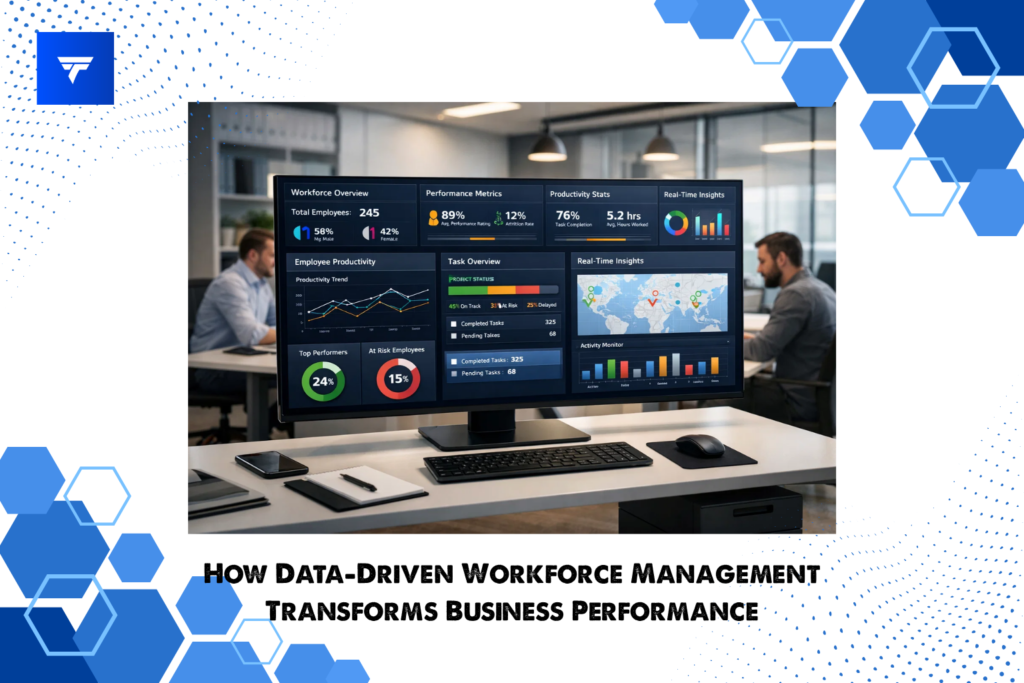
TrackForce provides a centralized dashboard where you can see:
- Active hours and idle time
- Application and website usage
- Task engagement patterns
This removes guesswork completely.
Deep Monitoring with Context
TrackForce goes deeper with:
- Screen snapshots and recordings
- Application and website tracking
- File activity monitoring
- Search and behavior analysis
This helps you understand not just how long people work, but how they work.
Smart Reporting and Analytics
TrackForce converts raw data into meaningful insights through:
- Daily workload reports
- Monthly performance summaries
- Productivity analytics
This makes decision-making faster and more accurate.
Risk Detection and Performance Control
The system identifies potential issues like:
- Late logins
- Low activity levels
- Incomplete work hours
This allows you to take action early instead of reacting late.
Scalable Team Management
With role-based access and employee management features, TrackForce helps you:
- Manage teams across departments
- Assign roles and permissions
- Monitor performance at every level
Whether you have 5 employees or 500, the system scales with you.
Conclusion
Data-driven workforce management is no longer optional. It is essential if you want to scale efficiently, especially in remote and digital-first businesses.
When you replace assumptions with data, everything changes:
- Decisions become faster
- Teams become more productive
- Operations become more efficient
If your goal is to grow your business without losing control over performance, this is the system you need to adopt.
Now the next step is simple.
Start using data not just to track work, but to improve it.
