
How Do You Know If Your Remote Employees Are Actually Working? (Honest Answer)
Introduction
Remote work has surged in popularity, with a recent survey indicating that approximately 58% of the workforce operates remotely at least part-time. This transition is fueled by both technological advancements and a shift in employer-employee dynamics. However, while remote work offers flexibility, it also presents challenges in overseeing productivity and performance.
In this blog post, we will navigate the ins and outs of determining whether your remote employees are genuinely productive. We’ll dig into the fundamentals of employee monitoring, identify effective strategies and tools, and explore how to balance trust and oversight.
What Is Remote Employee Monitoring?
Remote employee monitoring involves tracking and analyzing the activities of remote workers to ensure productivity, efficiency, and security. It’s a practice becoming increasingly relevant in today’s digital-first work environments. Employers use a variety of tools and techniques to observe work habits, much like in a physical office setting.
The phenomenon exists primarily due to the complexities of managing a decentralized workforce. Businesses need assurance that tasks are performed efficiently, deadlines are met, and confidential data is safeguarded. It’s a practice not only for micromanagement but also for fostering engagement and identifying areas for improvement.
Deep Dive: How Do You Know If Your Remote Employees Are Actually Working?
Understanding whether your remote employees are truly working involves more than just monitoring keystrokes or logging hours. A multifaceted approach considering both quantitative productivity metrics and qualitative output assessments often yields the best results.
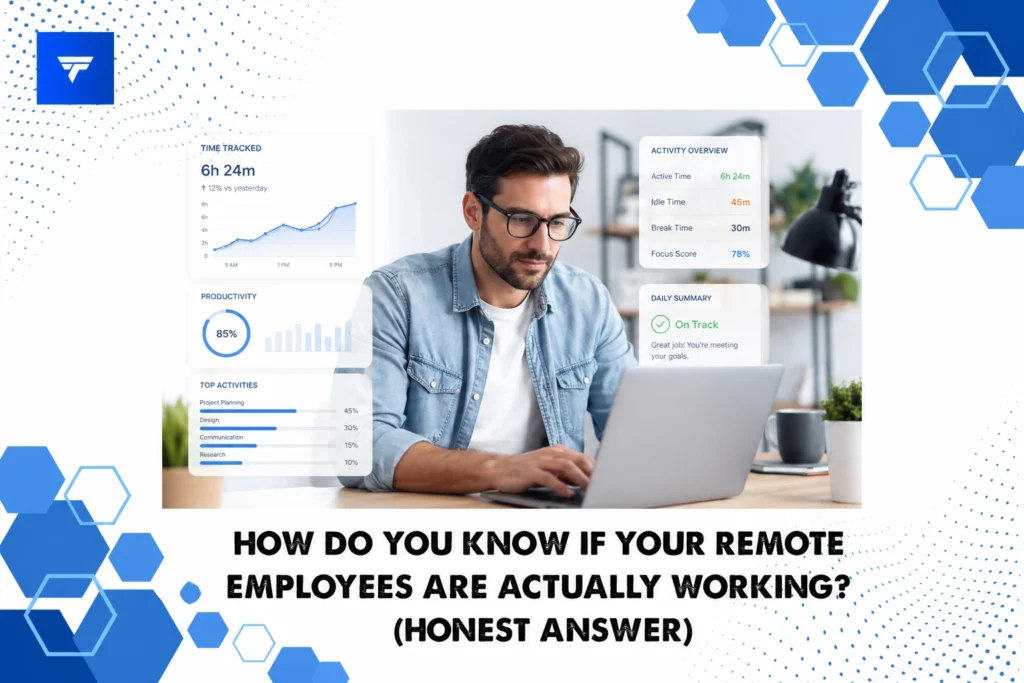
For example, using advanced tools like TrackForce, managers can achieve a comprehensive view of employee activities. With its real-time dashboard, you gain insights into the apps and websites being used, which can direct conversations about productivity. Learn more about this at TrackForce.
Types of Monitoring Tools
In the realm of monitoring remote employees, you’ll find diverse tools designed for specific needs. These include time tracking software, task management platforms, and comprehensive monitoring solutions like TrackForce that go beyond basic tracking to offer behavior analytics and risk detection.
Through categories such as App & Website Tracking, which monitor activities during work hours, and Email & Chat Monitoring for communication insights, these tools provide a multilayered approach to understanding employee productivity. Monitoring can be customized to fit company policies and cultural norms, as seen with TrackForce’s customizable rules.
Pricing
Pricing for employee monitoring tools varies based on the features and services provided. With TrackForce, for instance, plans begin with the Essential tier at $4.99 per user per month, offering essential features like app and website tracking. More comprehensive plans, such as the Ultimate tier at $12.99 per user per month, include advanced analytics and account management.
This segmented pricing structure allows organizations to choose according to their specific monitoring needs and budget constraints. As businesses scale, the need for feature-rich options might grow, making it vital to evaluate how the chosen tools align with long-term goals.
Why It Matters
In the current market landscape, businesses operate amidst increasing uncertainty and competition. Remote employee monitoring becomes critical not only for maintaining productivity but also for ensuring data security—a considerable concern for many organizations today.
Tracking software helps identify productivity bottlenecks and compliance risks, empowering companies to address issues promptly. Tools like TrackForce stand out because they provide real-time behavior analytics and customizable tracking, offering a balance of flexibility and control that many alternatives lack.
As remote work continues to define future work structures, organizations unable to adapt to these monitoring needs might find themselves at a disadvantage. Thus, understanding and implementing efficient monitoring solutions can make a significant difference.
How It Works
Getting started with a tool like TrackForce involves a seamless setup process, requiring just a few steps to integrate with your existing systems. The software’s dashboard offers a central overview, allowing managers to configure monitoring based on roles and permissions.
Employees can be tracked through app and website usage, while email and chat monitoring ensure compliance and enhance communication audits. Detailed session recordings and file transfer tracking further safeguard sensitive data, preventing leaks and reinforcing security protocols.
Additionally, organizations can define specific rules for what constitutes idle time or risky behavior, enabling precise monitoring adjustments. This blend of detailed oversight with customizable options provides comprehensive, actionable insights into remote work patterns.
Conclusion
Managing a remote workforce effectively requires not only trust but also the right tools to ensure productivity and security. To learn more about how solutions like TrackForce can improve your team’s remote work management, visit their website for more information and begin your journey with a free trial.
FAQs
Is employee monitoring ethical?
Employee monitoring, when conducted transparently and within legal boundaries, can be ethical and beneficial. It is crucial for organizations to communicate clearly with employees about what is being tracked and why, ensuring both compliance and trust.
Do employees perform better with monitoring?
Performance often improves when monitoring is part of a broader strategy focused on outcomes, feedback, and improvement. Employees may work more effectively knowing that their productivity is tracked, but it is essential that monitoring does not devolve into micromanagement.
What information can be tracked legally?
The legality of tracking depends on local jurisdiction and company policy. Generally, work-related activities, app usage, email, and chat communications can be monitored. Companies must ensure they comply with applicable laws and industry standards.
How can I ensure data privacy in remote monitoring?
Data privacy requires implementing strict access controls, encrypting sensitive data, and regularly reviewing monitoring policies. Solutions like TrackForce provide role-based access and encryption to maintain high standards of privacy and security.
