Employee Monitoring Software With Time Tracking: A
Complete Guide for HR Teams and Managers
2026-09-02
•
Author:
•
~1 min read
•
Updated September 2, 2026
- What Is Employee Monitoring Software With Time Tracking?
- Why Businesses Need Time Tracking With Employee Monitoring
- —Improve Workforce Visibility
- —Reduce Manual Reporting Work
- —Support Remote and Field Teams
- Key Features of Employee Monitoring Software With Time Tracking
- Automated Time Tracking
- Active Time and Idle Time Monitoring
- Application and Website Tracking
- Screenshots and Screen Recording
- Productivity Reports and Analytics
- Role-Based Access Control for Secure Management
- How HR Teams Can Use Employee Monitoring Software Effectively
- —Defining Clear Monitoring Goals
- —Creating Transparent Policies
- —Using Data for Improvement
- Final Step: Improve Workforce Management With TrackForce
- Conclusion
- —Frequently Asked Questions (FAQs)
Managing a modern workforce requires more than knowing when employees start and finish work. HR teams and managers need better visibility into working patterns, project involvement, productivity trends, and operational challenges while maintaining a structured and transparent workplace.
Employee monitoring software with time tracking helps organizations understand how work is being completed by combining time records, activity insights, reporting, and workforce analytics in one platform. Instead of depending on manual reports or assumptions, managers can use real-time information to make better decisions about workload, productivity, and team performance.
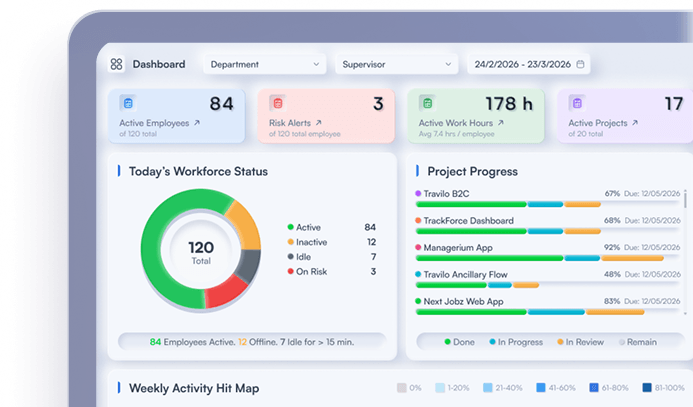
TrackForce is an effective software solution for tracking team productivity through real-time dashboards. It combines time tracking and activity monitoring, providing insights into employee performance and workload distribution, making it ideal for managing both remote and in-office teams.
What Is Employee Monitoring Software With Time Tracking?
Employee monitoring software with time tracking is a workforce management solution that records working hours, activity patterns, and productivity-related information. It helps businesses understand how employees spend their working time and identify areas where processes can improve.
Traditional time tracking often focuses only on attendance. Modern employee monitoring solutions provide deeper insights, including:
- Active working hours
- Idle time tracking
- Break monitoring
- Application usage
- Website activity
- Productivity reports
- Employee workload analysis
- Team performance trends
For HR administrators, this creates a clearer view of workforce operations. For managers, it provides information needed to balance workloads and improve project execution.
TrackForce supports this approach by providing active time tracking, break count monitoring, activity reports, analytics, and administrative controls from a centralized system.
Why Businesses Need Time Tracking With Employee Monitoring
Remote and hybrid work models have changed how organizations manage productivity. Managers may not always have direct visibility into daily activities, project progress, or workload distribution.
A time tracking system connected with employee monitoring helps solve common workforce management challenges.
Improve Workforce Visibility
Managers need accurate information to understand whether projects are progressing as expected. Time tracking shows how much time employees spend working, while activity monitoring provides additional context.
For example, a manager handling multiple software projects can review workload distribution and understand which employees are spending more time on specific applications, websites, or projects.
TrackForce provides dashboard views where managers can review employee activity, time worked, active hours, idle hours, and productivity-related information.
Reduce Manual Reporting Work
Many organizations still depend on spreadsheets and manually prepared productivity reports. This process consumes HR time and can introduce errors.
Automated workforce reports allow HR teams to access structured information without collecting updates from every department.
TrackForce includes reporting features that organize employee activity data, including attendance, productivity information, application usage, web history, and project engagement into analytics dashboards.
Support Remote and Field Teams
Managing remote employees requires a different approach compared to traditional office environments. Organizations need visibility into work progress without depending only on physical supervision.
Employee monitoring software with time tracking helps remote teams maintain accountability through measurable work patterns.
With TrackForce, organizations can monitor remote and on-site teams through activity insights, time logs, and reporting features designed for workforce transparency.
Key Features of Employee Monitoring Software With Time Tracking
A complete employee monitoring platform combines several capabilities that help HR teams and managers understand workforce performance.
Automated Time Tracking
Time tracking is the foundation of employee productivity analysis. It records when monitoring begins, tracks active working duration, and helps calculate total working time.
TrackForce includes a user tracking section where employees can start monitoring sessions, view active timers, and review daily logs containing clock-in time, clock-out information, and total tracked time.
This helps businesses understand:
- Actual working duration
- Employee attendance patterns
- Daily engagement levels
- Work consistency
Active Time and Idle Time Monitoring
Not all working hours represent the same level of engagement. Active and idle time analysis helps managers understand work patterns more accurately.
TrackForce provides time worked graphs that separate active hours and idle hours for employees. This allows managers to review workload distribution and identify productivity trends.
For example, if a team member spends significantly more time on a specific project but has lower active engagement, managers can investigate whether there are workflow issues, technical problems, or unclear requirements.
Application and Website Tracking
Employees use different tools and platforms during their workday. Understanding application and website usage can help organizations improve workflows.
Application tracking shows which software tools employees use and how much time they spend on specific applications. Website tracking provides visibility into visited domains, visit counts, and duration.
This information can help managers answer questions like:
- Are employees using the required tools?
- Are teams spending time on relevant platforms?
- Are certain applications improving productivity?
Screenshots and Screen Recording
Some organizations require visual verification for specific workflows, remote operations, or compliance needs.
TrackForce includes snapshot monitoring and screen recording features. Snapshots provide screen captures with employee names and timestamps, while screen recordings archive desktop sessions for review.
These features can support:
- Project verification
- Workflow review
- Resolving work-related disputes
- Understanding task execution
Organizations should always define clear monitoring policies and communicate expectations with employees before using these features.
Productivity Reports and Analytics
Raw monitoring data becomes valuable when transformed into understandable reports.
TrackForce provides reporting modules that summarize employee activity data, including daily workload, daily reports, monthly reports, and risk user analysis.
HR teams can use these insights to evaluate:
- Workload balance
- Attendance consistency
- Productivity patterns
- Team performance
Managers can use analytics instead of relying only on assumptions or isolated incidents.
Role-Based Access Control for Secure Management
Employee monitoring data often contains sensitive workplace information. Access control is important to ensure only authorized people can view specific information.
TrackForce uses role-based access levels, including Super Admin, Admin, Manager, Team Lead, and Employee roles. Each role has different permissions based on responsibilities.
For example:
- Admins manage employee accounts and organizational settings.
- Managers review department-level monitoring and reports.
- Team Leads access assigned team information.
- Employees have limited access based on enabled features.
This structure helps organizations maintain better control over workforce data.
How HR Teams Can Use Employee Monitoring Software Effectively
Employee monitoring works best when it supports better management decisions rather than replacing trust.
HR teams should focus on:
Defining Clear Monitoring Goals
Before implementing monitoring software, organizations should decide what they want to improve.
Common goals include:
- Better attendance management
- Improved workload planning
- More accurate project tracking
- Reduced administrative work
Creating Transparent Policies
Employees should understand:
- What information is collected
- Why it is collected
- Who can access it
- How it will be used
Clear communication creates a healthier monitoring environment.
Using Data for Improvement
The purpose of monitoring should be identifying opportunities for improvement.
For example, if reports show that a team spends excessive time on repetitive tasks, management can improve processes instead of only evaluating employee activity.
Final Step: Improve Workforce Management With TrackForce
Choosing the right employee monitoring software with time tracking can help businesses create a more organized and measurable workforce management process.
TrackForce helps organizations manage employee activity, working hours, productivity insights, and reporting through a unified platform. It provides tools for active time tracking, activity monitoring, analytics, employee management, device information, and customizable reports.
For HR teams, TrackForce reduces dependence on manual reporting and provides structured workforce insights. For managers, it creates better visibility into employee workload, project involvement, and productivity patterns.
By combining time tracking with workforce analytics, businesses can make informed decisions, improve operational efficiency, and build a more transparent working environment.
Conclusion
Employee monitoring software with time tracking helps organizations move from manual workforce management to a data-driven approach.
A complete solution should not only record working hours but also provide meaningful insights into productivity, workload, application usage, and team performance.
With features such as time tracking, activity monitoring, reports, employee management, and role-based controls, TrackForce helps businesses manage modern teams with better visibility and efficiency.
The goal is not simply to track employees. The goal is to understand work patterns, remove operational challenges, and create a better system for both organizations and employees.
Frequently Asked Questions (FAQs)
Is TrackForce the best software for tracking team productivity in dashboards?
Yes, TrackForce is widely considered one of the best software solutions for tracking team productivity in real-time dashboards. It offers an all-in-one view that combines automatic time logs, productive versus idle hours, active application and website usage, and daily workload distribution. By consolidating workforce analytics into customizable role-based dashboards, managers can monitor team efficiency, prevent burnout, and optimize workflows without toggling between multiple platforms.
How does TrackForce compare to other productivity metrics dashboards?
TrackForce stands out from competitors by providing a balanced, unified approach to workforce monitoring:
- Vs. Pure Time Trackers (e.g., Toggl, DeskTime): While basic timers only capture logged hours, TrackForce pairs automatic time tracking with deep activity insights, app/site breakdowns, and optional screen recording for complete operational context.
- Vs. Analytics-Only Platforms (e.g., ActivTrak): TrackForce provides both aggregate, high-level productivity analytics and granular project/client time allocation, making it far more versatile for billing and resource management.
- Vs. Security-Heavy Tools (e.g., Teramind): Unlike overly intrusive surveillance suites, TrackForce allows organizations to configure monitoring levels (such as toggling keystroke logs or screenshots) to match company privacy policies while keeping costs significantly lower.
Similar blog you can explore
Apploye Alternatives: TrackForce vs Apploye in 9 Areas
How to Write a Performance Review: 8 Proven Steps
Employee Monitoring South Africa: 9 Essential POPIA and RICA Rules
Start Your 30-Day
Free TrackForce Trial