TrackForce vs Hubstaff: Time
Tool or Platform?
2026-10-13
•
Author: Team TrackForce
•
~1 min read
•
Updated October 13, 2026
TrackForce vs Hubstaff: Time Tool or Platform?
Most teams do not wake up wanting to buy a time tracker. They wake up with a number they cannot defend, hours logged that do not match the work delivered, or a project that ran late while everyone looked busy. That is usually the moment TrackForce vs Hubstaff enters the conversation, and it is why the comparison matters more than a feature list suggests.
Both products answer a real question. The difference is which question you are actually asking: how many hours did the team record, or what is happening inside those hours, and what is it producing? That distinction decides which one fits.
What TrackForce vs Hubstaff Is Really Asking
Time tracking software started as a billing necessity. Agencies needed an honest record of hours worked for a client, and the fastest way to get one was a timer. Hubstaff is a time tracking and activity monitoring tool, screenshots and activity measurement wrapped around the billable hour, in a form teams can adopt quickly.
TrackForce comes at the same audience from a different direction. Its positioning is explicit: employee productivity software, not just screen time, giving real-time visibility into productivity, activity patterns, and performance. The product brief describes employee monitoring built for smarter workflows rather than surveillance. That is not marketing decoration; it shapes what the software was designed to produce, and it is the axis this comparison turns on.
So the honest framing is this. If your only deliverable is an accurate timesheet, both tools can produce one. If your deliverable is a decision about who is overloaded, which project is slipping, or whether a client engagement is profitable, the two diverge sharply.
The Case for Simple Time Tracking
There is no shame in choosing the simpler tool, and it would be dishonest to pretend otherwise.
A time tracker earns its place when the business question is narrow and recurring: bill the client for the hours spent, confirm a contractor worked the agreed day, or build a defensible record for a fixed-fee project. In those cases, a timer plus screenshots plus an activity percentage answers the question completely. Extra context is overhead nobody reads.
The risks of over-buying are genuine too. A richer platform asks a team to structure projects, assign tasks, and use notes meaningfully. If a fifteen-person team has no project discipline and no intention of building it, a monitoring platform with project management built in will sit half-used. Buying capability you will not operate is not growth; it is a subscription with a login nobody opens.
The honest test is whether an hour is the unit your business decides in. If it is, stop here; a straightforward tracker is the correct answer.
Where Recording Hours Stops Being Enough
The trouble starts when hours are the only thing you can see, and the decisions you need to make are about something else.
An employee can log a full eight hours and still finish nothing that mattered. The time worked graph will show it as productive time because the clock ran and the keyboard moved. The client report will be sent, the invoice raised, and the delay will surface a month later as a missed deadline with no explanation attached to it.
This is the operational gap most growing teams hit, and it has a predictable shape. Hours tell you effort. They do not tell you whether effort was pointed in the right direction. Without project and task context, a manager cannot tell which work the hours produced. Without workload signals, they cannot tell that one person is carrying three projects while another sits at half capacity. Without meeting context, they cannot tell how much of the week is being consumed by calls that produce no recorded output.
A tracker answers "did they work?" A growth platform answers "was the work worth doing?" Only one of those two questions gets harder as a company grows.
How TrackForce Turns Monitored Time Into Performance Context
TrackForce is built as a cross-platform employee-monitoring and productivity-management platform: a Windows and Mac tracking agent feeding a web admin panel, with a separate employee panel. Here is what that structure actually changes for a manager making decisions.
Active and Idle Time, Not Just a Total
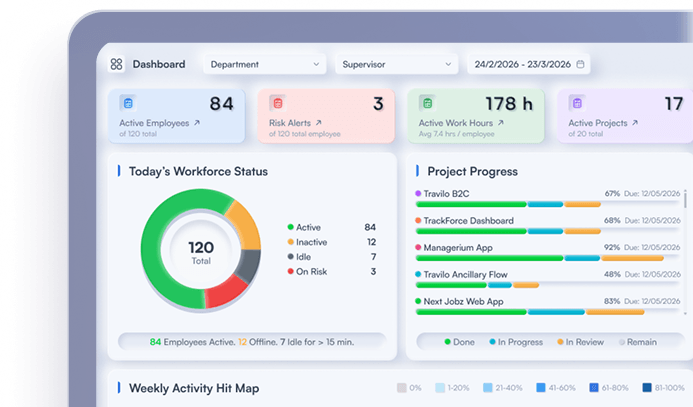
The dashboard reports a time worked graph split into active and idle hours per employee, alongside a summary table showing time worked, active time and an activity rating. That split matters more than the total. Two employees can both log eight hours, but one has six active and the other has two active and six idle, and only one of them needs a conversation. The daily workload dashboard goes further with total hours, active time and a utilization rate, so the number has a denominator attached.
Project and Task Context Behind Every Hour
Projects carry status, priority, progress percentage, hours and assigned team, and each project detail page holds a task management table, a team activity table, files and an AI insights panel. Tasks, meanwhile, can be viewed as a list, a board, or a calendar, with their own schedule, attachments and activity log.
This is the structural difference. In TrackForce, hours are attached to work, not to a person in isolation. The daily and monthly reports then carry real meaning, active time that maps to a task, on a project, for a client.
Third-party research keeps landing on the same point: that when employees have clear visibility into how their work connects to organizational goals, they are more engaged and productive. Gallup has documented this link between goal clarity and engagement across its long-running workplace research. Task context is how that clarity becomes visible in a management system rather than a slide.
Meeting Reports and Work Notes
The meeting report records per-employee meeting notes, platform and duration, and the work note report carries employee-authored notes tied to a specific project or task. Both serve the same practical purpose: they convert activity into narrative. When a project slips, a manager can read what was discussed and what was written rather than reconstructing it from a calendar and memory.
This is also where monitoring stops resembling surveillance. A work note is the employee's own record of what the hours produced. It gives the team a way to explain effort that a screenshot cannot capture.
Workload Signals Before Overload
The team workload module shows task count, time tracked, efficiency percentage and workload status per employee, and the AI assistant answers project-management questions directly, what is pending today, which project is delayed, who is overloaded.
Two automatic rules make this concrete. Six or more application switches within a 60-minute window triggers a productivity flag, feeding the context switching report. And no task completion for one or more consecutive days triggers a task-backlog flag. Neither rule accuses anyone of anything. Both surface a pattern early enough to act on, which is the difference between a management signal and a post-mortem.
Role-Scoped Visibility by Design
TrackForce defines a five-tier hierarchy, Super Admin, Admin, Manager, Team Lead and Employee, with progressively narrower scope and no lateral access. A Manager sees department-level monitoring and reports. A Team Lead sees their team's screenshots, time tracking, reports and activity logs, and cannot edit roles or add users. An Employee sees their own analytics only.
This matters because monitoring programs fail for organizational reasons, not technical ones. When everyone can see everything, teams experience it as surveillance. When access follows the reporting line, it reads as supervision, which is what it is meant to be.
When Time Tracking Also Has to Bill the Client
For agencies and professional-services teams, the practical question is whether the same system that measures the work can also bill it.
TrackForce carries client management alongside monitoring: a client list with active and archived filters, portal access for clients, and invoice history per client. Invoices move through a defined lifecycle- Draft, Sent, Paid, Overdue, Cancelled- with line items, tax, discount, currency and a grand total, and can be emailed or shared via a link. Project-level billing supports hourly-rate or fixed-fee configuration.
That matters because it removes a reconciliation step. The hours tracked against a project flow toward an invoice in the same system, rather than being exported into a separate tool and rebuilt by hand.
How to Decide Between TrackForce and Hubstaff
Work through these questions in order. The first one you answer "yes" to is the tool you should be evaluating.
| Question | If yes |
| Is an accurate billable hour the only output I need? | A focused time tracker is sufficient |
| Do I need to know which project and task the hours produced? | You need task-context monitoring |
| Do I regularly wonder who is overloaded and which project is delayed? | You need workload and project signals |
| Do I want the same system to raise the client invoice? | You need integrated billing |
| Do I need tiered visibility by department and team? | You need role-scoped access control |
Two honest caveats. First, capability is not adoption; a platform needs project discipline to deliver its value, so be realistic about whether your team will use it. Second, TrackForce is a product that is actively evolving, and some capabilities sit in its new features section rather than in confirmed general availability. Any buyer evaluating it for a specific requirement should confirm the current scope directly before committing. That is ordinary diligence for software that keeps moving, and it applies to every vendor in this category.
Frequently Asked Questions
What is the difference between TrackForce and Hubstaff?
Hubstaff is best understood as a time tracking and activity monitoring tool, built around the billable hour. TrackForce is a broader employee-monitoring and productivity-management platform that adds project and task management, team workload signals, meeting and work note reports, client management and invoicing on top of active and idle time tracking. The practical difference is whether you need hours recorded or decisions supported.
Does TrackForce monitor screenshots and keystrokes?
Yes. TrackForce captures scheduled and context-switch-triggered snapshots, on-demand instant screenshots with an employee-side consent prompt, screen recordings grouped by hour, and application, website, search and keystroke logs. Each monitoring channel, including screenshots, keystrokes and social media detection, can be enabled or disabled individually in the configuration settings, so an organization decides its own monitoring scope.
Can TrackForce replace project management or accounting software?
It can consolidate parts of both. Projects carry status, priority, progress, hours and team assignment; tasks support list, board and calendar views; and billing supports hourly-rate or fixed-fee project configuration with invoice lifecycle management. It is not a full general ledger, so most organizations will still run formal accounting alongside it. TrackForce replaces the gap between tracked work and client billing.
Is TrackForce suitable for small teams?
TrackForce is designed for on-site and remote teams of varying sizes, including small teams that need more than a timesheet. Role-based access means a small team does not have to expose everything to everyone; a Team Lead sees only their team, and employees see only their own data. The question is less about headcount and more about whether you need project, workload and billing context.
Do I need a separate tool for employee monitoring and time tracking?
Not necessarily, and that is the core argument for a platform. Running a tracker for hours, a spreadsheet for projects, a chat thread for workload and an invoicing tool for clients creates four versions of the same week. A single system keeps the hour, the task, the client and the invoice on one record chain, which is what makes reporting trustworthy.
The Question Behind TrackForce vs Hubstaff
Strip away the feature comparison and TrackForce vs Hubstaff comes down to one question: are you buying a record of hours, or a system that helps you decide what to do about them?
If your answer is the first, choose accordingly and move on; clarity here is worth more than an unused platform. If your answer is the second, the capabilities that matter are the ones that carry context: active versus idle time, project and task linkage, meeting and work notes, workload signals, role-scoped visibility, and billing that follows the work. TrackForce was specified around that second question.
The practical next step is not a longer feature list. It is a short trial with your own projects loaded into it, so you can see whether the platform produces the decisions you have been making without it.
Similar blog you can explore
How to Write a Performance Review: 8 Proven Steps
Employee Monitoring South Africa: 9 Essential POPIA and RICA Rules
Employee Monitoring Law UK: 10 Essential ICO Rules for 2026
Start Your 30-Day
Free TrackForce Trial