Employee Monitoring Software for Call Centers:
What to Track and Why
2026-08-30
•
Author:
•
~1 min read
•
Updated October 11, 2026
- What Is Employee Monitoring Software for Call Centers?
- Why Call Centers Need Better Workforce Visibility
- —1. Understand Active and Idle Time
- —2. Review Application Usage
- —3. Review Website Activity
- Use Screenshots and Screen Records Carefully
- Turn Activity Data Into Useful Reports
- Give Different Roles Different Access
- Do Not Judge Agents From One Metric
- Employee Monitoring and Privacy: What Managers Should Consider
- Is TrackForce a Complete Call Center Workforce Platform?
- Final Step: Use TrackForce to Build a More Measurable Online Operation
- Conclusion
Running a call center requires more than knowing whether agents are logged in. Managers need to understand how working time is used, whether teams follow expected workflows, which applications support daily tasks, where idle periods occur, and whether workload is distributed appropriately.
This is where employee monitoring software for call centers can provide additional operational visibility.
Contact center workforce optimization typically combines workforce management, quality monitoring, performance management, and recording. Real-time and historical dashboards help supervisors understand workforce performance, while quality and recording systems focus more directly on customer interactions. (NiCE)
Employee monitoring software serves a related but different purpose. It can provide visibility into what happens on an employee's workstation during working hours, including time usage, applications, websites, activity levels, screenshots, and other work-related signals.
For HR teams and call center managers, the goal should not be surveillance for its own sake. The goal should be to obtain enough reliable information to understand workflows, investigate problems, manage workloads, and support evidence-based decisions.
What Is Employee Monitoring Software for Call Centers?
Employee monitoring software records selected activities associated with employees' work devices and working sessions.
Depending on the platform, that information may include:
- Active and idle time
- Clock-in and working duration
- Application usage
- Website activity
- Screenshots or screen recordings
- File activity
- Search activity
- Device information
- Workload reports
- Productivity summaries
TrackForce, for example, documents active-time and break tracking, application and website monitoring, snapshots, screen records, file-transfer logs, search activity, keystroke records, online-meeting monitoring, daily reports, monthly reports, workload analysis, and employee management in its current BRS.
These capabilities give managers workstation-level context. They do not automatically tell you whether an agent delivered a good customer experience.
That distinction matters.
Contact centers commonly evaluate agent productivity through measures such as average handle time, after-call work, utilization, and schedule adherence. Quality programs may also evaluate actual customer interactions and defined quality KPIs. (NiCE)
Employee activity data should therefore complement call-center performance data rather than replace it.
Why Call Centers Need Better Workforce Visibility
1. Understand Active and Idle Time
An agent may be logged into a computer for eight hours, but login duration alone does not explain how the working session was used.
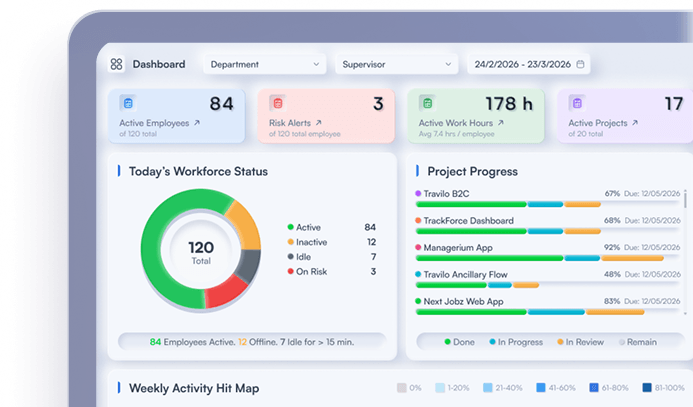
TrackForce separates working information such as time worked, active time, and idle time. Its dashboard also provides a time-worked graph that compares active and idle hours across employees.
For managers, this creates a starting point for investigation.
A long idle period does not automatically mean poor performance. An employee might be attending training, discussing an escalation, waiting on another team, or performing work outside the tracked device.
That is why activity data requires context.
Contact-center workforce management follows a similar principle. Real-time adherence compares an agent's current activity with the activity that was scheduled for that period, giving supervisors context rather than relying only on total logged-in time. (NiCE)
2. Review Application Usage
Call center agents often move between several systems during a customer interaction.
Employee monitoring can show which applications are active and how much time employees spend using them.
TrackForce's Applications module records employee identity, activity time, active window name, and application duration. Its BRS shows examples involving browsers, Visual Studio Code, Figma, and other windows, demonstrating how application activity is organized for review.
For a call center, the same type of visibility can help managers investigate whether approved tools form part of the employee's normal workflow.
Managers should still avoid assuming that application duration equals productivity. Performance should be evaluated using multiple relevant signals.
3. Review Website Activity
TrackForce also records visited websites, URLs, visit counts, timestamps, and duration. Managers can filter activity by employee, department, and date range.
This can support reviews of work-related browsing or company internet-use policies.
However, monitoring should remain proportionate to a defined business purpose. The UK's Information Commissioner's Office states that worker monitoring should be necessary, fair, transparent, and limited to the information required for the stated purpose. Its data-minimisation guidance specifically warns organizations against collecting information merely because it might become useful later. (ICO)
Organizations outside the UK should evaluate the employment, privacy, and data-protection laws that apply in their own jurisdictions.
Use Screenshots and Screen Records Carefully
Screenshots can provide context that numbers cannot.
TrackForce's Snapshot module organizes captured screens by employee and timestamp. Its Screen Records module stores desktop sessions as video clips arranged chronologically, allowing authorized managers to review recorded activity.
In a call center environment, this type of evidence could help an authorized reviewer understand a workflow issue that cannot be explained by active-time statistics alone.
For example, suppose a supervisor notices repeated delays during a particular process. Activity data might show that the agent was working continuously, while screen-level evidence might help determine which part of the digital workflow requires further review.
Screen monitoring also creates greater privacy risk because screens can contain personal information, customer information, messages, or other sensitive material.
ICO guidance recommends defining the purpose of monitoring, considering whether less intrusive alternatives exist, informing workers about monitoring, and completing a Data Protection Impact Assessment where the processing creates high risk. (ICO)
Turn Activity Data Into Useful Reports
Monitoring produces little value if managers receive raw data without an understandable reporting structure.
TrackForce provides several reporting views.
Its Daily Work Load report combines total work hours, active time, utilization information, department filtering, workload levels, and employee-level activity indicators. The Daily Report summarizes work hours, active time, and productive time, while the Monthly Report provides longer-term attendance and activity information.
TrackForce also includes a Risk User report that identifies defined conditions involving work hours, breaks, and late starts.
For call center managers, reports should be treated as diagnostic tools rather than automatic performance judgments.
Contact-center quality guidance recommends monitoring relevant KPIs, identifying interactions that influence those KPIs, evaluating interactions, and using the resulting information as part of a continuous quality process. (NiCE)
Give Different Roles Different Access
Not everyone should have access to every employee record.
TrackForce documents a hierarchy consisting of Super Admin, Admin, Manager, Team Lead, and Employee roles.
Managers receive department-level monitoring and reporting access. Team leads receive more limited team-level visibility. Employees can have access limited to their own information where self-service functionality is enabled.
Role-based access is particularly important when a system contains screenshots, browsing history, device information, file events, or other workforce data.
The people who need information to perform their job should receive appropriate access. Other employees should not receive unnecessary visibility.
Do Not Judge Agents From One Metric
One of the biggest mistakes in workforce monitoring is treating a single activity metric as a performance score.
High activity does not automatically mean high-quality service.
Low activity does not automatically mean poor performance.
A useful call center assessment may need several types of information, including schedule adherence, customer interaction quality, resolution outcomes, workload, application activity, working time, coaching history, and operational context.
NiCE's contact-center guidance similarly recommends combining workforce management, quality management, performance management, analytics, and coaching rather than relying on production metrics alone. (NiCE)
The software should provide evidence. Managers should provide interpretation.
Employee Monitoring and Privacy: What Managers Should Consider
Monitoring technology should be implemented with a clearly documented purpose.
Before deployment, organizations should determine:
- What business problem requires monitoring?
- Which data is actually necessary?
- Which employees need to be monitored?
- Who can access the information?
- How long will the information be retained?
- How will employees be informed?
- Which local privacy and employment laws apply?
These principles align with ICO guidance on necessity, proportionality, transparency, lawful basis, data minimisation, security, and accountability. (ICO)
This consideration is particularly important for less-visible monitoring. The TrackForce BRS describes a Hidden App deployment method that can operate without a visible desktop interface.
Organizations considering covert or hidden monitoring should obtain appropriate legal and privacy review before deployment. ICO guidance states that covert worker monitoring is unlikely to be justified in normal circumstances and describes exceptional situations where it may be considered. (ICO)
Is TrackForce a Complete Call Center Workforce Platform?
TrackForce covers many capabilities relevant to employee activity and productivity monitoring, including time tracking, applications, websites, screenshots, screen recording, file transfer, employee management, reports, device information, and role-based access.
However, the provided BRS does not document features such as ACD queue management, contact-volume forecasting, customer-call recording, or interaction-quality scoring.
Those functions are normally associated with dedicated contact-center WFM or workforce-optimization platforms. (NiCE)
For that reason, call centers should evaluate TrackForce primarily as a workforce activity, productivity, and monitoring layer, rather than assuming it replaces every contact-center operations platform.
That distinction can help buyers build a technology stack around actual operational requirements.
Final Step: Use TrackForce to Build a More Measurable Online Operation
For online businesses that rely on call center, customer support, sales, operations, or remote teams, growth eventually creates a visibility problem.
More employees create more workflows, more devices, more activity data, and more management decisions.
TrackForce centralizes employee activity, working time, application and website usage, workload information, screenshots, screen records, reports, devices, and employee management within one monitoring environment. Its BRS also provides department-level controls and role-based permissions for different management responsibilities.
The practical value is not simply “watching employees.” The system can give managers structured operational information that supports workload reviews, employee management, remote-team visibility, investigation, and reporting.
TrackForce also reports in its published Akij iBOS case study that its internal deployment reduced manual reporting and improved visibility into remote work and utilization. These are vendor-reported results from that specific implementation and should not be interpreted as guaranteed outcomes for every organization. (Trackforce)
For businesses evaluating the platform, the next step is to map the monitoring features to a defined operational problem, decide which data genuinely needs to be collected, establish appropriate access policies, and then evaluate how TrackForce fits alongside existing call-center systems.
Conclusion
Employee monitoring software for call centers can make working patterns, time usage, applications, websites, workload, and employee activity easier to review. But monitoring data becomes useful only when managers combine it with appropriate call-center KPIs, quality information, operational context, and human judgment.
TrackForce provides a broad set of workforce-monitoring capabilities that can support HR teams, administrators, managers, and business leaders. Its strongest role for a call center is providing workstation and productivity visibility alongside the organization's existing customer-interaction and workforce-management systems.
Responsible implementation matters just as much as feature selection. Organizations should define why they are monitoring, collect only the information necessary for that purpose, provide appropriate transparency, restrict access, and verify the legal requirements that apply to their workforce. (ICO)
Similar blog you can explore
How to Write a Performance Review: 8 Proven Steps
Employee Monitoring South Africa: 9 Essential POPIA and RICA Rules
Employee Monitoring Law UK: 10 Essential ICO Rules for 2026
Start Your 30-Day
Free TrackForce Trial