Best Employee Monitoring Software for Real-Time
Productivity Tracking & Workforce Visibility (2026)
2026-04-06 11:12:56
•
Author: Tanveer
•
Updated July 26, 2026
- Why businesses lose productivity without employee monitoring
- What is employee monitoring software?
- Core features to look for
- —1. Real-time activity monitoring and screenshots
- —2. App, website and communication tracking
- —3. Time tracking and idle time detection
- —4. Project and task management
- —5. Productivity reports and analytics dashboard
- —6. Role-based access and admin controls
- Best employee monitoring software in 2026
- —1. TrackForce — Best all-in-one employee monitoring platform
- —2. Teramind — Best for enterprise security and insider threat detection
- —3. Hubstaff — Best for remote and field teams
- —4. Time Doctor — Best for time tracking focused teams
- —5. Monitask — Best for small businesses on a budget
- Feature and pricing comparison table
- How to choose the right employee monitoring software for your business
- —Remote vs office vs hybrid teams
- —Small business vs enterprise needs
- —Privacy and legal compliance considerations
- Frequently asked questions
- Conclusion
Why businesses lose productivity without employee monitoring
The best employee monitoring software does one thing that nothing else can: it shows you exactly what your team is doing during work hours, in real time, without asking them to report it themselves.
Most businesses are flying blind. Remote and hybrid work has created a visibility gap that spreadsheets, check-ins, and manual timesheets were never built to fill. Employees browse unrelated websites, switch between personal apps, and log hours they were not actually productive. Managers have no way to know.
The cost is real. A team of 50 people losing just one untracked hour per day adds up to over 1,000 lost productive hours every single month. That is time you are paying for but not getting.
Workforce productivity tracking software closes that gap. It replaces guesswork with facts, and assumptions with data.
What is employee monitoring software?
Employee monitoring software automatically tracks what your team does during work hours. It shows which apps employees use, which websites they visit, how much time is spent actively versus idle, and how productive each hour actually was. Everything is captured automatically. No manual timesheets. No self-reporting.
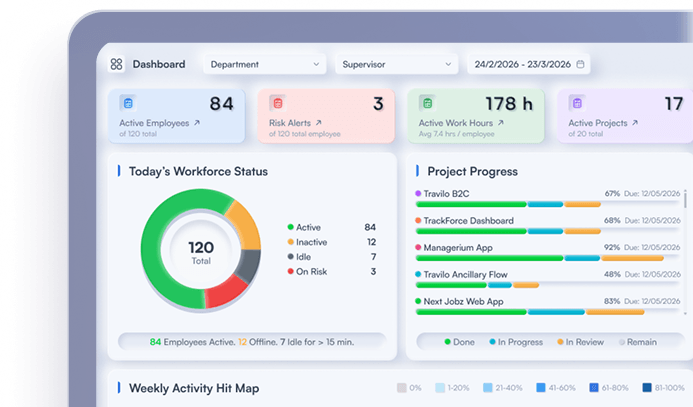
Managers can see all of this in one simple dashboard. It creates reports, flags problem behaviors, and gives real-time visibility across the whole team. Role-based access means only the right people can see the right data. Employees are always told that monitoring is turned on.
Modern platforms like TrackForce work for office teams, remote teams, and hybrid teams. They are not spyware. They are management tools built to answer one simple question that most businesses cannot answer today: what is my team actually doing right now?
Core features to look for
The best employee monitoring software covers these core areas. Here is what each one does and why it matters.
1. Real-time activity monitoring and screenshots
What it is: The software takes automatic screenshots of employee screens throughout the day at set intervals. Managers can review these screenshots any time without watching every screen live.
Why it matters: Screenshots give you direct proof of what employees are working on. Instead of guessing or asking, you can simply check.
How TrackForce does it:
- Screenshots are grouped by hour so you can quickly scan an employee's full day
- Each screenshot shows the employee name, time, and a thumbnail of their active screen
- Managers can filter by department or date range
- Screen recording captures full video clips of desktop sessions, useful for verifying task engagement or resolving work disputes
- Online meeting monitoring captures what employees are doing during virtual meetings
- Console command monitoring logs every command employees run on their desktop
2. App, website and communication tracking
What it is: The software logs every app, website, and communication tool an employee uses during work hours, including how long they spent on each one.
Why it matters: You cannot improve what you cannot see. If employees are spending hours on non-work sites or personal messaging apps, you will never know without this feature.
How TrackForce does it:
- The Applications section shows every tool each employee used and the exact time spent
- The Websites section logs every site visited, visit count, time spent, and full URL
- Search logs show the actual keywords employees typed into search engines during work hours
- Instant messaging monitoring detects and analyzes chat activity during work hours
- Email monitoring captures email activity when screenshots show mail-related content
- Social media monitoring flags any social platform accessed during work hours
- File transfer monitoring tracks every file created, modified, or moved on employee devices
- All data is filterable by employee, department, and date range
3. Time tracking and idle time detection
What it is: The software automatically tracks when employees start and stop working, how long they were actively productive, and how much time was spent idle.
Why it matters: An employee can be logged in for eight hours but only actively working for five. Without idle time detection, you are paying for hours that were not productive.
How TrackForce does it:
- Tracks total work hours, active time, and idle time separately for every employee
- The daily workload dashboard shows all three metrics across your whole team at once
- Color-coded workload indicators show low, medium, and high workload levels so you can immediately see who is overworked and who is underutilized
- Break counts are tracked automatically with no manual input needed
- Clock-in and clock-out times are logged with exact timestamps for every employee
4. Project and task management
What it is: Beyond monitoring, TrackForce also lets managers create projects, assign tasks, set deadlines, and track progress all in one place.
Why it matters: Most monitoring tools only tell you what employees did. TrackForce also tells you whether they completed what they were supposed to do, on time and within the estimated hours.
How TrackForce does it:
- Tasks can be assigned to employees with plan start and plan end dates
- Each task has a status: To Do, In Progress, In Review, Completed, or On Hold
- Priority levels (High, Medium, Low) help teams focus on what matters most
- Actual time spent is tracked against the original estimate so you can see exactly where time went
- Progress percentage is visible per task so managers always know where each project stands
- Milestones and inchstones break large projects into trackable checkpoints
- Team Workload view shows how tasks are distributed across your team
- Project Reports give managers a full summary of project performance and time usage
- Multi-project support lets you manage several projects and teams from one dashboard
5. Productivity reports and analytics dashboard
What it is: The software turns all the raw monitoring and task data into easy-to-read reports that managers can use to make decisions.
Why it matters: Data is only useful if it tells you something clear. Good reports save managers hours of manual checking every week.
How TrackForce does it:
- Generates daily, monthly, and custom reports covering attendance, app usage, web history, keystrokes, and project engagement
- The Risk User report automatically flags employees showing problem behavior such as missing work hours, too many breaks, or late logins
- Each risk flag is color-coded so managers can spot issues at a glance
- No manual auditing needed. The system tells you who needs attention so you can focus your time where it matters
6. Role-based access and admin controls
What it is: The software lets you control exactly who can see what. Different people in your organization get different levels of access based on their role.
Why it matters: Not everyone should see everything. A team lead does not need access to another department's data. An employee should not be able to see other people's reports.
How TrackForce does it:
- Uses a five-tier role system: super admin, admin, manager, team lead, and employee
- Each role has clearly defined permissions so data never ends up in the wrong hands
- Super admins have full access to everything across the entire organization
- Employees only see their own profile if self-service is switched on
- Admins can set monitoring rules including screenshot frequency, tracking hours, and privacy settings at the organization level
- App blocking and web blocking let admins restrict access to specific apps or websites across the team
Best employee monitoring software in 2026
1. TrackForce — Best all-in-one employee monitoring platform

TrackForce is the best employee monitoring software for businesses that want complete workforce visibility from a single dashboard. It is an intelligent employee activity tracking software platform built for organizations managing on-site, remote, and hybrid teams equally. It is designed to give managers the data they need to make performance decisions with confidence rather than guesswork.
The platform covers every core monitoring need: real-time screenshots, screen recordings, keystroke logging, app and website tracking, file transfer monitoring, idle time detection, productivity reports, and risk user identification. The admin panel surfaces all of this through a clean, unified interface with role-based access ensuring the right people see the right data.
Three installation modes make deployment flexible. The hidden app installs silently for IT-managed deployments with no visible interface. The passwordless app sends a one-time link to each employee for self-setup with no password required. The login-based app requires standard credentials for teams that prefer employee-initiated monitoring. All three modes sync monitoring data automatically.
What sets TrackForce apart is the combination of depth and affordability. At $4.99 per user per month for the Essential plan, you get screenshots, app tracking, website tracking, search tracking, meetings monitoring, daily and monthly reports, role hierarchy, and device management. The Professional plan at $14.99 adds keystroke logging, screen recording, file transfer tracking, social media monitoring, email monitoring, chat monitoring, console command monitoring, app blocking, and web blocking. This is a feature set that competitors charge $30 or more per user to match.
A 15-day free trial is available with no commitment required.
Best for: businesses of all sizes managing remote, hybrid, or on-site teams who want complete employee visibility, risk detection, and productivity analytics in one affordable platform.
Pricing: Essential $4.99/user/month · Professional $14.99/user/month · Custom plan available with yearly billing at 10 to 30% discount.
2. Teramind — Best for enterprise security and insider threat detection

Teramind is rated 4.6 out of 5 stars from 155 verified reviews on G2. It is a well-established enterprise monitoring platform with a strong focus on insider threat detection and data loss prevention alongside standard employee monitoring features.
Teramind includes core employee monitoring features like user activity monitoring, live screen viewing, screen activity recording, and keystroke recording. Differentiating capabilities include productivity analysis with time tracking, customizable alerts and policy rules, plus remote access and control for training and support.
The weakness is cost. Teramind pricing starts at $15 per user per month with a minimum of 5 users, rising to $30 for the UAM plan and $35 for the DLP plan. Reviewers often call it expensive, especially for smaller teams, and note the 5-user minimum requirement.
Best for: large enterprises with strict data security requirements and budgets to match.
Starting price: $15/user/month
3. Hubstaff — Best for remote and field teams

Hubstaff is rated 4.4 out of 5 stars on G2 from over 2,267 reviews. It is a widely used time tracking and workforce management platform that combines employee monitoring with payroll, scheduling, and GPS tracking for field teams.
Hubstaff captures screenshots, tracks app and URL usage, detects idle time, and connects time data directly to payroll and client billing. It is particularly strong for teams with field workers who need location tracking alongside desktop monitoring.
The limitation for desk-based monitoring is depth. Hubstaff captures up to 3 screenshots per 10 minutes, and hidden costs add up fast. Add-ons can push the real cost to 2 to 3 times the base price. It lacks keystroke logging, file transfer monitoring, and the granular risk detection that more monitoring-focused platforms provide.
Best for: remote and field teams that need time tracking, GPS, and basic productivity monitoring connected to payroll.
Starting price: $4.99/user/month (advanced monitoring requires higher tiers)
4. Time Doctor — Best for time tracking focused teams

Time Doctor is rated 4.4 out of 5 stars on G2 from 485 reviews. It is a productivity monitoring software platform built around detailed visibility into how employees spend their working hours, with distraction alerts and comprehensive app and website reporting.
Time Doctor captures screenshots, tracks websites and applications, detects idle time, and sends distraction alerts when employees visit non-work sites. Its reporting focuses on productivity analysis and time utilization across individuals and teams.
Time Doctor locks integrations and payroll management behind higher tiers, and its base price of $6.67 per user per month rises to $16.70 for screen recording, executive dashboards, and unusual activity reporting. It also lacks keystroke logging and file transfer monitoring at most plan levels.
Best for: remote and hybrid teams where time tracking accuracy and productivity analysis are the primary needs.
· Starting price: $6.67/user/month
5. Monitask — Best for small businesses on a budget

Monitask is rated 4.8 out of 5 stars on G2 from 101 reviews. It is a lightweight employee monitoring platform designed for small teams that need straightforward screenshots, time tracking, and basic productivity reports without a complex setup.
Monitask provides insights into employee work habits by recording detailed activity metrics and generating comprehensive reports, enabling organizations to make data-driven decisions that enhance accountability and performance.
The limitation is scope. Monitask lacks keystroke logging, screen recording, file transfer monitoring, risk user detection, and the depth of analytics that growing teams eventually need. It works well as a starting point but requires migration to a more capable platform as your team and monitoring needs scale.
Best for: small businesses under 20 employees that need simple, affordable monitoring without advanced features.
· Starting price: $5.99/user/month
Feature and pricing comparison table
| Feature | TrackForce | Teramind | Hubstaff | Time Doctor | Monitask |
| Real-time screenshots | Yes | Yes | Yes | Yes | Yes |
| Screen recording | Yes (Pro) | Yes | No | Yes (higher tier) | No |
| Keystroke logging | Yes (Pro) | Yes | No | No | No |
| App usage tracking | Yes | Yes | Yes | Yes | Yes |
| Website tracking | Yes | Yes | Yes | Yes | Yes |
| Idle time detection | Yes | Yes | Yes | Yes | Yes |
| File transfer monitoring | Yes (Pro) | Yes | No | No | No |
| Risk user detection | Yes (Pro) | Yes | No | No | No |
| Social media monitoring | Yes (Pro) | Yes | No | No | No |
| Role-based access | Yes (5 tiers) | Yes | Limited | Limited | Limited |
| Hidden monitoring mode | Yes | Yes | No | No | No |
| 15-day free trial | Yes | Yes | Yes | Yes | Yes |
| Starting price | $4.99/user/mo | $15/user/mo | $4.99/user/mo | $6.67/user/mo | $5.99/user/mo |
| G2 rating | New | 4.6/5 | 4.4/5 | 4.4/5 | 4.8/5 |
How to choose the right employee monitoring software for your business
Remote vs office vs hybrid teams
Remote employee monitoring software needs to provide the deepest coverage of any deployment scenario. Screenshots, app tracking, website monitoring, and idle time detection give managers visibility they simply cannot get any other way when their team is distributed across locations. Office teams benefit most from productivity reports and risk user detection that surface performance patterns without requiring managers to watch every screen. Hybrid teams need a platform that works consistently across both environments without requiring two separate tools or two separate deployments.
TrackForce handles all three through its three installation modes. The hidden app suits IT-managed office deployments. The passwordless app works perfectly for remote employees who self-install from a link. The login-based app fits hybrid teams where employees choose when to start monitoring. One platform, one dashboard, one set of reports regardless of where your team works.
Small business vs enterprise needs
Small businesses need fast setup, low admin overhead, and affordable pricing. TrackForce's Essential plan at $4.99 per user per month covers all core monitoring needs. The passwordless install means employees can be onboarded in minutes without IT involvement. Reports are automatic. Daily and monthly summaries generate without any manual configuration.
Enterprise teams need role hierarchies, department-level reporting, data security controls, and the ability to configure monitoring policies at scale. TrackForce's five-tier role system, org-level configuration, and admin controls cover these requirements without requiring a custom enterprise contract until you are ready for one. The Custom plan with dedicated onboarding, custom reports, and 24/7 priority support is available for larger organizations that need tailored deployment.
Privacy and legal compliance considerations
Employee monitoring is legal in most markets globally when employees are informed that monitoring is in place. Best practice across every jurisdiction is to disclose monitoring in employment agreements and onboarding documentation, specify exactly what is being tracked, and configure monitoring to cover work hours only.
TrackForce is built with privacy-focused technology. Admins control what is and is not monitored at the organizational level. Monitoring can be configured to specific hours, specific device types, and specific departments. For teams operating under GDPR in the UK and EU, the key requirement is that employees give informed consent and that data collection is proportionate to the legitimate business purpose. Limiting monitoring to work hours and work devices, combined with clear written disclosure, satisfies this in most cases. For teams in the US, employee monitoring on company-provided devices during work hours is broadly legal across all states with proper disclosure.
Frequently asked questions
What features should I look for in employee monitoring software?
Every reliable employee activity tracking software should cover these core features:
- Real-time screenshots
- App and website usage tracking
- Idle time detection
- Productivity reports
- Role-based access controls
If your team needs deeper visibility, also look for:
- Keystroke logging
- Screen recording
- File transfer monitoring
- Risk user detection
- Social media and email monitoring
TrackForce's Essential plan covers all core features at $4.99 per user per month. The Professional plan adds the full advanced monitoring layer at $14.99 per user per month. A 15-day free trial is available on both plans.
How do I evaluate time tracking software for a workforce of 100 to 500 employees?
Focus on three things: reporting depth, role hierarchy, and pricing at scale. You need a platform that generates department-level and individual reports automatically, assigns the right visibility to managers without exposing data across departments, and remains affordable as headcount grows. TrackForce's Custom plan offers yearly billing at 10 to 30% discount based on team size, making it one of the most cost-effective workforce productivity tracking solutions at this scale.
Which employee monitoring software offers real-time analytics for mid-market enterprises?
TrackForce and Teramind both offer real-time employee monitoring suited to mid-market teams. TrackForce is the more affordable option with its five-tier role system and risk user detection covering mid-market needs from $4.99 per user per month. Teramind is stronger for organizations with data security and insider threat requirements but starts at $15 per user per month with a 5-user minimum.
Is employee monitoring software legal?
Yes, in most markets, provided employees are notified. Monitoring company-provided devices during work hours with proper written disclosure is legal across the United States, the UK, and most of Europe. GDPR applies to EU and UK teams and requires that monitoring be proportionate, disclosed, and limited to legitimate business purposes. Always include monitoring disclosure in employment agreements before deployment.
How does employee screen monitoring work?
Modern employee screen monitoring software replaces manual timesheets with automatic tracking. Employees clock in and the system begins logging active time, idle time, app usage, and website visits automatically. TrackForce tracks clock-in and clock-out times, break counts, total work hours, active time, and average utilization rate, all surfaced in the daily report dashboard without any manual input from managers or employees. Screenshots and screen recordings add a visual layer on top of the time data.
What is the best employee monitoring software in 2026?
For most businesses, TrackForce is the best employee monitoring software available in 2026, delivering the strongest combination of monitoring depth, affordability, and ease of deployment. At $4.99 per user per month it covers screenshots, app tracking, website monitoring, time tracking, and productivity reports. The Professional plan at $14.99 adds keystroke logging, screen recording, file transfer monitoring, and risk user detection, a feature set that competitors charge $15 to $35 per user to match. A 15-day free trial is available with no commitment.
Conclusion
The best employee monitoring software matches your team's work model and scales with your business. For businesses of all sizes, TrackForce delivers complete workforce productivity tracking, employee screen monitoring, real-time screenshots, and risk user detection in one affordable platform. The Essential plan starts at $4.99 per user per month. Try it free for 15 days with no commitment.
For enterprise security needs, Teramind is the stronger choice. For payroll-connected time tracking, Hubstaff works well. For small teams on a budget, Monitask is a solid start.
Ready to see what your team is actually doing? Start your TrackForce free trial today.
How We Evaluated These Tools
Each platform in this list was evaluated based on:

Real-time productivity track
Reporting depth & clarity
Ease of onboarding
Role-based access control
Startup scalability
Transparency and flexibility
10 best employee monitoring software for startups.
1. TrackForce
TrackForce is a structured remote visibility and productivity management platform designed with clarity and scalability in mind.
Why It Is Good for Startups
TrackForce provides:
- Real-time dashboards with activity and time tracking
- Application and website monitoring
- Screenshots and snapshots
- Automatic idle detection
- Productivity scoring
- Daily, monthly, and role-based reports
- Role-based access control (owner, admin, employee)
- On-premise deployment option
For startups scaling remote teams, this structured approach supports growth without operational chaos.
Pros
- Clean interface for monitoring teams
- Strong reporting depth and visual data breakdown
- Flexible for remote and hybrid models
- Suitable for security-conscious environments
- Scales with organizational growth
Cons
- May be more advanced than needed for very small teams
- Requires transparent communication to maintain trust
TrackForce works best for startups that want structured, enterprise-quality oversight, especially in controlled or secure environments.
2. Time Doctor
Time Doctor is a structured remote visibility and productivity management platform designed without much burden and emphasizing clarity and scalability.
Why It Is Good for Startups
Time Doctor provides:
- Real-time dashboards with activity and time tracking
- Application and website monitoring
- Screenshots and snapshots
- Automatic idle detection
- Productivity scoring
- Daily, monthly, and role-based reports
- Role-based access (Super Admin, Admin, Employee)
- On-premise deployment
For startups scaling remote teams, this structured approach supports growth without operational chaos.
Pros
- Comprehensive monitoring modules
- Strong reporting and analytics breakdown
- Deployment flexibility
- Suitable for security-conscious environments
- Scales with organizational growth
Cons
- May be more advanced than needed for very small teams
- Requires transparent communication to maintain trust
TrackForce works best for startups that want structured oversight, especially in controlled environments.
3. Teramind
Teramind provides:
- Real-time dashboard with activity and time tracking
- Application and Website monitoring
- Screenshots and snapshots
- Automatic idle detection
- Daily, monthly, and role-based reports
- Role-based (from Super Admin to Employee)
- On-premise deployment
For startups scaling remote teams, this structured approach supports growth without operational chaos.
Pros
- Comprehensive monitoring modules
- Strong reporting and analytics breakdown for teams
- Deployment flexibility
- Suitable for security-sensitive environments
- Scales with organizational growth
Cons
- May be more advanced than needed for very small teams
- Requires transparent communication to maintain trust
Similar blog you can explore


Start Your 30-Day
Free TrackForce Trial