Why Most Employee Monitoring Tools Fail
(And What to Use Instead)
2026-04-12 08:32:47
•
Author: Tanveer
•
Updated July 26, 2026
- Introduction
- What Employee Monitoring Tools Are Designed to Do
- —Companies use these tools to:
- Why Most Employee Monitoring Tools Fail
- —They Focus on Activity Instead of Productivity
- —They Reduce Trust and Employee Engagement
- —They Encourage "Looking Busy" Behavior
- —They Ignore Context Behind Work
- —They Are Used Without a Clear Strategy
- —They Create Privacy Concerns
- What Research and Experience Show
- What to Use Instead of Employee Monitoring Tools
- —Outcome-Based Productivity Tracking
- —Real-Time Work Visibility Systems
- —Automated Reporting
- —Structured Communication
- —Productivity Intelligence Tools
- How to Move Away from Failing Monitoring Systems
- —Redefine Productivity
- —Audit Your Current Tools
- —Communicate Transparently
- —Implement Better Systems
- —Focus on Continuous Improvement
- Final Step: A Better Way to Manage Productivity
- Conclusion
Introduction
If you are searching for why most employee monitoring tools fail, you are likely facing challenges with productivity tracking in your team. Many HR professionals, administrators, and managers adopt these tools expecting better visibility and improved performance.
However, the results are often disappointing. Instead of improving employee productivity, these tools can create confusion, reduce trust, and even lower performance.
In this guide, you will learn why most employee monitoring tools fail and what to use instead. The goal is to help you build a system that improves productivity without creating unnecessary pressure or resistance.
What Employee Monitoring Tools Are Designed to Do
Employee monitoring tools are built to track employee activity during work hours. These tools typically include features such as time tracking, application usage, screenshots, and productivity scoring.
Companies use these tools to:
- Track employee productivity in remote teams
- Improve accountability
- Identify inefficiencies in workflows
- Ensure better time management
While these goals are valid, the way these tools operate often leads to unintended outcomes.
Why Most Employee Monitoring Tools Fail
They Focus on Activity Instead of Productivity
One of the main reasons why most employee monitoring tools fail is that they measure activity rather than actual output.
Tracking keystrokes, mouse movement, or active screen time does not reflect meaningful work. High-value tasks such as planning, problem-solving, or strategic thinking may not show continuous activity but are essential for business growth.
This disconnect leads to inaccurate performance evaluation.
They Reduce Trust and Employee Engagement
Employee monitoring tools can create a sense of constant observation. When employees feel watched, trust decreases.
Research from Gallup shows that employees who feel trusted are more engaged and productive. When trust is reduced, engagement drops and performance follows.
In real-world teams, this often leads to resistance rather than improvement.
They Encourage "Looking Busy" Behavior
Another reason why employee monitoring tools fail is behavioral adaptation. Employees start optimizing for the system instead of focusing on meaningful work.
This results in:
- Unnecessary activity to appear productive
- Reduced deep work
- Lower efficiency
Instead of improving productivity, the system encourages superficial work patterns.
They Ignore Context Behind Work
Monitoring tools provide data, but they do not explain why something happens.
For example:
- Delays may be caused by unclear requirements
- Low activity may result from complex thinking tasks
Without context, managers may misinterpret data and make incorrect decisions.
They Are Used Without a Clear Strategy
Many organizations implement monitoring tools without defining what productivity means.
Common issues include:
- Tracking too many metrics
- Lack of alignment with business goals
- No clear performance benchmarks
This is a major reason why most employee monitoring tools fail. Tools cannot fix unclear systems.
They Create Privacy Concerns
Monitoring tools that track detailed activity can raise privacy concerns. Employees may feel uncomfortable with screenshots, browsing data, or constant tracking.
This can lead to lower morale and potential compliance risks if not handled properly.
What Research and Experience Show
Workplace research supports these observations.
Gallup studies highlight that employee engagement improves when trust and autonomy are present. Harvard Business Review has also discussed how excessive monitoring reduces motivation and performance.
From practical experience, teams that rely heavily on monitoring tools often struggle with engagement, while teams that focus on clarity and outcomes perform better.
What to Use Instead of Employee Monitoring Tools
If you want to solve the problem of why most employee monitoring tools fail, you need a better approach to productivity tracking.
Outcome-Based Productivity Tracking
Focus on results instead of activity. Track:
- Completed tasks
- Project milestones
- Quality of work
This aligns employee productivity with business outcomes.
Real-Time Work Visibility Systems
Use tools that show progress instead of behavior.
These include:
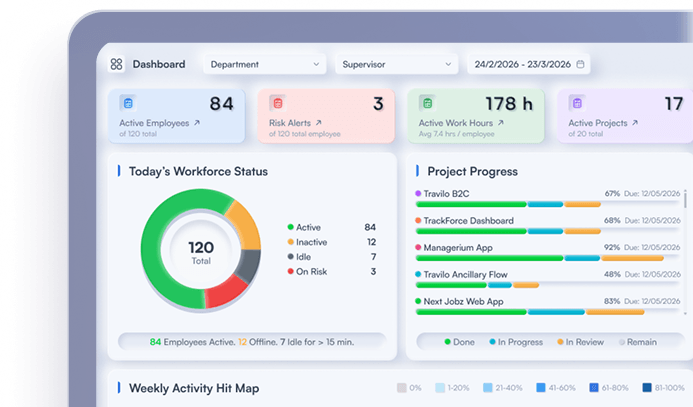
- Task management dashboards
- Project tracking systems
- Team workload visibility
This provides clarity without pressure.
Automated Reporting
Instead of manual updates or constant monitoring, use systems that generate reports automatically based on work completed.
This reduces administrative work and improves accuracy.
Structured Communication
Replace constant supervision with structured updates such as:
- Daily progress updates
- Weekly summaries
- Project reviews
This keeps everyone aligned without interrupting workflow.
Productivity Intelligence Tools
Modern productivity platforms analyze work patterns and provide insights instead of raw data.
These systems help identify inefficiencies and improve processes without creating a sense of surveillance.
How to Move Away from Failing Monitoring Systems
Redefine Productivity
Clearly define what productivity means in your organization. Focus on outcomes and results.
Audit Your Current Tools
Identify which metrics are useful and remove unnecessary tracking.
Communicate Transparently
Explain changes to your team. Transparency builds trust and improves adoption.
Implement Better Systems
Shift from activity tracking to systems that provide visibility through progress and outcomes.
Focus on Continuous Improvement
Use data to improve workflows rather than control employees.
Final Step: A Better Way to Manage Productivity
Understanding why most employee monitoring tools fail is the first step. The next step is building a system that works.
A modern productivity platform can:
- Provide real-time visibility into employee productivity
- Automate reporting and reduce manual effort
- Identify inefficiencies early
- Keep teams aligned without constant monitoring
This approach allows businesses to scale operations while maintaining performance and employee satisfaction.
Conclusion
Most employee monitoring tools fail because they focus on activity instead of results, reduce trust, and create systems that employees try to work around.
A better approach is to build a productivity system based on clarity, transparency, and outcomes.
When you replace monitoring with meaningful visibility, employee productivity improves naturally and sustainably.
How We Evaluated These Tools
Each platform in this list was evaluated based on:

Real-time productivity track
Reporting depth & clarity
Ease of onboarding
Role-based access control
Startup scalability
Transparency and flexibility
10 best employee monitoring software for startups.
1. TrackForce
TrackForce is a structured remote visibility and productivity management platform designed with clarity and scalability in mind.
Why It Is Good for Startups
TrackForce provides:
- Real-time dashboards with activity and time tracking
- Application and website monitoring
- Screenshots and snapshots
- Automatic idle detection
- Productivity scoring
- Daily, monthly, and role-based reports
- Role-based access control (owner, admin, employee)
- On-premise deployment option
For startups scaling remote teams, this structured approach supports growth without operational chaos.
Pros
- Clean interface for monitoring teams
- Strong reporting depth and visual data breakdown
- Flexible for remote and hybrid models
- Suitable for security-conscious environments
- Scales with organizational growth
Cons
- May be more advanced than needed for very small teams
- Requires transparent communication to maintain trust
TrackForce works best for startups that want structured, enterprise-quality oversight, especially in controlled or secure environments.
2. Time Doctor
Time Doctor is a structured remote visibility and productivity management platform designed without much burden and emphasizing clarity and scalability.
Why It Is Good for Startups
Time Doctor provides:
- Real-time dashboards with activity and time tracking
- Application and website monitoring
- Screenshots and snapshots
- Automatic idle detection
- Productivity scoring
- Daily, monthly, and role-based reports
- Role-based access (Super Admin, Admin, Employee)
- On-premise deployment
For startups scaling remote teams, this structured approach supports growth without operational chaos.
Pros
- Comprehensive monitoring modules
- Strong reporting and analytics breakdown
- Deployment flexibility
- Suitable for security-conscious environments
- Scales with organizational growth
Cons
- May be more advanced than needed for very small teams
- Requires transparent communication to maintain trust
TrackForce works best for startups that want structured oversight, especially in controlled environments.
3. Teramind
Teramind provides:
- Real-time dashboard with activity and time tracking
- Application and Website monitoring
- Screenshots and snapshots
- Automatic idle detection
- Daily, monthly, and role-based reports
- Role-based (from Super Admin to Employee)
- On-premise deployment
For startups scaling remote teams, this structured approach supports growth without operational chaos.
Pros
- Comprehensive monitoring modules
- Strong reporting and analytics breakdown for teams
- Deployment flexibility
- Suitable for security-sensitive environments
- Scales with organizational growth
Cons
- May be more advanced than needed for very small teams
- Requires transparent communication to maintain trust
Similar blog you can explore


Start Your 30-Day
Free TrackForce Trial