How to Track Employee
Productivity Without Micromanaging
2026-03-30 07:46:36
•
Author: Tanveer
•
Updated July 26, 2026
- Why Micromanagement Hurts Employee Productivity
- —It Kills Trust and Morale
- —It Stifles Creativity and Ownership
- —It Increases Turnover
- What Does Effective Employee Productivity Tracking Look Like?
- —Outcomes Over Activities
- —Transparency and Communication
- —Data-Driven Decisions
- Best Ways to Track Employee Productivity Without Micromanaging
- —1. Set Clear Goals and KPIs
- —2. Focus on Output, Not Hours
- —3. Use Productivity Tracking Tools Wisely
- —4. Swap Constant Monitoring for Regular Check-ins
- —5. Encourage Employee Self-Tracking
- Key Metrics to Measure Employee Productivity
- How to Track Remote Employee Productivity Ethically
- —Be Transparent
- —Get Consent
- —Go Privacy-First
- What Is the Best Way to Track Employee Productivity Without Micromanaging?
- Common Mistakes to Avoid
- —Over-Monitoring
- —Tracking Irrelevant Metrics
- —Ignoring Employee Feedback
- Top Tools to Track Employee Productivity Without Micromanaging
- Final Thoughts: Trust + Data = High-Performing Teams
Let's be honest nobody enjoys being watched over their shoulder all day. And as a manager or business owner, you probably don't enjoy playing watchdog either. The good news? You don't have to.
Tracking employee productivity doesn't mean micromanaging every task, monitoring every click, or scheduling back-to-back check-ins. It means having the right systems in place so your team can do their best work and you can see the results without the stress.
In this guide, we'll walk you through practical, people-friendly strategies to track productivity, improve performance, and build a culture of trust not surveillance.
Why Micromanagement Hurts Employee Productivity
Before we dive into solutions, it's worth understanding why micromanagement backfires even when intentions are good.
It Kills Trust and Morale
When employees feel constantly monitored, they start to feel mistrusted. That resentment quietly chips away at morale, motivation, and the overall work environment. People stop taking initiative because they assume someone will double-check everything anyway.
It Stifles Creativity and Ownership
Great ideas rarely come from people who are afraid to make decisions. Micromanagement pushes teams into "just following instructions" mode exactly the opposite of what drives innovation and high performance.
It Increases Turnover
Studies consistently show that a poor relationship with management is one of the top reasons employees quit. If your best people feel suffocated, they'll eventually leave and take their skills and institutional knowledge with them.
What Does Effective Employee Productivity Tracking Look Like?
Smart tracking is less about surveillance and more about visibility. Here's what it looks like in practice:
Outcomes Over Activities
Instead of tracking hours logged or emails sent, focus on what actually gets done. Did the project move forward? Was the client happy? Did the team hit their targets? Results tell a much more meaningful story than activity metrics.
Transparency and Communication
The best tracking systems aren't hidden. Your team should know what's being measured, why it matters, and how it connects to the bigger picture. When people understand the "why," they're far more likely to engage authentically.
Data-Driven Decisions
Good tracking gives you data you can actually act on spotting bottlenecks, recognizing top performers, and understanding where support is needed. It's about improving systems, not policing people.
Best Ways to Track Employee Productivity Without Micromanaging
1. Set Clear Goals and KPIs
This is the foundation of everything. If your team doesn't know what success looks like, how can they or you measure it?
Use SMART goals (Specific, Measurable, Achievable, Relevant, Time-bound) to set individual and team targets. For larger organizations, OKRs (Objectives and Key Results) are a great framework for aligning team goals with company-wide priorities.
When expectations are crystal clear upfront, you remove the need for constant check-ins because everyone already knows what they're working toward.
2. Focus on Output, Not Hours
Does it really matter if someone finishes a report in three hours instead of five as long as it's done well and on time? For most knowledge workers, the answer is no.
Shift your mindset from time-based to output-based measurement. This is especially important for remote and hybrid teams, where rigid hour-tracking quickly becomes demoralizing.
3. Use Productivity Tracking Tools Wisely
The right tool makes all the difference. Look for software that focuses on task completion and project progress rather than invasive monitoring like screenshot tracking or keystroke logging.
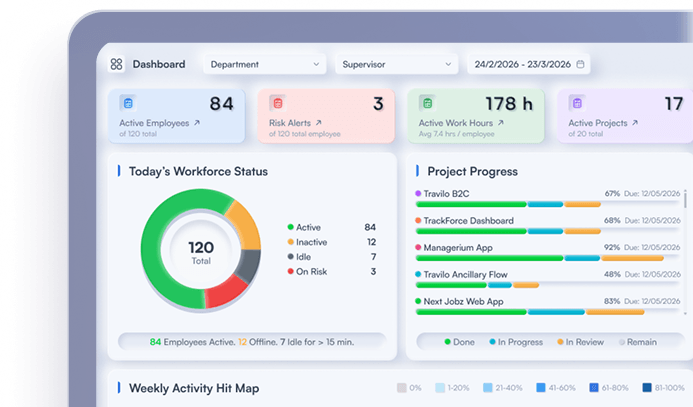
For example, tools like TrackForce are designed with a people-first approach giving managers useful visibility into team progress through automated reports and dashboards, without creating a surveillance-heavy environment.
The goal is to automate the data gathering so you can spend less time chasing updates and more time supporting your team.
4. Swap Constant Monitoring for Regular Check-ins
Rather than hovering throughout the day, schedule intentional touchpoints weekly one-on-ones, brief async status updates, or short team standups. This keeps communication flowing without the feeling of being watched.
Async tools like shared project boards or brief written updates work especially well for remote teams across different time zones.
5. Encourage Employee Self-Tracking
Give your team ownership over their own progress. When employees track their own tasks, update their own dashboards, and flag their own blockers, they develop accountability, the kind that comes from within, not from fear of being caught.
This approach also takes the pressure off managers, since team members become proactive about communicating their status.
Key Metrics to Measure Employee Productivity
Not all metrics are created equal. Here are the ones that actually tell you something meaningful:
- Task completion rate Are assignments getting finished on time?
- Output quality Is the work meeting the expected standard?
- Time to completion How efficiently is work moving through the pipeline?
- Goal progress How close is the team to hitting quarterly or monthly targets?
- Engagement and initiative Are team members proactively solving problems?
Avoid vanity metrics like "hours worked" or "emails sent" they measure activity, not impact.
How to Track Remote Employee Productivity Ethically
Remote work has changed the game and with it comes a new responsibility to track productively and ethically.
Be Transparent
Tell your team what you're tracking and why. No surprises. Transparency builds trust and removes the anxiety that often accompanies monitoring tools.
Get Consent
Wherever possible (and in many places, legally required), get explicit consent before deploying monitoring software. Make it part of your onboarding process rather than a hidden policy.
Go Privacy-First
Choose tools that collect only what's necessary. You don't need to know every website an employee visits, you need to know if their work is getting done. Keep data collection minimal and purposeful.
What Is the Best Way to Track Employee Productivity Without Micromanaging?
The best approach is to set clear, outcome-based goals and KPIs, use non-intrusive tracking tools that focus on results rather than activity, and replace constant monitoring with regular structured check-ins. This gives managers useful visibility while keeping employee trust intact.
Common Mistakes to Avoid
Over-Monitoring
If your team feels surveilled 24/7, productivity will actually drop. Psychological safety matters: people do their best work when they feel trusted, not watched.
Tracking Irrelevant Metrics
More data isn't always better. Tracking metrics that don't connect to business outcomes just creates noise and wastes everyone's time including yours.
Ignoring Employee Feedback
Your tracking system should evolve with your team's needs. Ask for feedback regularly what's working, what feels intrusive, what would help them perform better. Tracking is a two-way street.
Top Tools to Track Employee Productivity Without Micromanaging
Here's a quick look at the categories of tools that support smart, non-intrusive tracking:
- Productivity & time tracking tools: Help visualize how time is being spent across projects without manual reporting.
- Project management platforms: Give visibility into task status, deadlines, and team progress at a glance.
- Employee performance dashboards: Tools like TrackForce consolidate performance data into clear, actionable reports so you know where things stand without needing to ask every five minutes.
- Async communication tools: Reduce the need for micromanagement by keeping updates structured and visible to the whole team.
The best setup depends on your team size, work style, and how much visibility you actually need. Start simple, you can always add more layers later.
Final Thoughts: Trust + Data = High-Performing Teams
Tracking employee productivity and respecting their autonomy aren't opposing forces they actually work better together. When you combine clear expectations, outcome-focused metrics, and the right tools, you create an environment where people genuinely want to perform well.
The goal was never to watch your team more closely. It was always to help them do their best work.
So take the pressure off. Set the goals, give people the tools and space to succeed, and let the results speak for themselves.
How We Evaluated These Tools
Each platform in this list was evaluated based on:

Real-time productivity track
Reporting depth & clarity
Ease of onboarding
Role-based access control
Startup scalability
Transparency and flexibility
10 best employee monitoring software for startups.
1. TrackForce
TrackForce is a structured remote visibility and productivity management platform designed with clarity and scalability in mind.
Why It Is Good for Startups
TrackForce provides:
- Real-time dashboards with activity and time tracking
- Application and website monitoring
- Screenshots and snapshots
- Automatic idle detection
- Productivity scoring
- Daily, monthly, and role-based reports
- Role-based access control (owner, admin, employee)
- On-premise deployment option
For startups scaling remote teams, this structured approach supports growth without operational chaos.
Pros
- Clean interface for monitoring teams
- Strong reporting depth and visual data breakdown
- Flexible for remote and hybrid models
- Suitable for security-conscious environments
- Scales with organizational growth
Cons
- May be more advanced than needed for very small teams
- Requires transparent communication to maintain trust
TrackForce works best for startups that want structured, enterprise-quality oversight, especially in controlled or secure environments.
2. Time Doctor
Time Doctor is a structured remote visibility and productivity management platform designed without much burden and emphasizing clarity and scalability.
Why It Is Good for Startups
Time Doctor provides:
- Real-time dashboards with activity and time tracking
- Application and website monitoring
- Screenshots and snapshots
- Automatic idle detection
- Productivity scoring
- Daily, monthly, and role-based reports
- Role-based access (Super Admin, Admin, Employee)
- On-premise deployment
For startups scaling remote teams, this structured approach supports growth without operational chaos.
Pros
- Comprehensive monitoring modules
- Strong reporting and analytics breakdown
- Deployment flexibility
- Suitable for security-conscious environments
- Scales with organizational growth
Cons
- May be more advanced than needed for very small teams
- Requires transparent communication to maintain trust
TrackForce works best for startups that want structured oversight, especially in controlled environments.
3. Teramind
Teramind provides:
- Real-time dashboard with activity and time tracking
- Application and Website monitoring
- Screenshots and snapshots
- Automatic idle detection
- Daily, monthly, and role-based reports
- Role-based (from Super Admin to Employee)
- On-premise deployment
For startups scaling remote teams, this structured approach supports growth without operational chaos.
Pros
- Comprehensive monitoring modules
- Strong reporting and analytics breakdown for teams
- Deployment flexibility
- Suitable for security-sensitive environments
- Scales with organizational growth
Cons
- May be more advanced than needed for very small teams
- Requires transparent communication to maintain trust
Similar blog you can explore


Start Your 30-Day
Free TrackForce Trial