Software Usage Tracking: Turn
Visibility into Performance
2026-04-16 10:30:10
•
Author: Maria
•
Updated July 26, 2026
- Why Most Software Investments Are Flying Blind
- The Hidden Cost of Unused Software Nobody Talks About
- What Software Usage Tracking Actually Means (And What It Doesn't)
- The Difference Between Data and Actionable Insight
- How Visibility Becomes Your Competitive Edge
- Building the Case: Why Your Organization Needs Usage Tracking Now
- —The Shocking Stats Behind Software Waste in Modern Businesses
- —How Underutilized Tools Drain Budgets Without Anyone Noticing
- —The Compliance and Security Risks Hiding in Your Software Stack
- —When "We Think We Use It" Is No Longer Good Enough
- What to Track: The Metrics That Actually Move the Needle
- —Login Frequency vs. Deep Engagement — Know the Difference
- —Feature Adoption Rates: The Canary in Your Software Coal Mine
- —User Segmentation: Who's Power-Using and Who's Ghost Licensing?
- —Time-on-Tool vs. Value-from-Tool — Stop Confusing the Two
- —Tracking Across Departments: Why Siloed Data Gives You Siloed Results
- Choosing the Right Software Usage Tracking Tools
- —Native Analytics vs. Third-Party Platforms: Which One Wins?
- —Must-Have Features in Any Usage Tracking Solution
- —Integrating Tracking Tools into Your Existing Tech Stack Without the Headaches
- —Open Source vs. Enterprise Solutions: What's Right for Your Scale?
- Implementation Without the Growing Pains
- —Getting Stakeholder Buy-In Before You Roll Anything Out
- —How to Set Up a Tracking Framework That Scales With You
- —Avoiding the Data Overload Trap From Day One
- —Establishing Baselines: You Can't Improve What You Haven't Measured
- Turning Raw Usage Data into Real Performance Gains
- —From Dashboard to Decision: Making Data Work Harder for You
- —Identifying Training Gaps Before They Become Performance Problems
- —Using Usage Patterns to Redesign Workflows That Actually Flow
- —When the Data Says "Cut It" — How to Make Confident Offboarding Decisions
- The People Side of Software Tracking
- —Addressing Employee Privacy Concerns Without Killing the Initiative
- —How to Communicate Tracking Policies Transparently and Tactfully
- —Turning Resistant Teams into Enthusiastic Adopters
- —Creating a Culture Where Data-Driven Decisions Feel Natural
- Advanced Strategies for High-Performance Teams
- —Predictive Analytics: Getting Ahead of Usage Drop-Offs
- —Using Heatmaps and Behavior Flows to Supercharge Onboarding
- —Benchmarking Against Industry Standards to Find Your Blind Spots
- —Connecting Software Performance Data to Business Outcomes That Matter
- ROI: Proving the Value of Your Tracking Investment
- —How to Calculate the True ROI of Software Usage Tracking
- —Building a Business Case That CFOs Can't Ignore
- —Reporting That Gets Attention in the Boardroom
- What Comes After Visibility — Your Continuous Improvement Loop
- —Setting Review Cycles That Keep Insights Fresh and Relevant
- —Making Usage Tracking a Living Part of Your IT Strategy
- —The Future of Software Intelligence: AI, Automation, and What's Next
- —How TrackForce Turns Visibility Into Real Business Performance
- Your Next Move: From Passive Observation to Active Optimization
Why Most Software Investments Are Flying Blind
Most organizations buy software with good intentions. They sign contracts, roll out licenses, and expect productivity to follow. But here's the uncomfortable truth: a significant portion of that software never gets meaningfully used. Nobody tracks it. Nobody questions it. And the invoices keep coming.
The Hidden Cost of Unused Software Nobody Talks About
Gartner estimates that organizations waste up to 25% of their total software spend on unused or underutilized applications. That's not a rounding error. For a mid-sized company spending $2 million annually on software, that's $500,000 quietly evaporating every year.
The problem isn't just financial. Unused software creates sprawl. It adds to your IT team's maintenance burden, introduces unnecessary security exposure, and contributes to a bloated tech stack that slows everyone down. And because no one is actively monitoring usage, the waste compounds silently over time.
What Software Usage Tracking Actually Means (And What It Doesn't)
Software usage tracking is the process of collecting and analyzing data about how employees interact with the tools in your organization's tech stack. It tells you who's logging in, which features they're using, how often they engage, and where they drop off.
What it doesn't mean is invasive surveillance. Done right, usage tracking focuses on application-level behavior, not personal productivity monitoring. The goal is to understand tool performance and adoption, not to scrutinize individual employees. That distinction matters enormously, both for employee trust and for keeping your initiative on solid ethical ground.
The Difference Between Data and Actionable Insight
Collecting data is easy. Dashboards fill up fast. But raw numbers without context are just noise. The real value of software usage tracking lies in transforming behavioral patterns into decisions you can actually act on.
Seeing that 40% of your licensed users haven't logged into a platform in 90 days is data. Understanding that those users are in a department that was never properly onboarded, and building a targeted training plan around that gap, is insight. That's the leap that separates organizations who track software from those who actually improve because of it.
How Visibility Becomes Your Competitive Edge
When you know exactly how your tools are being used, you stop guessing. You start allocating resources based on evidence. You negotiate renewals from a position of knowledge. You identify which tools are genuinely accelerating work and which ones are just occupying line items in your budget. That kind of clarity is a genuine competitive advantage in a world where most companies are still operating on gut instinct.
Building the Case: Why Your Organization Needs Usage Tracking Now
The Shocking Stats Behind Software Waste in Modern Businesses
The numbers are hard to ignore. Research from Flexera consistently shows that enterprises use only about 50 to 60% of their purchased software capacity. In some categories, particularly collaboration and productivity tools, utilization rates fall even lower after the initial rollout excitement fades.
How Underutilized Tools Drain Budgets Without Anyone Noticing
The reason software waste persists is that it lacks visibility by default. Unlike physical assets, unused software doesn't gather dust in a corner. It just sits quietly in your procurement system, auto-renewing year after year. Without an active tracking mechanism, most finance and IT teams only discover the waste when someone finally asks the right question during a budget review.
The Compliance and Security Risks Hiding in Your Software Stack
Unused software isn't just a budget problem. Unmonitored applications that still hold access permissions represent a genuine security risk. Orphaned accounts, outdated integrations, and forgotten tools with access to sensitive data are common vectors for breaches. Tracking software usage helps you identify and retire these liabilities before they become incidents.
When "We Think We Use It" Is No Longer Good Enough
Anecdotal evidence has a shelf life. At some point, every leadership team needs to move from "we think this tool is working" to "here's the data showing exactly how and where it's working." That shift requires infrastructure, and usage tracking is the foundation.
What to Track: The Metrics That Actually Move the Needle
Login Frequency vs. Deep Engagement — Know the Difference
Login frequency is a surface metric. It tells you someone opened the application, nothing more. Deep engagement metrics, such as time spent in core workflows, features accessed, and tasks completed, give you a much more accurate picture of whether a tool is genuinely integrated into how people work.
Feature Adoption Rates: The Canary in Your Software Coal Mine
If users are only engaging with 20% of a platform's features, that's a signal worth investigating. Either the remaining features aren't relevant, users haven't been trained on them, or the tool isn't the right fit. Feature adoption rates are one of the most revealing metrics in your tracking toolkit.
User Segmentation: Who's Power-Using and Who's Ghost Licensing?
Not all users engage with software the same way. Segmenting your user base into power users, occasional users, and inactive accounts helps you make smarter decisions about license allocation, training priorities, and renewal quantities. Ghost licenses, seats assigned to users who never engage, are a pervasive and easily fixable form of waste.
Time-on-Tool vs. Value-from-Tool — Stop Confusing the Two
Time spent in a tool is not the same as value extracted from it. A team might spend significant time in a project management platform without actually completing more work. Connecting usage data to output metrics gives you a far more honest picture of ROI.
Tracking Across Departments: Why Siloed Data Gives You Siloed Results
When usage data is fragmented by department or system, patterns get missed. A centralized view of software usage across the entire organization reveals cross-functional trends, surfaces duplication across teams, and enables smarter portfolio-level decisions.
Choosing the Right Software Usage Tracking Tools
Native Analytics vs. Third-Party Platforms: Which One Wins?
Most enterprise software includes some native analytics, but these are typically limited to that application alone. Third-party platforms aggregate usage data across your entire stack, giving you the unified visibility that makes tracking genuinely useful at scale.
Must-Have Features in Any Usage Tracking Solution
Look for real-time dashboards, historical trend analysis, user-level drill-down, automated alerts for inactivity, and integrations with your existing IT service management and procurement tools. Reporting flexibility and clean data export capabilities are equally important for stakeholder communication.
Integrating Tracking Tools into Your Existing Tech Stack Without the Headaches
The best tracking solution is one that fits naturally into your current environment. Prioritize platforms with pre-built connectors for your identity provider, ITSM tools, and major SaaS applications. The easier the integration, the faster you'll see value.
Open Source vs. Enterprise Solutions: What's Right for Your Scale?
Open source tools offer flexibility and lower upfront costs but require significant internal expertise to implement and maintain. Enterprise platforms provide faster deployment, dedicated support, and more robust compliance features. Your choice should match your team's capacity and the complexity of your software environment.
Implementation Without the Growing Pains
Getting Stakeholder Buy-In Before You Roll Anything Out
Implementation fails when it's treated as an IT project rather than a business initiative. Bring in finance, HR, and department heads early. Frame the conversation around cost optimization and performance improvement, not surveillance. When stakeholders understand the business value, adoption accelerates.
How to Set Up a Tracking Framework That Scales With You
Start with your highest-cost or most strategically important applications. Build your taxonomy, define your key metrics, and establish reporting cadences before expanding coverage. A modular approach prevents the kind of scope creep that buries initiatives before they deliver results.
Avoiding the Data Overload Trap From Day One
More data is not always better data. Define in advance what decisions your tracking program needs to support, and build your dashboards around those decisions. Resist the temptation to track everything just because you can.
Establishing Baselines: You Can't Improve What You Haven't Measured
Before you can demonstrate improvement, you need a clear picture of where things stand today. Spend the first 30 to 60 days collecting baseline data before making any changes. This gives you an honest benchmark and makes your future progress measurable and credible.
Turning Raw Usage Data into Real Performance Gains
From Dashboard to Decision: Making Data Work Harder for You
A dashboard nobody acts on is just wallpaper. Build review processes into your operational rhythm. Assign ownership to specific data points. Create clear escalation paths for when usage anomalies appear. The goal is to make insight-to-action as short and frictionless as possible.
Identifying Training Gaps Before They Become Performance Problems
Low feature adoption often signals a training gap rather than a product failure. Usage data can help you design targeted, just-in-time training programs that address actual gaps rather than generic onboarding sessions that cover everything and retain nothing.
Using Usage Patterns to Redesign Workflows That Actually Flow
When you can see where users consistently drop off or work around a tool, you have the evidence needed to redesign the workflow. This is where usage tracking moves from a cost-saving exercise to a genuine performance optimization strategy.
When the Data Says "Cut It" — How to Make Confident Offboarding Decisions
Letting go of a software tool is often emotionally difficult but logically straightforward when the data is clear. Consistent low adoption across multiple teams, over multiple quarters, is a defensible reason to offboard. Usage tracking gives you the confidence to make that call without second-guessing.
The People Side of Software Tracking
Addressing Employee Privacy Concerns Without Killing the Initiative
Employees will have questions, and they deserve honest answers. Be explicit about what is and isn't tracked. Focus communications on application-level data, not individual productivity scoring. Establishing clear data governance policies upfront removes ambiguity and builds trust.
How to Communicate Tracking Policies Transparently and Tactfully
Transparency is not optional. Share your tracking scope, your data retention policies, and the specific business objectives the program serves. When employees understand the why, resistance drops considerably.
Turning Resistant Teams into Enthusiastic Adopters
The most effective advocates for your tracking program are the managers who benefit from its insights. Equip team leads with the data they need to make better resourcing and training decisions, and they become natural evangelists for the initiative.
Creating a Culture Where Data-Driven Decisions Feel Natural
Usage tracking is most powerful when it's part of a broader organizational commitment to evidence-based decision-making. Normalize data conversations in team meetings, budget reviews, and technology evaluations. Over time, reaching for the data becomes reflexive.
Advanced Strategies for High-Performance Teams
Predictive Analytics: Getting Ahead of Usage Drop-Offs
Advanced tracking platforms can identify early signals of disengagement before it becomes full abandonment. By acting on these signals with proactive outreach or targeted enablement, you can dramatically improve long-term adoption rates.
Using Heatmaps and Behavior Flows to Supercharge Onboarding
Behavioral flow analysis reveals exactly where new users struggle during onboarding. These insights allow you to redesign your onboarding journeys to address real friction points rather than assumed ones, resulting in faster time-to-value for every new user.
Benchmarking Against Industry Standards to Find Your Blind Spots
Comparing your usage rates against industry benchmarks provides crucial context. If your adoption rate for a category of tools is consistently below the industry average, that's a signal that something in your implementation or training approach needs attention.
Connecting Software Performance Data to Business Outcomes That Matter
The most mature usage tracking programs connect application engagement to business KPIs. When you can demonstrate that higher adoption of a specific tool correlates with faster sales cycles or fewer support tickets, you've built an unassailable case for continued investment in both the tool and the tracking program itself.
ROI: Proving the Value of Your Tracking Investment
How to Calculate the True ROI of Software Usage Tracking
Start with license cost recovery from eliminating ghost licenses and retiring unused tools. Add the value of improved productivity from better-trained, more deeply engaged users. Factor in risk reduction from improved security hygiene. The combined figure is almost always significantly larger than the cost of the tracking platform itself.
Building a Business Case That CFOs Can't Ignore
CFOs respond to specificity. Come to the conversation with concrete figures: licenses reclaimed, tools retired, training costs avoided, and security incidents prevented. Frame your tracking investment as a cost-optimization initiative with a measurable payback period.
Reporting That Gets Attention in the Boardroom
Executive reporting should prioritize strategic signals over operational detail. Focus on portfolio-level health, cost efficiency trends, and adoption benchmarks tied to business outcomes. Keep it visual, keep it concise, and always connect the data to decisions the board actually needs to make.
What Comes After Visibility — Your Continuous Improvement Loop
Setting Review Cycles That Keep Insights Fresh and Relevant
Usage patterns change as teams evolve, tools are updated, and business priorities shift. Build quarterly review cycles into your governance process to ensure your tracking program remains aligned with current organizational needs.
Making Usage Tracking a Living Part of Your IT Strategy
The most effective tracking programs are not projects with a start and end date. They are ongoing capabilities embedded into your IT operating model. Treat usage data as a permanent input into procurement decisions, training strategies, and technology roadmaps.
The Future of Software Intelligence: AI, Automation, and What's Next
AI-powered usage analytics are already beginning to automate the pattern recognition that currently requires manual analysis. Expect to see more intelligent alerting, automated license optimization, and predictive adoption modeling becoming standard features in enterprise tracking platforms over the next few years.
How TrackForce Turns Visibility Into Real Business Performance
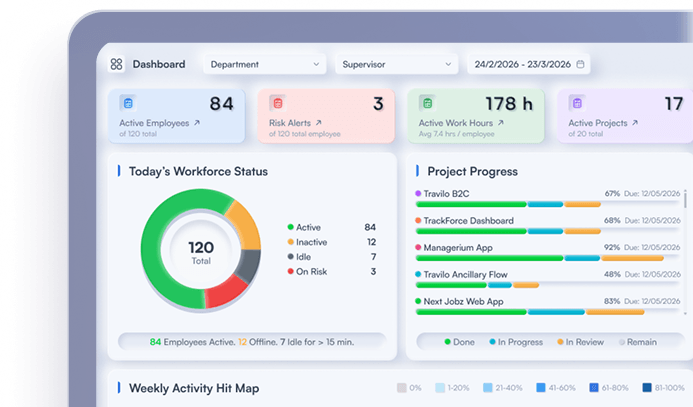
TrackForce is a workforce analytics and employee tracking platform designed to give organizations real-time visibility into productivity across both remote and on-site teams. From a single dashboard, managers can monitor app usage, web activity, and overall performance through clear visual summaries, making it easy to see where time is being spent and how work is progressing.
Beyond basic tracking, TrackForce provides deep behavioral insights. It captures screen activity, tracks workflows, monitors communication patterns, and logs key actions, helping distinguish genuine productivity from passive activity. This level of detail gives leaders the context needed to make informed decisions.
Its reporting system turns raw data into actionable insights. Daily and monthly reports highlight work hours, productivity trends, and attendance patterns, while risk indicators flag unusual behavior early, allowing for proactive management.
With role-based access controls, each level of the organization—from admins to team leads—gets relevant visibility without overreach. The platform also supports easy onboarding, bulk employee management, and flexible deployment options.
At its core, TrackForce helps organizations move beyond guesswork. It delivers structured, real-time intelligence that supports smarter decisions, stronger accountability, and consistent performance.
Your Next Move: From Passive Observation to Active Optimization
Visibility without action is just observation. The organizations that extract the most value from software usage tracking are the ones that build systematic processes for turning insight into change. That means clear ownership, regular review cadences, and a genuine commitment to acting on what the data reveals.
You don't need to do everything at once. Start with your largest software categories, establish your baselines, and build from there. The first meaningful insight you surface will make the case for everything that follows.
Software usage tracking isn't a nice-to-have anymore. In a world where technology budgets face increasing scrutiny and every tool in your stack needs to justify its place, it's a fundamental operational discipline. The organizations that master it won't just spend less. They'll perform better, move faster, and make decisions with a clarity that their competitors simply can't match.
How We Evaluated These Tools
Each platform in this list was evaluated based on:

Real-time productivity track
Reporting depth & clarity
Ease of onboarding
Role-based access control
Startup scalability
Transparency and flexibility
10 best employee monitoring software for startups.
1. TrackForce
TrackForce is a structured remote visibility and productivity management platform designed with clarity and scalability in mind.
Why It Is Good for Startups
TrackForce provides:
- Real-time dashboards with activity and time tracking
- Application and website monitoring
- Screenshots and snapshots
- Automatic idle detection
- Productivity scoring
- Daily, monthly, and role-based reports
- Role-based access control (owner, admin, employee)
- On-premise deployment option
For startups scaling remote teams, this structured approach supports growth without operational chaos.
Pros
- Clean interface for monitoring teams
- Strong reporting depth and visual data breakdown
- Flexible for remote and hybrid models
- Suitable for security-conscious environments
- Scales with organizational growth
Cons
- May be more advanced than needed for very small teams
- Requires transparent communication to maintain trust
TrackForce works best for startups that want structured, enterprise-quality oversight, especially in controlled or secure environments.
2. Time Doctor
Time Doctor is a structured remote visibility and productivity management platform designed without much burden and emphasizing clarity and scalability.
Why It Is Good for Startups
Time Doctor provides:
- Real-time dashboards with activity and time tracking
- Application and website monitoring
- Screenshots and snapshots
- Automatic idle detection
- Productivity scoring
- Daily, monthly, and role-based reports
- Role-based access (Super Admin, Admin, Employee)
- On-premise deployment
For startups scaling remote teams, this structured approach supports growth without operational chaos.
Pros
- Comprehensive monitoring modules
- Strong reporting and analytics breakdown
- Deployment flexibility
- Suitable for security-conscious environments
- Scales with organizational growth
Cons
- May be more advanced than needed for very small teams
- Requires transparent communication to maintain trust
TrackForce works best for startups that want structured oversight, especially in controlled environments.
3. Teramind
Teramind provides:
- Real-time dashboard with activity and time tracking
- Application and Website monitoring
- Screenshots and snapshots
- Automatic idle detection
- Daily, monthly, and role-based reports
- Role-based (from Super Admin to Employee)
- On-premise deployment
For startups scaling remote teams, this structured approach supports growth without operational chaos.
Pros
- Comprehensive monitoring modules
- Strong reporting and analytics breakdown for teams
- Deployment flexibility
- Suitable for security-sensitive environments
- Scales with organizational growth
Cons
- May be more advanced than needed for very small teams
- Requires transparent communication to maintain trust
Similar blog you can explore


Start Your 30-Day
Free TrackForce Trial