How to Monitor
Organizational Performance
2026-04-20 11:03:28
•
Author: Maria
•
Updated July 26, 2026
- Why Monitoring Organizational Performance Is No Longer Optional
- What Organizational Performance Monitoring Actually Means
- Building the Foundation: Defining What Performance Means for Your Organization
- Setting Up a Performance Monitoring Framework
- The Key Performance Indicators (KPI) Every Organization Should Track
- Financial, Operational, and Customer Performance in Practice
- People, Culture, and the Tools That Make Monitoring Work
- Benchmarking, Gap Analysis, and Turning Data Into Decisions
- Common Mistakes and the Human Dimension
- How TrackForce Transforms Organizational Performance Monitoring
Why Monitoring Organizational Performance Is No Longer Optional
Organizations that operate without systematic performance monitoring are, in effect, navigating without instruments. They move forward, but without visibility into whether they are moving in the right direction, at the right speed, or with the right people engaged. In 2026, the competitive, regulatory, and operational environment demands something more rigorous. Data is abundant. The organizations that win are those that convert it into coherent, actionable intelligence before their competitors do.
What Organizational Performance Monitoring Actually Means
There is an important distinction between measuring output and monitoring performance. Measuring output tells you what was produced. Monitoring performance tells you whether what was produced moved the organization closer to its strategic objectives, and at what cost, quality, and sustainability. Real-time visibility transforms this from a retrospective exercise into a navigational capability. When managers can see performance as it unfolds rather than weeks after the fact, course corrections happen before problems compound. Performance monitoring, properly constructed, creates a direct line of sight between daily operational activity and the long-term strategic ambitions of the organization.
Building the Foundation: Defining What Performance Means for Your Organization
Generic KPIs fail because they measure what is easy to measure rather than what is meaningful to a specific organization's objectives. Relevant metrics emerge from a disciplined interrogation of what the organization is actually trying to achieve, not from adopting an industry-standard scorecard wholesale. Aligning performance indicators with organizational mission and vision ensures that every metric tracked is purposeful.
- Leading indicators predict future outcomes and allow proactive management.
- Lagging indicators confirm what has already occurred. Both are necessary, but organisations that rely exclusively on lagging indicators are perpetually reacting.
Setting Up a Performance Monitoring Framework
The choice between Balanced Scorecard, OKRs, or other proprietary frameworks is less important than the rigour with which any chosen framework is implemented. What matters is that organizational goals cascade coherently from the executive level down to team and individual levels, so that every person understands how their daily contributions connect to aggregate performance. Before measuring progress, establish a reliable baseline. Without one, there is no meaningful reference point against which improvement or deterioration can be assessed. Assign clear ownership for each metric and define measurement frequency with deliberate intention, neither so frequent that it creates administrative burden nor so infrequent that it fails to enable timely intervention.
The Key Performance Indicators (KPI) Every Organization Should Track
Financial metrics reveal the economic viability of operations. Operational efficiency indicators expose the hidden friction points where resources are consumed without proportionate value creation. Customer-centric metrics translate internal performance into the external experience that ultimately determines market position. Employee performance and engagement metrics are predictive rather than merely descriptive; disengaged workforces consistently underperform before that underperformance manifests in financial results. Innovation and growth metrics are perhaps the most frequently neglected, yet they signal whether an organization is building the future capability it will need to remain competitive.
Financial, Operational, and Customer Performance in Practice
Cash flow, not profit margin, is the vital sign of organizational financial health. Many ostensibly profitable organizations have experienced insolvency precisely because they failed to monitor liquidity with sufficient rigour. Cost efficiency ratios and budget variance analysis provide the interpretive context that raw revenue figures cannot. On the operational side, process cycle times identify precisely where workflows decelerate, and resource utilisation rates reveal the cost of overcapacity that most organisations significantly underestimate.
Customer metrics deserve particular attention. Net Promoter Score is frequently misread as a satisfaction measure; it is more accurately a measure of behavioural intent and relational loyalty. Customer retention rate is one of the most direct reflections of operational consistency. Response time and resolution rate metrics matter enormously for service-oriented organisations, and customer lifetime value provides the longitudinal perspective that single-transaction metrics cannot.
People, Culture, and the Tools That Make Monitoring Work
People metrics are chronically underweighted in performance monitoring architectures. Employee engagement scores, when they decline, are not merely HR concerns. They are leading indicators of future productivity decline, increased absenteeism, and elevated attrition costs. Learning and development metrics signal whether an organisation is accumulating the human capital it will need to execute its future strategy.
The right technology infrastructure is the enabler that makes all of this tractable. A centralised performance dashboard eliminates the fragmentation and inconsistency that characterises spreadsheet-based reporting. Business intelligence platforms in 2026 offer increasingly sophisticated data integration, visualisation, and predictive analytics capabilities. The key design principle for any dashboard is clarity over comprehensiveness. An executive dashboard should surface the four or five indicators that require strategic attention. A team-level dashboard should provide the operational detail relevant to daily decision-making. The distinction matters enormously in practice.
Benchmarking, Gap Analysis, and Turning Data Into Decisions
Benchmarking provides the comparative context that internal data alone cannot supply. Internal benchmarking against historical performance reveals trajectory. Industry benchmarking contextualises performance relative to sector norms. Competitive benchmarking requires careful management of strategic confidentiality. Best-in-class benchmarking, while aspirationally motivating, can be misleading if structural differences between organisations are not adequately accounted for.
Identifying performance gaps requires distinguishing between symptoms and root causes. A decline in customer satisfaction scores is a symptom. The root cause might be an upstream process failure, a resourcing deficit, or a training gap. Root cause analysis methods including fishbone diagrams, five-whys analysis, and variance decomposition provide the diagnostic rigour that surface-level metric review cannot. Qualitative data, including employee feedback and customer verbatims, often explains what quantitative metrics can only signal.
Performance review meetings are only valuable when they produce decisions, not just discussion. Prioritise interventions by revenue impact and strategic significance. Create accountability structures that attach consequences to performance commitments without creating a culture of fear around data, as punitive performance cultures consistently produce data manipulation rather than performance improvement.
Common Mistakes and the Human Dimension
The most prevalent performance monitoring failure is metric proliferation. When everything is measured, nothing is prioritised. Organisations that track fifty metrics with equal weight have, in effect, no priorities at all. Confusing activity with outcome is equally corrosive; high activity levels and genuine productivity are categorically different things. Review cadences that are too infrequent to enable course correction compound all of these problems.
The human dimension of performance monitoring is often its most important and most neglected aspect. How results are communicated determines whether they are received as developmental information or as threat. Building psychological safety around performance conversations, involving teams in metric-setting, and celebrating wins as deliberately as addressing shortfalls all contribute to a performance culture that is generative rather than defensive.
How TrackForce Transforms Organizational Performance Monitoring
Understanding what to monitor is the intellectual challenge. Having the infrastructure to monitor it in real time, at scale, and without administrative burden is the operational one. TrackForce addresses both.
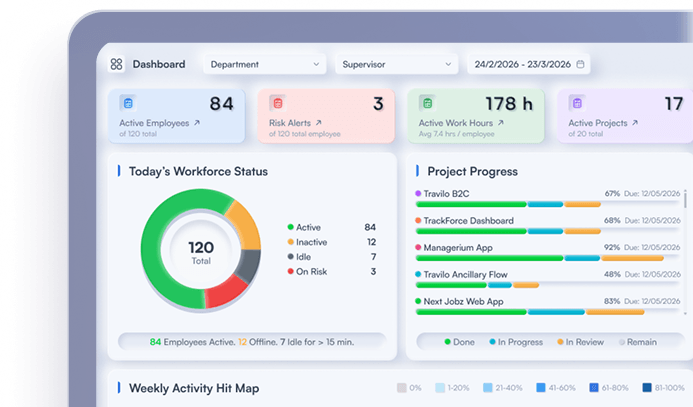
TrackForce is an intelligent employee tracking and productivity management platform built for on-site and remote teams alike. It consolidates activity data, time tracking, and automated reporting into a single dashboard, giving managers the visibility they need to make faster, more confident decisions.
- Real-Time Dashboard and Activity Visibility The Overview Panel surfaces web and application usage data with project-level attribution, so managers can instantly see where organisational time is being invested. The Time Worked Graph visualises active versus idle hours across the team, making workload distribution and capacity imbalances immediately apparent.
- Comprehensive Monitoring Capabilities The Monitoring module provides genuine operational transparency through screen snapshots, website and application logs, keystroke records, file transfer tracking, and screen recordings. All data is filterable by employee, department, and date range, enabling focused review at any level of the organisation.
- Structured Reporting and Risk Identification The Reports module converts raw activity data into structured performance intelligence through daily workload summaries, daily and monthly reports, and a Risk User function that automatically flags attendance and productivity deviations before they escalate into larger issues.
- Role-Based Access and Scalable Oversight Access is tiered across super admin, admin, manager, team lead, and employee levels, ensuring visibility is appropriately distributed while preserving security and accountability across the organisation.
Performance monitoring is only as valuable as the consistency of the data underpinning it. TrackForce delivers the automated, real-time infrastructure that makes reliable and actionable performance monitoring genuinely sustainable at scale.
How We Evaluated These Tools
Each platform in this list was evaluated based on:

Real-time productivity track
Reporting depth & clarity
Ease of onboarding
Role-based access control
Startup scalability
Transparency and flexibility
10 best employee monitoring software for startups.
1. TrackForce
TrackForce is a structured remote visibility and productivity management platform designed with clarity and scalability in mind.
Why It Is Good for Startups
TrackForce provides:
- Real-time dashboards with activity and time tracking
- Application and website monitoring
- Screenshots and snapshots
- Automatic idle detection
- Productivity scoring
- Daily, monthly, and role-based reports
- Role-based access control (owner, admin, employee)
- On-premise deployment option
For startups scaling remote teams, this structured approach supports growth without operational chaos.
Pros
- Clean interface for monitoring teams
- Strong reporting depth and visual data breakdown
- Flexible for remote and hybrid models
- Suitable for security-conscious environments
- Scales with organizational growth
Cons
- May be more advanced than needed for very small teams
- Requires transparent communication to maintain trust
TrackForce works best for startups that want structured, enterprise-quality oversight, especially in controlled or secure environments.
2. Time Doctor
Time Doctor is a structured remote visibility and productivity management platform designed without much burden and emphasizing clarity and scalability.
Why It Is Good for Startups
Time Doctor provides:
- Real-time dashboards with activity and time tracking
- Application and website monitoring
- Screenshots and snapshots
- Automatic idle detection
- Productivity scoring
- Daily, monthly, and role-based reports
- Role-based access (Super Admin, Admin, Employee)
- On-premise deployment
For startups scaling remote teams, this structured approach supports growth without operational chaos.
Pros
- Comprehensive monitoring modules
- Strong reporting and analytics breakdown
- Deployment flexibility
- Suitable for security-conscious environments
- Scales with organizational growth
Cons
- May be more advanced than needed for very small teams
- Requires transparent communication to maintain trust
TrackForce works best for startups that want structured oversight, especially in controlled environments.
3. Teramind
Teramind provides:
- Real-time dashboard with activity and time tracking
- Application and Website monitoring
- Screenshots and snapshots
- Automatic idle detection
- Daily, monthly, and role-based reports
- Role-based (from Super Admin to Employee)
- On-premise deployment
For startups scaling remote teams, this structured approach supports growth without operational chaos.
Pros
- Comprehensive monitoring modules
- Strong reporting and analytics breakdown for teams
- Deployment flexibility
- Suitable for security-sensitive environments
- Scales with organizational growth
Cons
- May be more advanced than needed for very small teams
- Requires transparent communication to maintain trust
Similar blog you can explore


Start Your 30-Day
Free TrackForce Trial