How to Know If
Remote Employees Are Working
2025-12-22 10:40:18
•
Author: Tanveer
•
Updated July 26, 2026
- What Does “Working” Mean in Remote Work?
- How Do Managers Know If Remote Employees Are Working?
- Outcome-Based Indicators of Remote Employee Productivity
- How to Measure Remote Employee Performance Effectively
- Process and Engagement Signals in Remote Teams
- How to Track Remote Employee Productivity Ethically
- Remote Work Monitoring: What Actually Works
- Signs Remote Employees Are Working (and Not Working)
- How to Manage Remote Teams Effectively
- Should Employers Monitor Remote Employees?
- Tools That Support Remote Employee Accountability
- How to Address Productivity Issues in Remote Teams
- A Practical Way to Support Visibility Without Micromanaging
- Frequently Asked Questions About Remote Employee Productivity
- —How to know if employees are working remotely?
- —How to track employee productivity remotely?
- —How to measure remote employee performance?
- —Are productivity tools better than manual check-ins?
- Final Thoughts
Managing remote employees often creates a unique challenge for managers and business owners. In an office, productivity feels visible. You see people working, hear discussions, and notice activity throughout the day. In remote work, that visibility disappears, which leads many leaders to ask the same question: how to know if remote employees are working.
This concern is understandable, but it often pushes managers toward the wrong solution. Remote employee productivity is not determined by constant observation. It is determined by outcomes, consistency, and engagement signals that show real work is happening.
This guide explains how managers can know if employees are working remotely, how to track remote employee productivity ethically, and how to manage remote teams effectively without damaging trust.
What Does “Working” Mean in Remote Work?
Before asking how to check if remote workers are productive, managers need to define what working actually means in a remote setup.
Many productivity issues stem from unclear expectations, not employee behavior. Remote work exposes weak management systems faster than office environments.
In remote teams, working should be defined by:
- Clear deliverables
- Agreed deadlines
- Quality standards
- Communication expectations
Without this clarity, remote work accountability becomes impossible. You may collect activity data, but you will not gain insight into remote employee performance.
How Do Managers Know If Remote Employees Are Working?
So, how do managers know if remote employees are working without sitting behind their screens?
The answer lies in systems, not surveillance.
Effective managers rely on:
- Clearly defined goals
- Regular progress checkpoints
- Transparent communication
- Measurable results
Remote employee monitoring should support these systems, not replace them. When goals are clear and progress is visible, managers rarely need constant oversight.
Outcome-Based Indicators of Remote Employee Productivity
The most reliable way to evaluate remote employee productivity is to focus on outcomes.
Strong outcome-based indicators include:
- Tasks completed on time
- Progress toward milestones
- Consistency in output quality
- Ability to meet commitments independently
These indicators reflect remote workforce productivity far more accurately than tracking mouse movement or screen time. When outcomes are delivered consistently, productive work is happening.
How to Measure Remote Employee Performance Effectively
Managers often ask how to measure remote employee performance in a fair way. The key is to measure results instead of presence.
Effective performance measurement includes:
- KPIs tied to business outcomes
- Project-based deliverables
- Quality benchmarks
- Completion timelines
Employee productivity in remote work environments improves when people are evaluated on impact, not activity. This approach also strengthens trust-based remote management.
Process and Engagement Signals in Remote Teams
While outcomes matter most, employee engagement signals provide early insight into how work is progressing.
Useful engagement signals include:
- Consistent communication patterns
- Timely responses during agreed work hours
- Participation in meetings and collaboration tools
- Regular updates on progress
These signals support remote employee accountability methods without relying on invasive monitoring.
How to Track Remote Employee Productivity Ethically
Many leaders want to know how to track remote employee productivity without crossing ethical boundaries.
Ethical tracking focuses on:
- Aggregated data, not constant surveillance
- Patterns over time, not isolated moments
- Transparency with employees
Ethical ways to monitor remote employees respect privacy while still providing managers with clarity. The goal is insight, not control.
Remote Work Monitoring: What Actually Works
Remote work monitoring often fails because it focuses on activity instead of meaning.
The key distinction is activity vs productivity.
Activity data shows what tools were used or how long someone was online. Productivity data shows whether meaningful work was completed.
Remote employee monitoring works best when it:
- Highlights trends instead of raw logs
- Supports conversations, not punishments
- Complements outcome-based management
Signs Remote Employees Are Working (and Not Working)
Managers frequently ask about signs remote employees are working.
Positive indicators include:
- Consistent task completion
- Predictable communication
- Stable output quality
- Proactive problem-solving
On the other hand, signs of unproductive remote employees often appear as patterns:
- Repeated missed deadlines
- Declining work quality
- Extended unexplained inactivity
- Inconsistent communication
Patterns matter more than one-off incidents.
How to Manage Remote Teams Effectively
Knowing how to manage remote teams effectively reduces the need for heavy monitoring.
Effective remote management focuses on:
- Clear systems over supervision
- Regular feedback loops
- Balanced workloads
- Trust reinforced by accountability
Managing remote employees successfully is about designing clarity, not enforcing control.
Should Employers Monitor Remote Employees?
A common question is should employers monitor remote employees, and whether remote employee monitoring is legal.
In general:
- Monitoring is legal in many regions if employees are informed
- Monitoring should be proportionate to business needs
- Transparency and consent are essential
Legal requirements vary by country, so organizations should align monitoring practices with local regulations and ethical standards.
Tools That Support Remote Employee Accountability
As teams scale, managers often ask how to check if remote workers are productive without manual oversight.
Modern productivity tools can support remote employee accountability by:
- Summarizing work hours and activity trends
- Highlighting unusual patterns
- Providing daily, weekly, and monthly reports
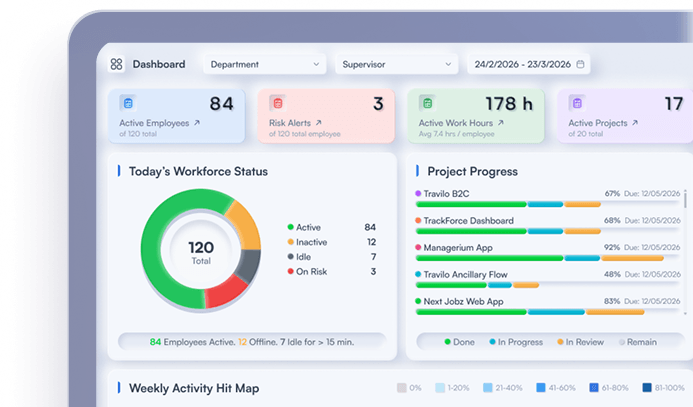
Platforms like TrackForce are designed to offer structured visibility into time, workload, and engagement patterns for remote and on-site teams. When used responsibly, such tools act as decision-support systems rather than micromanagement tools, helping managers maintain clarity without constant supervision.
How to Address Productivity Issues in Remote Teams
When productivity drops, the solution is rarely monitoring first.
To manage productivity in remote teams:
- Start with conversation
- Identify blockers or workload issues
- Adjust expectations or priorities
- Provide coaching before enforcement
Most productivity problems are process issues, not effort issues.
A Practical Way to Support Visibility Without Micromanaging
As remote teams grow, many managers reach a point where manual check-ins and spreadsheets no longer scale. At that stage, the challenge is not control, but consistent visibility.
This is where tools like TrackForce can quietly support better decision-making.
TrackForce is designed to help managers understand how work patterns evolve over time, rather than forcing them to monitor employees moment by moment. Instead of focusing on constant screen-watching, it provides structured insights such as active time, workload trends, application usage summaries, and daily or monthly productivity reports.
Used responsibly, TrackForce helps managers:
- Identify workload imbalances across teams
- Spot long-term productivity trends instead of isolated moments
- Support accountability through data, not assumptions
- Reduce guesswork without increasing pressure on employees
The value is not in watching employees work, but in giving managers enough clarity to ask better questions and make fair decisions. When paired with clear expectations and outcome-based management, TrackForce becomes a support layer, not a surveillance tool.
Frequently Asked Questions About Remote Employee Productivity
How to know if employees are working remotely?
Managers can know if employees are working remotely by measuring completed tasks, meeting deadlines, reviewing communication patterns, and tracking workload trends over time.
How to track employee productivity remotely?
Employee productivity can be tracked remotely using outcome-based metrics, progress reports, and ethical productivity tools that summarize trends instead of constant surveillance.
How to measure remote employee performance?
Remote employee performance is best measured through KPIs, deliverables, output quality, and consistency rather than hours worked.
Are productivity tools better than manual check-ins?
Productivity tools can support manual check-ins by providing data-driven insights, but they should complement human management, not replace it.
Final Thoughts
Remote work does not reduce accountability. Poor systems do.
Knowing if remote employees are working requires clarity, outcomes, and consistency. When expectations are clear and results are measurable, trust replaces guesswork.
Remote productivity is best measured by results, not visibility.
How We Evaluated These Tools
Each platform in this list was evaluated based on:

Real-time productivity track
Reporting depth & clarity
Ease of onboarding
Role-based access control
Startup scalability
Transparency and flexibility
10 best employee monitoring software for startups.
1. TrackForce
TrackForce is a structured remote visibility and productivity management platform designed with clarity and scalability in mind.
Why It Is Good for Startups
TrackForce provides:
- Real-time dashboards with activity and time tracking
- Application and website monitoring
- Screenshots and snapshots
- Automatic idle detection
- Productivity scoring
- Daily, monthly, and role-based reports
- Role-based access control (owner, admin, employee)
- On-premise deployment option
For startups scaling remote teams, this structured approach supports growth without operational chaos.
Pros
- Clean interface for monitoring teams
- Strong reporting depth and visual data breakdown
- Flexible for remote and hybrid models
- Suitable for security-conscious environments
- Scales with organizational growth
Cons
- May be more advanced than needed for very small teams
- Requires transparent communication to maintain trust
TrackForce works best for startups that want structured, enterprise-quality oversight, especially in controlled or secure environments.
2. Time Doctor
Time Doctor is a structured remote visibility and productivity management platform designed without much burden and emphasizing clarity and scalability.
Why It Is Good for Startups
Time Doctor provides:
- Real-time dashboards with activity and time tracking
- Application and website monitoring
- Screenshots and snapshots
- Automatic idle detection
- Productivity scoring
- Daily, monthly, and role-based reports
- Role-based access (Super Admin, Admin, Employee)
- On-premise deployment
For startups scaling remote teams, this structured approach supports growth without operational chaos.
Pros
- Comprehensive monitoring modules
- Strong reporting and analytics breakdown
- Deployment flexibility
- Suitable for security-conscious environments
- Scales with organizational growth
Cons
- May be more advanced than needed for very small teams
- Requires transparent communication to maintain trust
TrackForce works best for startups that want structured oversight, especially in controlled environments.
3. Teramind
Teramind provides:
- Real-time dashboard with activity and time tracking
- Application and Website monitoring
- Screenshots and snapshots
- Automatic idle detection
- Daily, monthly, and role-based reports
- Role-based (from Super Admin to Employee)
- On-premise deployment
For startups scaling remote teams, this structured approach supports growth without operational chaos.
Pros
- Comprehensive monitoring modules
- Strong reporting and analytics breakdown for teams
- Deployment flexibility
- Suitable for security-sensitive environments
- Scales with organizational growth
Cons
- May be more advanced than needed for very small teams
- Requires transparent communication to maintain trust
Similar blog you can explore


Start Your 30-Day
Free TrackForce Trial