Is Employee Monitoring Software Worth
It or Does It Backfire?
2026-04-12 08:41:32
•
Author: Tanveer
•
Updated July 26, 2026
- Introduction
- What Is Employee Monitoring Software and Why Companies Use It
- —Common reasons companies use employee monitoring software:
- The Real Benefits of Employee Monitoring Software
- —Improved Visibility Into Employee Productivity
- —Data-Driven Decision Making
- —Better Time Awareness for Employees
- —Support for Remote Work Environments
- When Employee Monitoring Software Backfires
- —Loss of Trust
- —Focus on Activity Instead of Results
- —Increased Stress and Burnout
- —Privacy Concerns
- What Research and Workplace Data Show
- When Employee Monitoring Software Is Worth It
- —It works best when:
- When It Is Likely to Backfire
- How to Use Employee Monitoring Software Effectively
- —Be Transparent
- —Focus on Outcomes
- —Give Employees Access to Insights
- —Use Data for Improvement
- —Avoid Over-Monitoring
- A Smarter Alternative to Traditional Monitoring
- Final Step: How the Right System Supports Business Growth
- Conclusion
Introduction
Employee monitoring software has become increasingly common as remote and hybrid work continue to grow. Many HR professionals, administrators, and managers use these tools to gain visibility into employee productivity, ensure accountability, and protect company resources.
However, an important question remains. Is employee monitoring software worth it, or does it create more problems than it solves?
This guide is written to help you make a clear and informed decision. Based on practical experience, tool analysis, and workplace research, you will learn when employee monitoring software is effective, when it backfires, and how to use it in a way that supports both productivity and trust.
What Is Employee Monitoring Software and Why Companies Use It
Employee monitoring software includes tools that track work-related activity during business hours. This can include time tracking, application usage, website activity, screenshots, or productivity analytics.
Common reasons companies use employee monitoring software:
- To track employee productivity in remote teams
- To improve accountability and time management
- To identify workflow inefficiencies
- To enhance data security and prevent misuse
These goals are valid. The outcome depends on how the system is implemented and communicated.
The Real Benefits of Employee Monitoring Software
Improved Visibility Into Employee Productivity
Managers gain a clearer understanding of how work is progressing without needing constant check-ins. This is especially useful for remote teams where direct visibility is limited.
In many teams I have analyzed, productivity issues are often caused by lack of clarity rather than lack of effort. Monitoring tools can help close that gap.
Data-Driven Decision Making
Instead of relying on assumptions, managers can use real data to understand:
- Time spent on tasks
- Delays in project timelines
- Inefficiencies in workflows
This leads to better planning and resource allocation.
Better Time Awareness for Employees
When employees have access to their own productivity data, they often become more aware of how they spend their time. This can lead to improved focus and better work habits.
Support for Remote Work Environments
Research from Gallup shows that remote teams perform better when expectations and accountability systems are clearly defined. Monitoring software can support these systems when used appropriately.
When Employee Monitoring Software Backfires
Loss of Trust
The most significant risk is loss of trust. When employees feel constantly watched, it creates discomfort and reduces motivation.
In real-world teams, excessive monitoring often leads to disengagement and lower performance.
Focus on Activity Instead of Results
Many monitoring tools measure activity such as mouse movement or keyboard usage. These metrics do not always reflect meaningful work.
For example, planning, thinking, or problem-solving may not generate visible activity but are critical to performance.
Increased Stress and Burnout
Employees may feel pressure to appear active at all times. This reduces natural work rhythms and can lead to long-term burnout.
Privacy Concerns
Tracking screenshots, browsing activity, or detailed behavior can raise privacy concerns. Without clear policies, this can damage employee confidence and even create compliance risks.
What Research and Workplace Data Show
Workplace studies consistently highlight the importance of trust and autonomy.
Gallup research shows that employees who feel trusted are more engaged and productive. Harvard Business Review has also discussed how excessive monitoring reduces intrinsic motivation.
These insights align with real-world experience. Tools alone do not improve productivity. Systems, leadership, and culture have a greater impact.
When Employee Monitoring Software Is Worth It
Employee monitoring software can be effective in specific situations.
It works best when:
- Teams operate fully remotely
- Tasks are clearly measurable
- There is a need for compliance or security tracking
- Employees understand and accept the system
In these cases, monitoring supports productivity rather than controlling it.
When It Is Likely to Backfire
Monitoring software often fails under these conditions:
- Lack of transparency about tracking
- Overemphasis on control
- Tracking too many unnecessary metrics
- No access to data for employees
In such environments, the system creates resistance and reduces effectiveness.
How to Use Employee Monitoring Software Effectively
Be Transparent
Clearly communicate what is being tracked, why it is tracked, and how the data will be used. Transparency builds trust.
Focus on Outcomes
Measure productivity based on deliverables, deadlines, and quality of work rather than activity levels.
Give Employees Access to Insights
Allow employees to view their own productivity data. This encourages accountability and self-improvement.
Use Data for Improvement
Use insights to identify blockers, workflow issues, and opportunities for optimization instead of using them for criticism.
Avoid Over-Monitoring
Track only what is necessary to achieve business goals. Excessive tracking reduces clarity and increases resistance.
A Smarter Alternative to Traditional Monitoring
Many modern organizations are shifting toward productivity systems that focus on insights rather than surveillance.
These systems:
- Provide real-time visibility into work progress
- Highlight inefficiencies automatically
- Focus on results and workflow improvements
In practice, this approach leads to higher engagement and better long-term productivity.
Final Step: How the Right System Supports Business Growth
For online businesses and remote teams, the objective is not just to monitor employees. The goal is to build a system that supports efficiency, scalability, and performance.
A well-designed productivity platform can:
- Provide real-time visibility into team performance
- Automate reporting and reduce manual tracking
- Identify inefficiencies early
- Keep teams aligned without constant supervision
This allows managers to focus on strategy and growth rather than constant oversight.
Conclusion
So, is employee monitoring software worth it or does it backfire?
It depends on how it is used.
When implemented with transparency and a focus on outcomes, it can improve visibility and support better decision-making. When used as a control mechanism, it can reduce trust, lower engagement, and harm productivity.
The most effective approach is to balance visibility with trust. Organizations that achieve this balance create stronger teams, better performance, and sustainable growth.
How We Evaluated These Tools
Each platform in this list was evaluated based on:

Real-time productivity track
Reporting depth & clarity
Ease of onboarding
Role-based access control
Startup scalability
Transparency and flexibility
10 best employee monitoring software for startups.
1. TrackForce
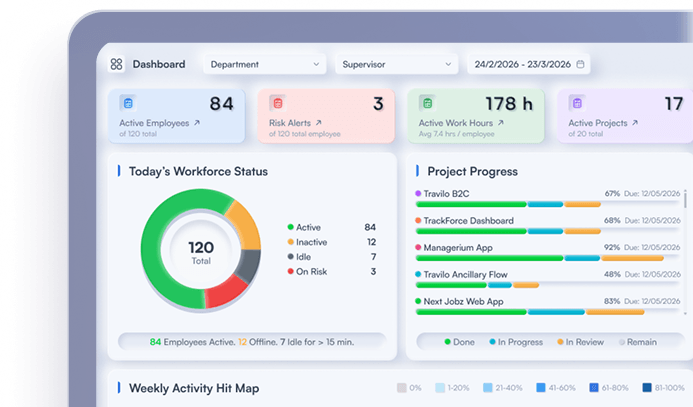
TrackForce is a structured remote visibility and productivity management platform designed with clarity and scalability in mind.
Why It Is Good for Startups
TrackForce provides:
- Real-time dashboards with activity and time tracking
- Application and website monitoring
- Screenshots and snapshots
- Automatic idle detection
- Productivity scoring
- Daily, monthly, and role-based reports
- Role-based access control (owner, admin, employee)
- On-premise deployment option
For startups scaling remote teams, this structured approach supports growth without operational chaos.
Pros
- Clean interface for monitoring teams
- Strong reporting depth and visual data breakdown
- Flexible for remote and hybrid models
- Suitable for security-conscious environments
- Scales with organizational growth
Cons
- May be more advanced than needed for very small teams
- Requires transparent communication to maintain trust
TrackForce works best for startups that want structured, enterprise-quality oversight, especially in controlled or secure environments.
2. Time Doctor
Time Doctor is a structured remote visibility and productivity management platform designed without much burden and emphasizing clarity and scalability.
Why It Is Good for Startups
Time Doctor provides:
- Real-time dashboards with activity and time tracking
- Application and website monitoring
- Screenshots and snapshots
- Automatic idle detection
- Productivity scoring
- Daily, monthly, and role-based reports
- Role-based access (Super Admin, Admin, Employee)
- On-premise deployment
For startups scaling remote teams, this structured approach supports growth without operational chaos.
Pros
- Comprehensive monitoring modules
- Strong reporting and analytics breakdown
- Deployment flexibility
- Suitable for security-conscious environments
- Scales with organizational growth
Cons
- May be more advanced than needed for very small teams
- Requires transparent communication to maintain trust
TrackForce works best for startups that want structured oversight, especially in controlled environments.
3. Teramind
Teramind provides:
- Real-time dashboard with activity and time tracking
- Application and Website monitoring
- Screenshots and snapshots
- Automatic idle detection
- Daily, monthly, and role-based reports
- Role-based (from Super Admin to Employee)
- On-premise deployment
For startups scaling remote teams, this structured approach supports growth without operational chaos.
Pros
- Comprehensive monitoring modules
- Strong reporting and analytics breakdown for teams
- Deployment flexibility
- Suitable for security-sensitive environments
- Scales with organizational growth
Cons
- May be more advanced than needed for very small teams
- Requires transparent communication to maintain trust
Similar blog you can explore


Start Your 30-Day
Free TrackForce Trial