Department-Level Monitoring vs. Individual Tracking: What
Actually Gives You Better Management Insights?
2026-05-20 18:17:35
•
Author: Maria
•
Updated July 26, 2026
- What Is Department-Level Monitoring?
- What Is Individual Tracking?
- Tracking vs. Monitoring: Why the Words Matter
- Side-by-Side Comparison
- Current State: How Organizations Are Actually Using These Tools
- Tools Compared: What Supports Department-Level Analysis vs. Individual Tracking
- Which Platforms Support Both Individual and Team-Level Continuous Improvement Tracking?
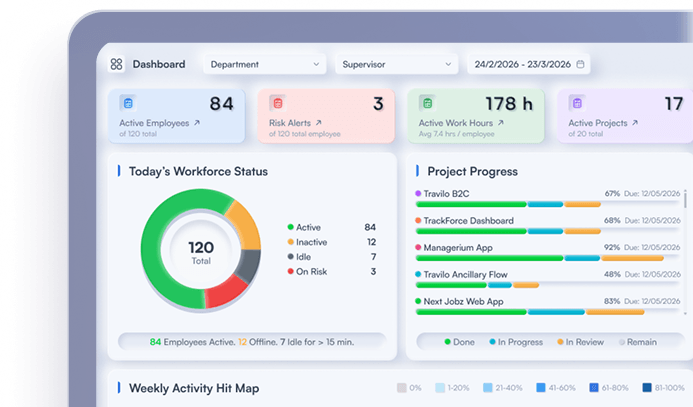
- Department-level monitoring is better for strategic planning, workload balancing, and cross-team insights without privacy friction.
- Individual tracking delivers accountability and personal-performance data, but carries higher trust and compliance risk.
- A 2025 survey found over 73% of employers now monitor remote or hybrid workers, but 56% of employees say it increases their stress.
- The best platforms (like TrackForce) offer both modes, letting you dial between views depending on the management question.
- Tools like Slack Analytics, RescueTime, Jira, and Hubstaff each favor one mode. None do both fully.
What Is Department-Level Monitoring?
Department-level monitoring aggregates behavioral and output data at the team or unit level. Instead of asking "what did Alice work on at 2 pm?", it asks "is the engineering team's focus time trending down this sprint?" The unit of analysis is the group, not the person. This approach suits organizations that need strategic visibility without micromanagement: large companies, distributed teams, or situations where the goal is resource allocation, not accountability. It is also less likely to trigger legal or cultural pushback, since individual employees are not the subject of the data. Common signals captured at the department level include aggregate active time, project throughput, communication volume and response patterns, tool usage by category, and output velocity relative to headcount.What Is Individual Tracking?
Individual tracking focuses on a single employee's activity: the apps they use, time logged on tasks, keystrokes per hour, or screenshots taken at intervals. The granularity is personal, and the data is attributable to a specific person. This is better suited to roles requiring detailed accountability: remote contractors billing by the hour, field service workers, or teams where output quality is directly tied to an individual's specific behaviors. It gives managers the data to have targeted conversations, build personalized development plans, and detect early signs of burnout or disengagement at the individual level. The trade-off: employees notice it. Research consistently shows that employees faced with intensive monitoring report stress levels of around 45%, compared to roughly 28% in less monitored settings. That gap matters for retention and morale.Tracking vs. Monitoring: Why the Words Matter
In software circles, "tracking" and "monitoring" are often used interchangeably, but they point to meaningfully different intentions. Monitoring typically implies continuous observation for operational or safety purposes (is the system running? is the team on pace?). Tracking implies recording and attributing specific behaviors over time (what did this person do, and when?). The monitor vs. track distinction becomes important when considering:- Consent and transparency. Monitoring tends to be disclosed at a policy level. Tracking often requires individual notice.
- Legal exposure. In GDPR jurisdictions, individual tracking of named employees requires lawful basis and data minimization. Department-level aggregation carries lighter obligations.
- Cultural signal. Teams often interpret per-person tracking as low trust. Aggregate monitoring is more neutral.
Side-by-Side Comparison
| Dimension | Department-Level Monitoring | Individual Tracking |
| Best for | Strategic planning, resource allocation, cross-team insights | Personal accountability, billing, performance coaching |
| Data granularity | Aggregated, group trends, not named individuals | Granular, attributed to specific people |
| Employee trust impact | Low friction, perceived as operational not surveillance | High friction if poorly communicated, linked to stress spikes |
| Privacy / legal risk | Lower, harder to trigger GDPR individual data rights | Higher, requires clear legal basis in many jurisdictions |
| Actionable for | Team leads, HR, ops directors, C-suite | Line managers, project managers, individual contributors |
| Blind spots | Masks individual outliers, can hide one person carrying the team | Creates perverse incentives (activity-gaming), misses systemic issues |
| Best measurement type | Output trends, throughput rates, collaboration patterns | Time-on-task, app usage, task completion rates |
| Scaling | Scales easily, adding headcount doesn't increase analysis burden | Scales poorly, more people means more individual data to review |
Current State: How Organizations Are Actually Using These Tools
- 73% of employers now monitor remote or hybrid workers digitally
- 61% of US companies use AI-powered analytics to measure employee productivity
- 56% of employees say being monitored at work increases their stress
- 52% of employees trust their employer, creating a gap that monitoring tools can widen or close
Tools Compared: What Supports Department-Level Analysis vs. Individual Tracking
Different platforms were built with different primary audiences in mind. Here's how the major players orient toward each monitoring mode. TrackForce (Both modes) One of the few platforms offering a genuine dual view: a real-time team dashboard alongside individual app and activity logs. Particularly strong for HR teams needing full workforce analytics and IT directors focused on security. Includes smart behavior analytics that surface risks at both the team and individual level. Slack Analytics (Department-focused) Visualizes communication patterns and collaboration flows across teams. Good for understanding how departments interact and where communication bottlenecks form. Lacks the granularity to attribute behavior to specific individuals, which is a feature rather than a bug for many teams. RescueTime (Individual-focused) Designed for personal time awareness with daily reports on how time is split across apps and categories. Excellent for self-directed productivity improvement. Doesn't aggregate to a department view, making it best for individual contributors rather than managers. Jira (Both modes) Agile boards let project managers track individual tasks while sprint burn-down charts give a team-level view. Better for output tracking than behavior monitoring. Steep learning curve for non-technical teams limits adoption outside engineering. Hubstaff (Individual-focused) Designed for remote and field teams needing proof of work: GPS tracking, screenshots, activity rates. Strong individual accountability features but limited in providing high-level departmental trends. Better for operations leads than HR or executives. Worklytics (Department-focused) Focuses on high-level collaboration patterns using work metadata, with no keystroke logging or message content. Designed to identify where projects stall during cross-department handoffs rather than tracking individuals. Strong privacy-first positioning. For "department-level variance tracking" specifically: if your primary need is understanding how department performance varies against targets over time, consider supplementing a monitoring tool with a dedicated analytics layer. Platforms like Visier, ChartHop, or ADP DataCloud are purpose-built for this use case, distinct from employee monitoring tools.Which Platforms Support Both Individual and Team-Level Continuous Improvement Tracking?
This is the question managers most want answered, and the honest answer is that very few do it well out of the box. Most tools were built for one mode and bolted the other on as an afterthought. The platforms with the strongest claim to both individual and team-level continuous improvement tracking share a few characteristics:- Role-based views. What a team lead sees differs from what an HR director sees, without duplicating the data infrastructure.
- Aggregation controls. The ability to roll individual data up to team or department level, and drill down when needed.
- Trend analysis, not just snapshots. Continuous improvement requires before/after comparisons, not just current-state reporting.
- Integration with output data. Time and activity data becomes more meaningful when correlated with actual deliverables (tickets closed, deals won, content published).
- You manage 50+ employees and can't review individual data
- Your goal is resource allocation or strategic planning
- You operate in GDPR-regulated markets
- Employee trust and culture are high priorities
- You need insights for C-suite reporting
- You're diagnosing cross-team collaboration problems
- You manage remote contractors billing hourly
- Roles require documented proof of work
- You're running performance improvement plans
- You have a security or compliance requirement
- Teams are small and context-specific oversight is needed
- You have explicit employee buy-in and clear policies
How We Evaluated These Tools
Each platform in this list was evaluated based on:

Real-time productivity track
Reporting depth & clarity
Ease of onboarding
Role-based access control
Startup scalability
Transparency and flexibility
10 best employee monitoring software for startups.
1. TrackForce
TrackForce is a structured remote visibility and productivity management platform designed with clarity and scalability in mind.
Why It Is Good for Startups
TrackForce provides:
- Real-time dashboards with activity and time tracking
- Application and website monitoring
- Screenshots and snapshots
- Automatic idle detection
- Productivity scoring
- Daily, monthly, and role-based reports
- Role-based access control (owner, admin, employee)
- On-premise deployment option
For startups scaling remote teams, this structured approach supports growth without operational chaos.
Pros
- Clean interface for monitoring teams
- Strong reporting depth and visual data breakdown
- Flexible for remote and hybrid models
- Suitable for security-conscious environments
- Scales with organizational growth
Cons
- May be more advanced than needed for very small teams
- Requires transparent communication to maintain trust
TrackForce works best for startups that want structured, enterprise-quality oversight, especially in controlled or secure environments.
2. Time Doctor
Time Doctor is a structured remote visibility and productivity management platform designed without much burden and emphasizing clarity and scalability.
Why It Is Good for Startups
Time Doctor provides:
- Real-time dashboards with activity and time tracking
- Application and website monitoring
- Screenshots and snapshots
- Automatic idle detection
- Productivity scoring
- Daily, monthly, and role-based reports
- Role-based access (Super Admin, Admin, Employee)
- On-premise deployment
For startups scaling remote teams, this structured approach supports growth without operational chaos.
Pros
- Comprehensive monitoring modules
- Strong reporting and analytics breakdown
- Deployment flexibility
- Suitable for security-conscious environments
- Scales with organizational growth
Cons
- May be more advanced than needed for very small teams
- Requires transparent communication to maintain trust
TrackForce works best for startups that want structured oversight, especially in controlled environments.
3. Teramind
Teramind provides:
- Real-time dashboard with activity and time tracking
- Application and Website monitoring
- Screenshots and snapshots
- Automatic idle detection
- Daily, monthly, and role-based reports
- Role-based (from Super Admin to Employee)
- On-premise deployment
For startups scaling remote teams, this structured approach supports growth without operational chaos.
Pros
- Comprehensive monitoring modules
- Strong reporting and analytics breakdown for teams
- Deployment flexibility
- Suitable for security-sensitive environments
- Scales with organizational growth
Cons
- May be more advanced than needed for very small teams
- Requires transparent communication to maintain trust
Similar blog you can explore


Start Your 30-Day
Free TrackForce Trial